Hello, everyone.
This is Enta.
I’d like to write about how to handle the situation when a ground anchor came loose the other day.
Basically, ground anchor work is considered a critical structural element, so it must not fail.
Assuming that is the case, it is certain that the work will have to be redone, but we need to identify the cause.
That's what I wrote about last time.
1. Construction errors
2. Design Error
3. Defective Materials
4. Natural Disasters (Earthquakes, etc.)
However, the primary reason why this number is so low is design error No. 2.
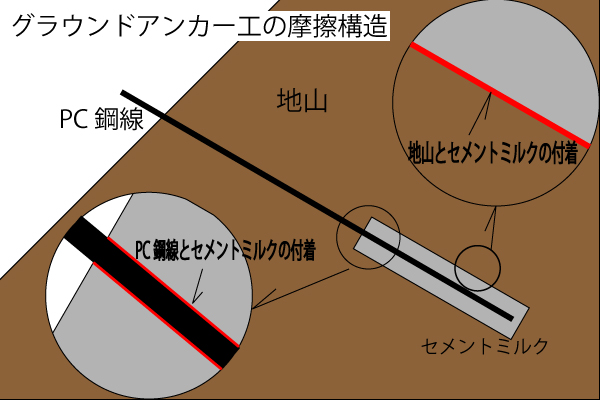
Simply put, the low circumferential friction resistance that causes slippage is a difficult issue to address, as it’s partly unavoidable rather than a design flaw.
If the circumferential friction resistance (τ) is overestimated, there is a possibility that it could slip out; however, since most designs tend to err on the side of caution, this is considered unlikely.
Furthermore, it seems that mistakes in selecting the backfill material are quite rare.
However, if there is no exploratory drilling or if the ground anchor work fails at a site where no basic tests were conducted, this is not a one-time occurrence.
Also, while contractors often seem eager to complain to designers, I haven’t actually seen that many fundamental design errors.
There was a time when it came loose because the underlying soil was different (the test point was too far away), lol.
Also, natural disasters like the one in No. 4 don't happen very often, do they?
In my experience, there have been instances where the mountain shifted during construction (by 1 mm or more over the course of a week), but it has often stopped moving after the stress was applied.
An anchor has never been torn loose by a sudden earthquake.
First of all, if something comes loose, people will suspect a construction error.
However, even if the work was done correctly, if only one or two trees are affected, it is highly likely that the contractor will be held responsible.
For example, if 20 posts are installed side by side, if just one or two of them are missing, it’s generally considered an installation error.
Therefore, the contractor is responsible for any rework.
However, since it’s unlikely that the construction method would have changed only in that one spot, it’s also important to consider the possibility of localized changes in soil conditions or similar factors. (From the government’s perspective, it’s more convenient to blame a construction error.)
For that reason, when redoing the work, it would be best to reevaluate the angles and lengths. (From the government’s perspective, if it turns out for the better, go ahead and do whatever you want, lol.)
One possible cause of a suspected installation error is that oil was applied to the anchorage area when the anchor was inserted.
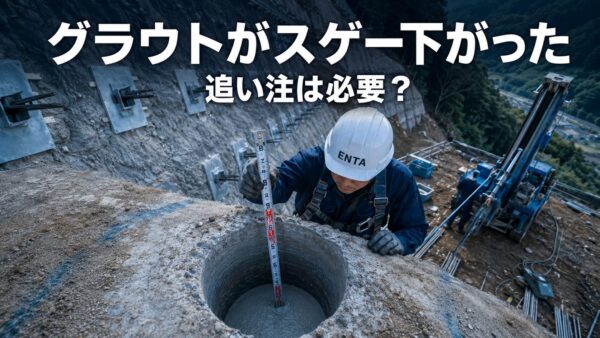
The grout hasn't been applied properly.
The grout has low strength.
These are some possible examples.
Please keep in mind that there is a high likelihood you will be asked about this matter by government officials and may be required to take corrective action or propose future measures (if any).
Next time, I'll write about the repair procedure for when an anchor comes loose from its mounting.
See you later.