Hello, everyone.
This is Enta.
When I saw the shocking footage from Atami the other day, I felt a sense of regret, thinking that maybe there was more we slope engineers could have done.
Well, since I'm not there, there's not much I can do about it, but if anything comes up in the future, I'd be happy to help.
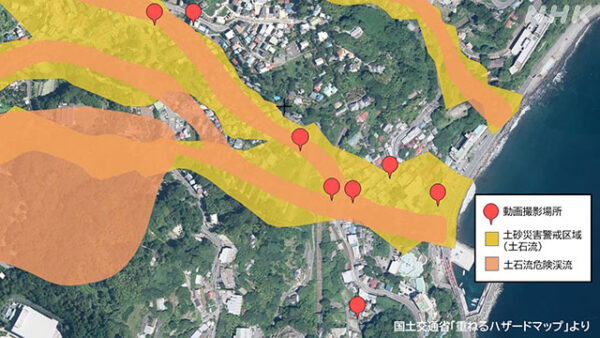
A mudslide occurred the other day, and it’s highly likely that this situation will continue.
That's because it looks like the rain will continue for a while this week.
This time it was a mudslide, but of course, slope (cliff) collapses are also entirely possible. (There are already many areas where collapses have occurred.)
Since my blog is read by the general public, I hope today’s post will be helpful to them.
I’m sure you’ve often heard on TV and the radio that heavy rain and prolonged rainfall like we’re experiencing now can cause the ground to become unstable, leading to landslides on slopes (cliffs), which is dangerous.
That's right.
I'm sure you're well aware of that, but there are other risks as well.
Actually, the area within a few hundred meters of where slope protection works were previously installed is surprisingly dangerous.
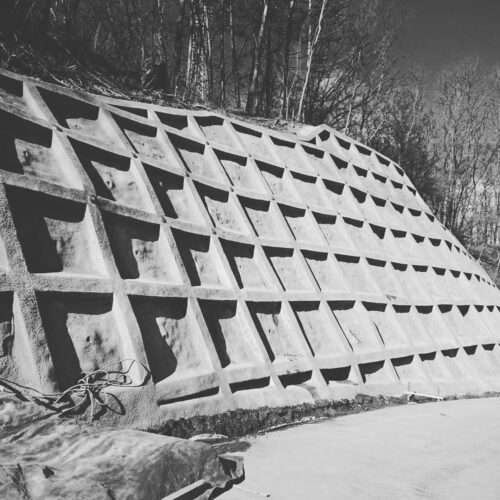
The areas where this type of construction has been carried out are places that have collapsed in the past or were at risk of collapsing, so measures were taken to prevent that.
Let's say there was a heavy rain in that entire mountainous area.
In the past, this area (pictured above) collapsed, releasing water from inside the mountain, which stabilized the mountain.
However, since this section has already been reinforced, it cannot collapse.
Essentially, it is a mountain’s job to crumble.
So, whenever there’s a heavy rain, it’s a sure sign that a landslide is about to happen.
If a mountain is reinforced, the energy accumulated inside it will not dissipate unless it is released somewhere.
So, where will it collapse? It will collapse in the places that haven't collapsed yet.
Somewhere in the mountains in that same area.
I don't know if it's 100 meters away or 500 meters away.
However, in cases of heavy rain or prolonged rainfall like this, the risk of collapse increases significantly.
Therefore, we ask that anyone who meets the following three conditions evacuate.
1,For those who have a slope (cliff) behind their house
2. People whose homes are located directly below a slope (cliff) on someone else’s property
3. Those who live near a mountain that previously collapsed and is currently undergoing slope stabilization work
4. Those located several hundred meters away from the slope protection work site
You never know where a mountain might collapse.
However, one thing we know for sure isSomewhere in the mountain area where remedial work is being carried out will collapse.
I can't tell which part of the mountain range is the weakest.
If you hear people saying things like, “A huge amount of water is gushing out!” or “Murky water is pouring down from the mountain!”—that means the situation is already critical, and it’s entirely possible that by the time you realize it, it’ll be too late.
My recommendation is that people living in the areas that meet the above criteria, as well as those living in the surrounding areas, evacuate as soon as possible.
Please stay at a nearby business hotel or similar place just for that day.
It might be hard to relax, but it's only for a night or two. (Or maybe a week.)
It’s precisely at times like this that I want people to evacuate quickly and protect their own lives.
Let's be extra careful this week!
Stay on alert for about three days even after the rain stops!
See you later.