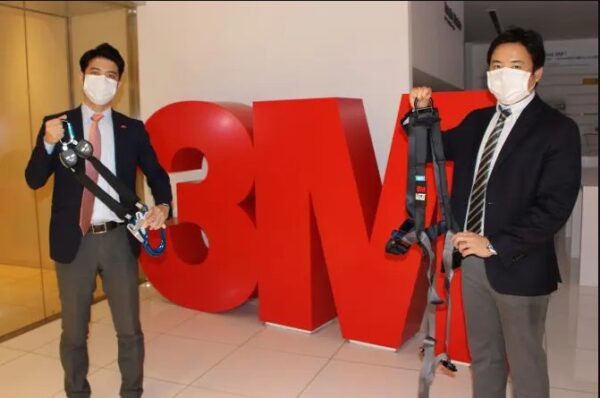
Starting January 2, 2022, products that do not meet the new standards will no longer be permitted for use.
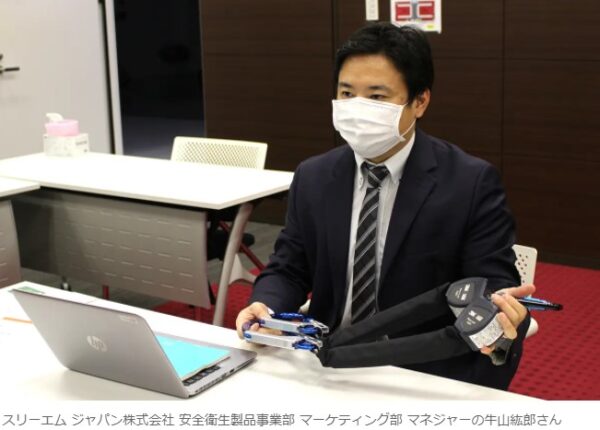
In February 2019, amendments to the Occupational Safety and Health Act made the use of full-body harnesses mandatory in principle. Since then, as a transitional measure, the use of all safety harnesses that comply with current standards has been permitted until January 1, 2022; however, their use will be completely prohibited as of January 2.
However, even though the adoption of full-body harnesses has been gradually increasing, waist belt-type safety harnesses still account for a large share of the market. In particular, due in part to the impact of the novel coronavirus last year, there is no denying the sense that the adoption of full-body harnesses has been ”put on the back burner.” However, with only about 300 days remaining until the full transition—leaving little time to spare—failure to adopt full-body harnesses promptly could potentially have a negative impact on proper on-site operations starting January 2.
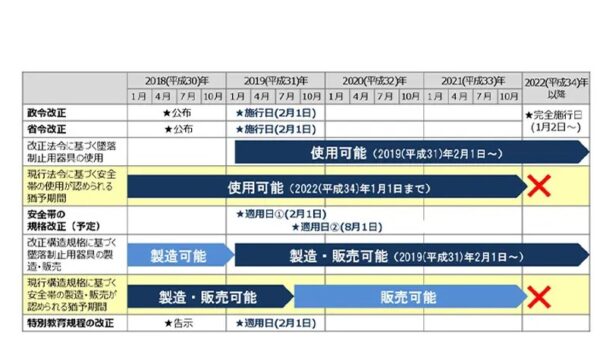
With over 40 years of experience in the development and sale of full-body harnesses, primarily in Europe and the United States, 3M (U.S.)—which entered the Japanese safety harness market in 2017—through its Japanese subsidiary, we spoke with Ryota Nakanishi, General Manager of the Safety and Health Products Division, and Hiroo Ushiyama, Manager of the Marketing Department within the same division at 3M Japan K.K., about how to select full-body harnesses and how to use them properly.
The Imminent Full Transition to Full-Body Harnesses
――Could you please explain again the background behind the mandatory use of full-body harnesses?
Mr. Nakanishi Historically, falls from heights have accounted for about one-quarter of workplace accidents in Japan, and this trend has remained largely unchanged.
The Japanese government has identified the prevention of falls from heights as an urgent priority and, in order to promote the adoption of full-body harnesses—which are the international standard—in the Japanese market, began enforcing the mandatory use of full-body harnesses in principle in February 2019. The grace period before products that do not meet the new standards can no longer be used ends on January 1, 2022, which is now less than 300 days away.

――Since the law was amended, the number of fatalities from falls has been steadily declining. Is the adoption of full-body harnesses progressing?
Mr. Ushiyama While I don’t have exact figures, my impression is that major general contractors and homebuilders, in particular, are switching to full-body harnesses. However, the construction industry is extremely broad, with a large number of small and medium-sized enterprises and sole proprietors, so I understand that adoption and the transition to full-body harnesses have not yet progressed very far.
This is because we had heard some people say, “There’s still time before the full transition, so it should be fine,” and because the impact of the COVID-19 pandemic has caused changes in the originally planned budget and spending priorities, resulting in the introduction of full harnesses being put on the back burner.
That said, since this is the final year of the transition period, we expect the rollout to proceed rapidly.
How to Choose a Full-Body Harness and Lanyard
――Given that waist belt-style safety harnesses remain widely used, I imagine there are still many people who have never used a full-body harness. What criteria should one use when choosing one?
Mr. Nakanishi While safety is obviously a priority, we also want you to choose a garment that takes into account ease of movement when worn properly. Specifically, this means being able to bend your knees and squat without feeling any tightness. If the garment restricts movement, you won’t wear it in the first place; and if you adjust it to make it more comfortable, that compromises safety.
Also,Some customers say, ”At heights of 5 meters or less, if you’re wearing a full-body harness, you’ll hit the ground if you fall, so a waist belt is better.”. Due to amendments to the law, in the construction industry, full-body harnesses are required for work at heights of 5 meters or more, and and for work at heights of 2 to 5 meters, appropriate fall arrest devices are permitted. This is because, with a full-body harness, the lanyard is attached to the upper back—well above the center of gravity—so a fall typically occurs in an upright position with the feet first. Consequently, compared to a waist belt, a full-body harness generally requires a slightly greater distance to the ground.
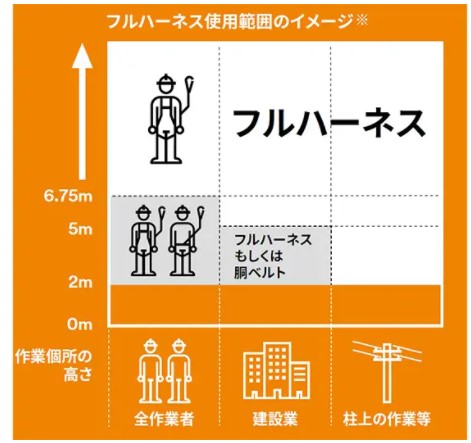
However, this is a misconception. Whether you’re using a waist belt or a full-body harness, there are cases where you won’t touch the ground. This depends on the choice of lanyard and how it’s used at different work heights.
The impact force when a fall is stopped is the same at any height as long as the person does not hit the ground; furthermore, a waist harness places localized stress on the body during the fall and results in an unstable position when the fall is stopped.“Not just a waist belt for low-level work,” but ”a full-body harness even at low heights,”We recommend using this product with the lanyard in mind, while keeping the basic design in mind.
Full-body harnesses and lanyards should be considered as a ”set.”
――In other words, you have to carefully select not only the full-body harness itself, but also the lanyard.
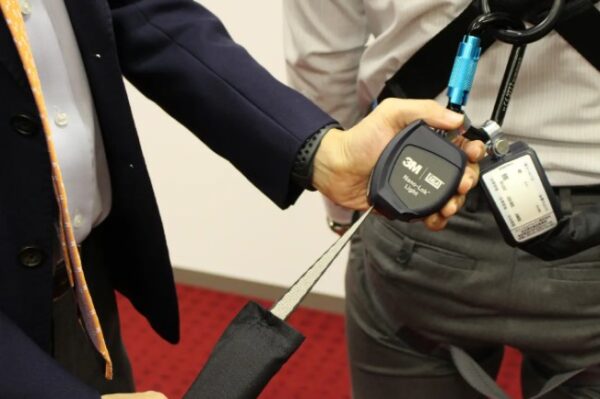
Mr. Nakanishi That’s right. The ”Nano-Lok Light” offered by 3M is a ”retractable lanyard” equipped with a locking mechanism that engages upon fall detection. Prior to the regulatory changes, ”retractable” and “rope-style” lanyards were the norm. While these retractable and rope-style lanyards are lightweight, the fall distance at the point of arrest is longer than that of a retractable lanyard equipped with a locking mechanism, making them difficult to use at low heights.
On the other hand, retractable lanyards lock the rope in the event of a fall, limiting the fall distance. In particular,With 3M's retractable lanyard, the lock engages when the rope is pulled out by approximately 20 cm at minimum, making it possible to use a full-body harness even at a working height of 2 meters.. As we move toward the widespread adoption of full-body harnesses for work at low elevations, we must also consider using retractable lanyards as part of the system.
For this reason, 3M has been actively promoting retractable lanyards since the regulatory changes took effect in February 2019. However, retractable lanyards have the drawback of being heavy and adding to the worker’s workload. Just like full-body harnesses, if lanyards are difficult to use, workers will ultimately stop using them.
So,In this new product, we’ve succeeded in reducing the weight by about 40% (approximately 500 g) compared to previous models by making the parts smaller and switching the hook from steel to aluminum, among other changes. It’s now as lightweight and compact as a retractable lanyard.。
Immediately after the law was amended, many customers tended to think of full-body harnesses as the standard option, but since last year, I get the impression that more and more customers are saying, “We have to choose a lanyard first.”
――You’re really promoting the use of lanyards, aren’t you?
Mr. Nakanishi Yes. That’s because the question we get most often from customers is, “What happens if I use this lanyard at this height?” But in reality, for people who have never used a full-body harness before, it’s hard to visualize how it works, and it’s difficult to know where to attach the hook or up to what height the full-body harness can be used.
So,We have also created a unique guide chart that shows at a glance “at what height the product can be used safely.”。
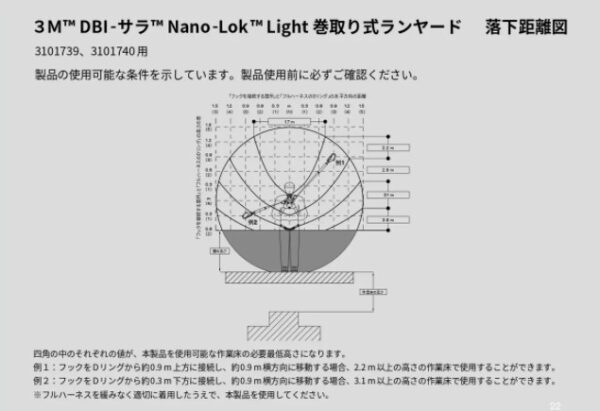
To be more specific, the area enclosed by the solid circle in the figure indicates the position where the lanyard hook should be attached, and the value inside the rectangle represents the minimum height of the work platform at which a 3-meter product can be used.
With this diagram, you’ll have a guide to help you determine where to attach the lanyard and the maximum working height you can reach, so I hope it proves helpful—even in a small way—in your use of full-body harnesses and lanyards.
――With one year remaining, how do you plan to proceed with your awareness-raising efforts and sales promotion?
Mr. Ushiyama First, we will focus on highlighting the safety and convenience of full-body harnesses. While opportunities to speak with customers in person have inevitably decreased due to the COVID-19 pandemic, we intend to provide clear and easy-to-understand explanations through online seminars and videos on our website.
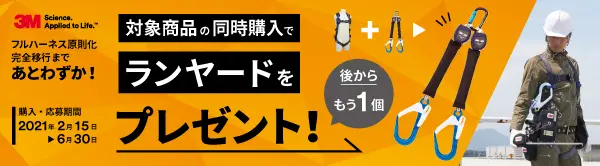
Also, to reiterate, we will continue to emphasize not only the importance of full-body harnesses but also that of lanyards. As part of this effort,We have also launched a promotion where, if you purchase a qualifying 3M full-body harness and lanyard at the same time, we’ll give you an additional lanyard for free.。
Of course, since there’s a possibility that you won’t be able to work on-site if your lanyard deteriorates or breaks, we want you to have a spare on hand so you can always feel secure—but above all, this stems from 3M’s strong belief that full-body harnesses and lanyards should be considered as a set.
――That’s quite a bold campaign.
Mr. Nakanishi Yeah. Since the list price for a single “Nano-Lok Light” is 39,800 yen, I think it’s a great deal. If it doesn’t work out, we might lose our jobs (laughs).
Joking aside, while we naturally want you to buy 3M products, we’d be overjoyed if this campaign served as an opportunity for you to switch to a full-body harness.