Client Support Services That Are Often Resented
Previously,"Behind the Scenes of Client Support Services"When I posted that article, I received a lot of comments, and it was a great learning experience to find out how contractors view us.
Thank you so much for all the scathing comments, like “You’re just posing for a photo with a blackboard” and “You’re just a ‘fox borrowing the tiger’s might.’ You’re pushing your agenda based on nothing but half-baked rules of thumb, without any real knowledge, experience, or qualifications” (lol).
Although client support services are often seen as a nuisance (or perhaps even disliked?), I’d like to take this opportunity to focus specifically on construction supervision support and explain what the work actually entails.
*Please note that this applies only to the company I work for; circumstances may vary depending on the client. I appreciate your understanding in advance.
Scope of Work for Client Support Services (Construction Supervision Support Services)
The following outlines the main scope of work from the Common Specifications for Client Support Services, Part 4: Construction Supervision Support Services. (Detailed explanations of each item have been omitted.)
- Preparation of documents and other tasks necessary for the performance of contracts for construction projects covered by the scope of work
- Verification of the Construction Status of Projects Covered by the Scope of Work, etc.
- Preparation of materials necessary for consultation and coordination with local communities and relevant organizations
- Attendance at Construction Inspections, etc.
- Other Matters (Emergencies, Ad Hoc Measures, etc.)
The number of projects assigned to each person is not just one.
In construction supervision support roles, it’s common for a single person to handle four to five projects. While there are primary and secondary supervisors, the primary supervisor often manages the bulk of the work, and since each person is responsible for four to five projects, every day is a whirlwind of activity.
For example, our work covers a wide range of tasks, such as obtaining drawing data for modified sections from the contractor, preparing revised and as-built drawings, verifying bills of quantities, preparing meeting materials, and conducting investigations related to construction at the client’s request.
In addition, we prepare various forms—such as the work report, construction progress tracking sheet, and safety management sheet—as attachments and submit them to the supervising engineer. After the supervising engineer reviews them, we present the submitted work report and other documents during a meeting with the chief inspector (the client). Once approved, the work is considered completed, and we receive a partial payment.
Given that we have to handle this many tasks, I suspect there are very few people who can do everything perfectly.
In addition, we’re actually doing things like this, too.
In addition to the duties described above, there are still other tasks to be done. These include handling local matters and responding to disasters.
"Local response" refers to addressing situations such as overgrown grass that covers the road and could cause an accident, uneven pavement with potholes that could cause vehicle breakdowns, or conditions where pedestrians are at risk of falling. Even for routine maintenance work, we sometimes issue work orders to request specific tasks, but responses outside of regular business hours are often handled through support services.
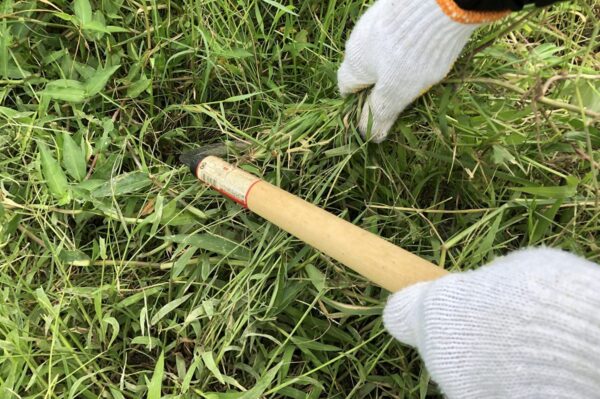
Mowing is particularly troublesome. While it can sometimes be done in just a few minutes using a lawn mower, since this is support work, we generally spend several hours using hand sickles to mow the grass to a level where there is no risk of accidents, and then hand it over to the contractor responsible for maintenance work. As for potholes in the pavement, since we keep repair materials in stock, we make temporary repairs using a tamper (manual compaction) and then hand the work over to the contractor.
In addition, as part of our disaster response efforts, when an earthquake with a seismic intensity of 3 or higher occurs or during a typhoon, we conduct safety checks (on-site inspections) of the construction projects under our responsibility and report the results to the client. During periods of heavy snowfall, we drive along the roads to conduct on-site inspections of road conditions, spread de-icing agents, and move stranded vehicles.
However, since local emergencies and natural disasters can strike at any time, I sometimes have to be on standby around the clock, constantly checking the weather forecast and my cell phone. I remember a time a few years ago, during a typhoon and heavy snowfall, when the client called me at 3:00 a.m. to inspect roads and rivers.
From the contractor’s perspective, they might say, “This doesn’t even count as work,” but in reality, we’re handling these kinds of small details behind the scenes. As a team supporting clients, we wrote this article to let you know that we’re working hard every day—including on these seemingly minor tasks—to do our jobs to the best of our ability.
――I’m sure most contractors think, “Client support services are unnecessary.” I’m embarrassed to admit that there are various critical opinions—such as being forced to draw revised drawings or being made to do things not specified in the specifications—but"Behind the Scenes of Client Support Services"I found out about it in the comments section.
In this article as well, I’d love to hear your comments and opinions. Please feel free to send them my way.