Hello, everyone.
This is Enta.
I'm actually younger than you'd think!
Yeah, I'm 40, lol.
People say I look like I'm in my late 40s, but...
It's been about 21 years since I entered this industry, and I've come to realize that experience really does matter in this field.
In the world,The 10,000-Hour RuleThere is something that is said to be...
They say that anyone who spends 10,000 hours on something is considered a professional.
In terms of years, it's about three years.
However, if anything, it’s the kind of thing that can be handled however you like, depending on how much you practice—
If it's something like that, even 10,000 hours would be fine. (Piano, violin, etc.)
But a construction site is a living, breathing thing. (That’s what a former boss of mine used to say, lol.)
It is constantly changing.
We will anticipate these changes as they arise and respond accordingly.
The challenges of on-site management.
Civil engineering is all about experience. It’s a field where experience is everything.
In about three years, you'll probably only gain a basic understanding of this industry.
If you keep going for three years with the determination to finish in one year what would normally take three years,
You can grow tremendously, but,
In today's world, they call that kind of thing a "black company"—how ridiculous lol

When you think about it, it’s a time when it’s hard to grow, but,
There are actually a lot of "white-collar" companies in the construction industry.
Black used to be more common, but now white is more common.
I guess White is trying to swallow Black.
However, behind the scenes, Black is also on the verge of being swallowed up by White.
So that's how it maintains its balance.
To gain valuable experience, you need to experience both in a well-balanced way.
The diagram above is a symbol known as a polar diagram.
But that's beside the point.
For suspended drilling rigs and attachment drills, the drilling depth is determined by the length of the drill rod.
During drilling, the drill rod is fed into the hole, but
I just can't seem to figure out the current drilling depth.
Even when government officials are present,
Government Official: "How much drilling have you done so far?"
Construction Supervisor: "I'd say about half, I guess~"
Government Official: "That's a bit confusing, isn't it?"
Construction Supervisor: "Once the main unit reaches the spray area, we're done."
Government Official: “4 meters based on that mark?”
Construction Supervisor: "It's about 4 meters."
That's why it ends up feeling a bit vague.
In reality, I suppose it would be best to drill a little deeper than the specified design depth, but,
It’s also important to make it look as though you’re managing that aspect carefully.
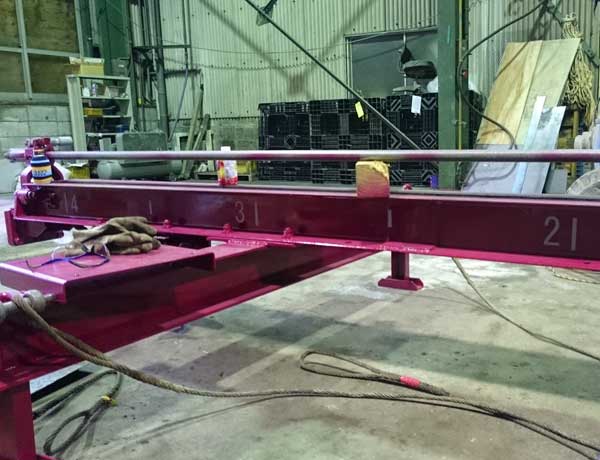
So, if you mark and display it in advance as shown in the photo,
You won't hesitate during drilling operations, and you'll make fewer mistakes.
With a few simple tweaks, both installation and maintenance become easier.
Well, that's it for now.