Hello, everyone.
This is Enta.
You're working on a quote, right? (Well, duh lol)
What is your typical rate for machine fees in such cases?
I think they'll come up with a rough budget estimate before providing a quote.
That's the pricing at that time, isn't it?
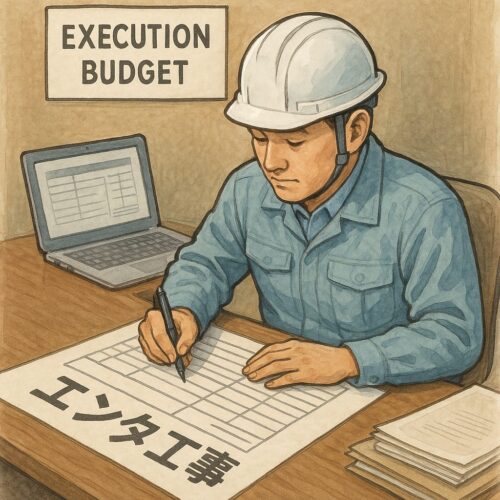
Roughly speaking, the budget breaks down as follows:
These costs are broken down into material costs, labor costs, and equipment costs.
For example
Area: 500 cm²
Let's say it takes 5 days to complete the sprayed mortar work. (*Note: At the end)
The method for determining the unit price of the machinery in that case is described below:
This is just a rough estimate of the unit price.
| Machine Name | Purchase Price | Depreciation Period | Annual Amount | Number of Operating Days | Day 1 | Rounding |
|---|---|---|---|---|---|---|
| Spray Machine | 9,000,000 | 8 | 1,125,000 | 60 | 18,750 | 18,800 |
| 60-kVA Generator | 5,000,000 | 6 | 833,333 | 60 | 13,889 | 13,900 |
| 100-horsepower compressor | 6,000,000 | 6 | 1,000,000 | 60 | 16,667 | 16,700 |
| Belcon | 350,000 | 6 | 58,333 | 60 | 972 | 1,000 |
| Weighing Machine | 700,000 | 6 | 116,667 | 60 | 1,944 | 2,000 |
| Hopper | 200,000 | 6 | 33,333 | 60 | 556 | 600 |
| High-Pressure Washer | 500,000 | 6 | 83,333 | 60 | 1,389 | 1,400 |
I've included a rough estimate of the purchase price.
This is a tax-related matter, but *the useful life for depreciation is set as shown in the table.
Divide the purchase price by the depreciation amount and the useful life (which varies by machine).
Assuming there are 3 months of operating days in a year, divide the annual amount by the number of operating days in a year (30 days × 3 months).
The daily rate will be calculated.
That amount has been rounded and is shown in the far-left column.
Whether it's considered cheap or expensive depends on the company.
If you want to raise it more, just go ahead and do it.
The amounts listed here are the minimum costs and do not include repair fees.
If you're going to include repair costs, I think it's okay to add about 20 percent.
The key point is: How much of the time does that machine actually operate over the course of a year?
After all, machines don't run 365 days a year, do they? ^^
Apart from that, there are times when you might rent equipment, right?
Since there are monthly and daily rates, you can calculate the minimum cost by entering the applicable unit prices.
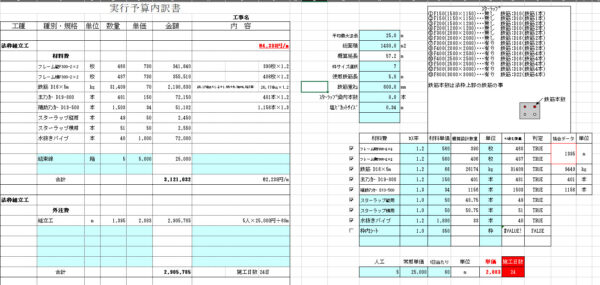
I've created the basic framework for this budget in Excel.
I'm sharing this with everyone today.
(Everything's here—from legal frameworks to anchors—but you can't use them if you don't understand them, so I'll just leave it at this for now.)
Shioda Development Co., Ltd. Website
It's listed as No. 39 in the downloads section here, so please try downloading it.
This is strictly the minimum cost.
Please try adding your company's profit margin of about 20% to 30% to this figure.
Of course, don't forget about business expenses and statutory welfare benefits, too ^^
See you later.
For your information
✅ The “number of years” determined by the government during which fixed assets (such as machinery and buildings) can be used
🔧 To be a little more specific:
When a company purchases high-value machinery or equipment (e.g., generators, heavy machinery), it does not expense the entire amount in a single year, but rather spreads the expense over several years (i.e., depreciation).
At that time, “How many years should we use as the basis for the division?"The criterion for this is,"Depreciation PeriodThat's it.
📘 Example:
| Machine Name | Purchase Price | Depreciation Period | Annual Expenses |
|---|---|---|---|
| 60 kVA Generator | ¥5,000,000 | 6 years | ¥833,333 |
In other words, the government considers that “this generator will depreciate over six years,” so the system allows you to claim 830,000 yen annually as an expense over that six-year period.