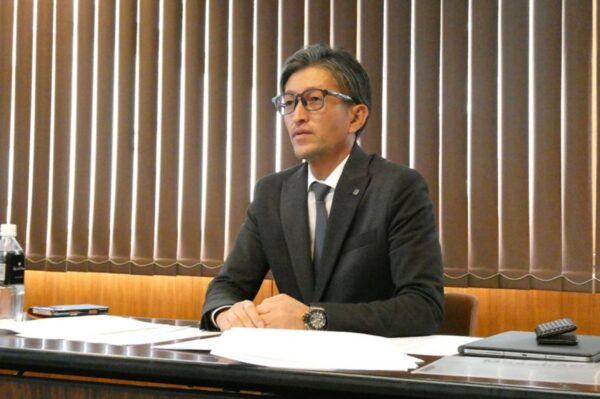
The Multi-Angle Construction Method Association (Chairman Yuki Tsurugi, President of Tsurugi-gumi Co., Ltd.) held a press conference to announce its establishment as a general incorporated association. The association aims to promote safe work practices and eliminate workplace accidents through rationalization and the advancement of technology and skills in the field of slope-work scaffolding. It also seeks to contribute to the sustainable development of the construction industry and the field of slope disaster prevention by promoting the widespread adoption and utilization of these methods.
Specific activities include: (1) sales efforts targeting clients to promote the multi-angle construction method; (2) technical cooperation regarding assembly and disassembly; (3) research and guidance on safe construction; (4) collection and provision of information and materials related to the construction method; ⑤ training of engineers and skilled workers; ⑥ establishing a cooperative framework among member companies; and ⑦ other projects necessary to achieve these objectives. Through these seven initiatives, the organization is working to develop the infrastructure for slope disaster prevention.
Scaffolding used in slope disaster prevention projects is particularly challenging to install due to the nature of the work—which involves erecting structures on natural terrain—and has traditionally relied on the specialized skills of individual workers using conventional single-tube methods. While it takes many years to train these skilled workers, the heavy physical demands of the work lead to high attrition rates, resulting in a chronic shortage of workers. Consequently, a structural challenge has existed in which rapid responses to disaster recovery and disaster prevention projects have been hindered.
Chairman Yari, who has long felt a strong sense of urgency regarding these issues based on his many years of practical experience, collaborated with Nissou Industries, a manufacturer of temporary construction equipment, to develop the “Multi-Angle Method”—a high-load-bearing, modular work platform designed for use on steep slopes and mountain slopes. This method has continued to evolve as a safe construction technique.
Meanwhile, based on the belief that “a system ensuring proper use and widespread adoption at a consistent level of quality is essential,” the association was established in 2023 to serve as an organization responsible for construction quality standards, workforce development, information sharing, and disaster response systems. To clarify its social responsibility and ensure transparency, it has recently incorporated as a general incorporated association. In this article, based on a press conference by Chairman Yari, we will track the future developments of the Multi-Angle Construction Method Association.
A New Chapter in Infrastructure Defense Through the Transition to a General Incorporated Association
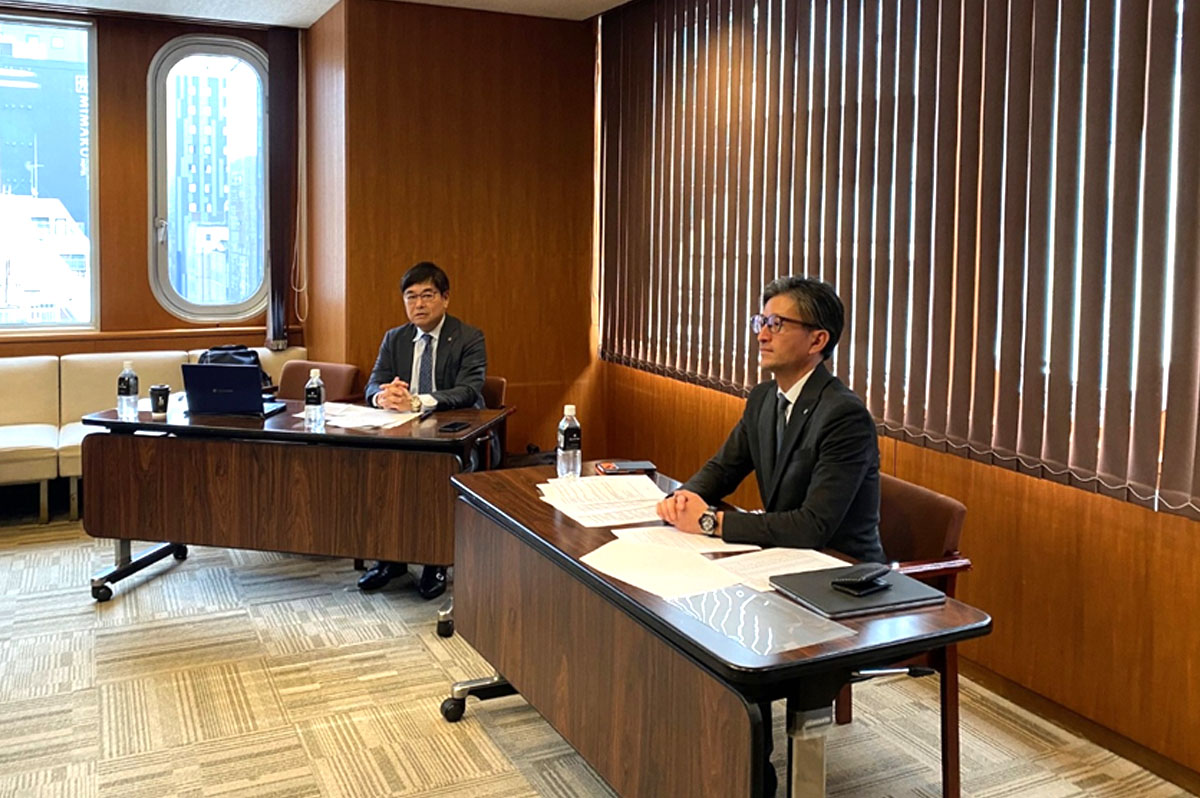
Scene from the press conference (Left: Takahiro Kato, Executive Director and General Manager of the Slope Engineering Division at Nissho Industries; Right: Chairman Yuki Yari)
Chairman Yuki Yari outlined the three social values that the association should uphold.
The first pillar is “Improving Disaster Response Capabilities.” By standardizing construction quality and safety standards nationwide and establishing a robust network of engineers, we will build a system capable of providing a swift and stable response in the event of an emergency.
Second, the company is committed to “improving safety and sustainability.” It aims to thoroughly reduce the risk of accidents by implementing highly reproducible construction methods. Furthermore, the company is committed to maintaining and developing an environment that encourages young professionals and the next generation of talent to join the industry with enthusiasm.
Third is “standardization of technology and establishment of reliability.” As an association, we will standardize and make visible the know-how that has previously been buried within individual companies and on-site operations, and present clients and government agencies with an unshakable “reliable option.”
The number of member companies, which stood at 17 at the time of the association’s founding, has now expanded to 19. Membership is by no means granted lightly. To join, a proven track record of construction work, a rigorous safety management system, and a deep commitment to the association’s core philosophy of “coexistence, mutual prosperity, and mutual benefit” are essential. Only after completing the steps from application to verification and training are applicants welcomed as official members.
During the question-and-answer session, Chairman Yari once again touched on the significance of becoming a general incorporated association—a goal the organization had been pursuing since its founding. “Going forward, when entering into agreements with government ministries and agencies or disseminating information, a track record (evidence) of organizational management that prioritizes transparency will be indispensable. We deliberately spent two years on this process because we believed we should not simply go through the motions of incorporation, but rather transition only after demonstrating the Association’s necessity through a series of meaningful activities,” he reflected. Armed with organizational transparency and credibility, the Multi-Angle Construction Method Association has now stepped onto a new stage.
In the event of an emergency, we protect the nation through a network of 19 companies nationwide
Over the past two years, the Multi-Angle Construction Method Association has focused on “standardization from a strictly on-site perspective.” While construction methods can, in principle, be customized in countless ways for each specific site, there were concerns that this could sometimes lead to “overspecification” or “inappropriate application.” Therefore, the Association began by holding study sessions aimed at ensuring the proper implementation of construction methods, so that high reproducibility could be guaranteed regardless of who performed the work. Furthermore, by establishing cost estimation standards, the Association eliminated reliance on individual expertise and put in place a system to enhance transparency in pricing and proposal content.
Currently, the association is promoting the use of a “construction method selection flowchart” tailored to site conditions, the sharing of construction case studies, and the objective assessment of characteristics through comparison charts with similar methods. While deepening understanding of construction practices through regular site inspections and patrols, the association is also working to improve the accuracy of construction plans by establishing product management criteria and developing 3D software. Looking ahead, the association aims to be recognized by government agencies and clients as an indispensable partner in the field of temporary scaffolding for slope disaster prevention. Chairman Yari has expressed strong determination regarding the response to natural disasters.
"In the event of disasters such as landslides, temporary construction work will likely be needed immediately. Our greatest contribution to society is to respond swiftly through our nationwide network to direct requests from the Ministry of Land, Infrastructure, Transport and Tourism and local governments. We are working to compile a list of members who can respond and want to expedite the signing of agreements in preparation for emergencies."
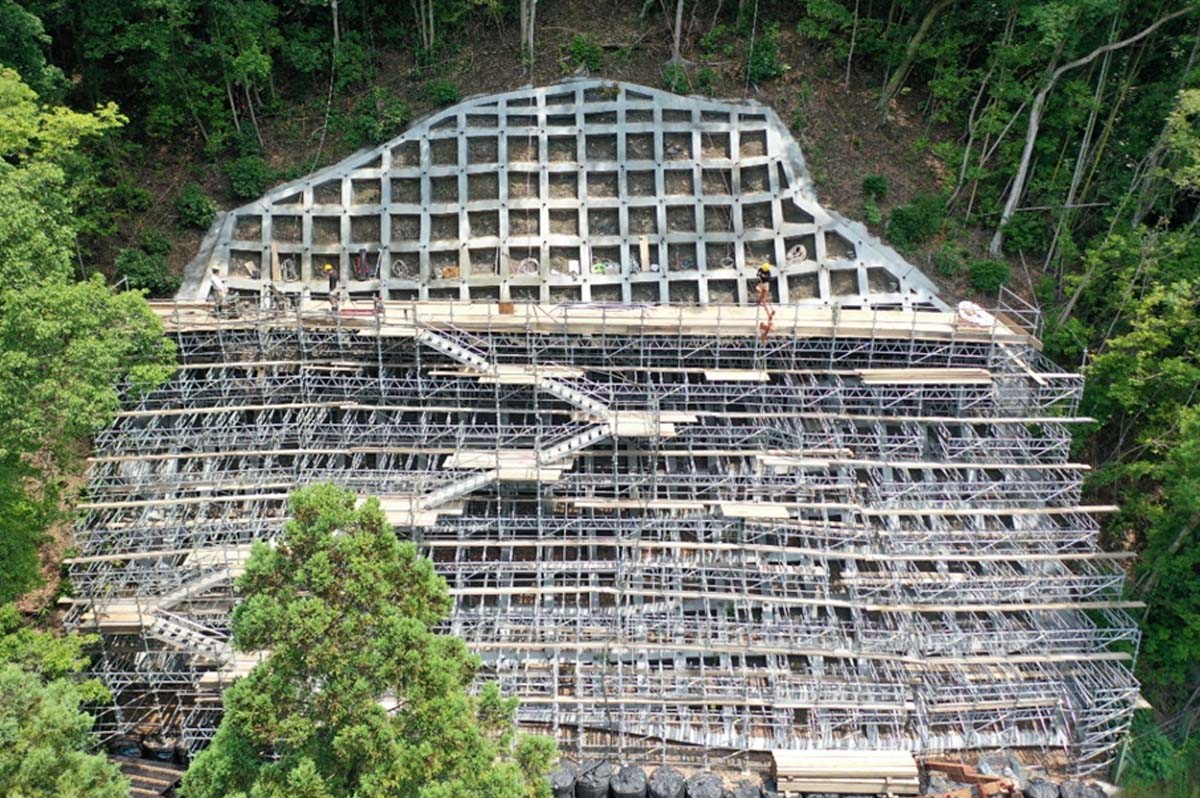
Multi-Angle Construction Method
Chairman Yari, who also serves as a director of the National Temporary Construction Safety Cooperative (Access), is considering collaboration with that cooperative as well.
“By the general meeting in November, we want to take some form of action toward concluding agreements with the Ministry of Land, Infrastructure, Transport and Tourism, NEXCO, the Ministry of Defense, and others. In doing so, we intend to collaborate with Access to move forward with realizing these agreements,” he stated, outlining the broad direction for value creation. The association plans to leverage its strength—having member companies scattered throughout the country—to deepen collaboration with local governments in the future. Furthermore, there are currently no high-strength cost estimation standards for slope scaffolding on sloped terrain. Therefore, the association will propose such cost estimation standards to the national government.
With a dual focus on honing technical expertise and strengthening its organization, the Multi-Angle Construction Method Association is striving to establish itself as the “last line of defense” for protecting social infrastructure.
The Power of “Shinsei”: No Heavy Equipment Needed—Just a Single Hammer to Shorten Construction Time by 40 Percent
Following Chairman Yari’s explanation of the association’s activities, Takahiro Kato of the Daido Association Secretariat (Executive Director and General Manager of the Slope Engineering Division at Nissho Industries) provided a detailed explanation of the construction method.
The Multi-Angle Method is a proprietary construction technique that uses temporary materials to build a safe work platform on slopes. By applying the “Nisso 3S System”—a wedge-fastening system that serves as both scaffolding and shoring—this wedge-fastening system platform method allows for the safe and rapid installation of work platforms on slopes and embankments, enabling flexible adaptation to slopes of various gradients using temporary construction materials.
Its most notable feature is that it requires no heavy machinery and can be easily assembled and dismantled using just a single hammer. While it allows for manual installation on slopes where setting up heavy machinery is difficult, it also significantly reduces construction time compared to conventional methods such as single-tube scaffolding. Based on a comparison using a 1,000-cubic-meter model, the association estimated that, compared to conventional scaffolding using single-tube pipes, clamps, and wire ties, this system can reduce assembly and disassembly labor by 37.78% and costs by 21.34%. It is ideal for use on narrow lots, in mountainous areas, on steep slopes, and for emergency restoration efforts following disasters.
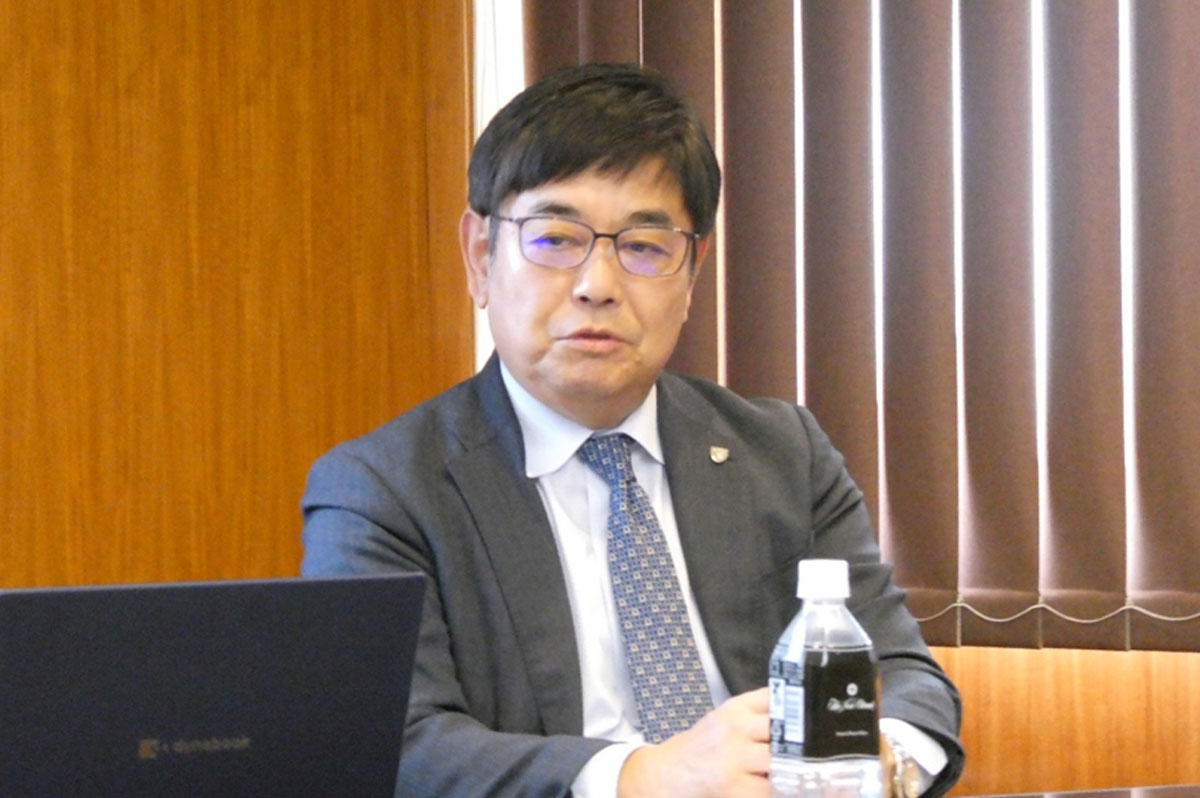
Mr. Takahiro Kato Explains the Multi-Angle Construction Method
Technical development was initially carried out by Nissou Industries, but later incorporated the expertise of Yari-gumi, which was responsible for construction. Although the original multi-angle construction method presented some challenges for scaffolding workers, Yari-gumi proposed to Nissou Industries the addition of new components, changes to construction procedures, and modifications to materials. Ultimately, through joint development, a new and improved Multi-Angle Method was born, which remains in use today.
Since the Yari-gumi has repeatedly introduced and refined the multi-angle construction method, the fact that this information is shared among members is a major benefit of the association. The Yari-gumi’s activities serve as a positive inspiration for other members, prompting them to test various implementation methods of the multi-angle construction technique. By further sharing these insights among members, construction precision has improved dramatically.
The maximum allowable load for the support columns is 7.1 metric tons. With more than three times the allowable bearing capacity of single-tube scaffolding, it can support loads of up to approximately 70 metric tons—a capacity unattainable with single-tube scaffolding—making it suitable for supporting heavy machinery such as 50-metric-ton rough-terrain cranes. Another major advantage is that strength calculations with a clear basis can be performed in accordance with JIS Standard A8972 (Temporary Equipment for Slope Construction). Since these are rental items intended for reuse, they help reduce waste materials such as sandbags, thereby contributing to the SDGs.
In April 2025, it was designated as a “Semi-Recommended Technology” under the Ministry of Land, Infrastructure, Transport and Tourism’s New Technology Information System (NETIS). This designation signifies that its reliability and effectiveness have been recognized by the national government. "Semi-Recommended Technologies" are recognized following review and evaluation by the Ministry of Land, Infrastructure, Transport and Tourism. The Multi-Angle Construction Method has become one of the technologies recommended for priority adoption in public works projects. Going forward, as its adoption in national and local government construction projects is expected to offer incentives—such as bonus points in contractor evaluations—its use on construction sites is expected to be further promoted.
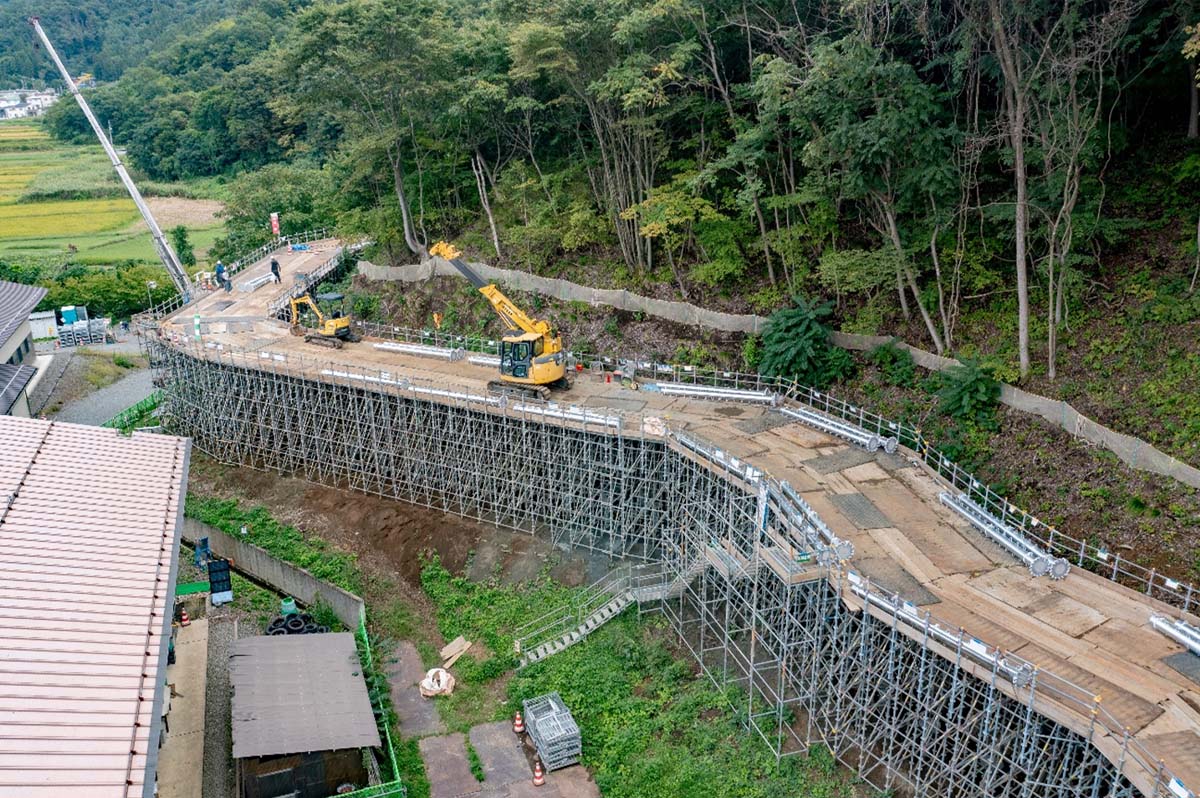
Chairman Yari proudly states, “Compared to similar construction methods, the Multi-Angle Method offers the highest strength achievable with hand-assembled joints. However, since it’s important to avoid both high costs and overspecification, we offer more than 70 customization options that allow specifications to be adjusted up or down based on strength requirements, providing a wide range of solutions.”
A Paradigm Shift Toward “Slope-Type Next-Generation Scaffolding”
Looking at the market—from slope repairs and disaster prevention measures to emergency restoration in the event of a crisis—there is enormous untapped demand. Yet on-site construction remains a “backward” world where single-pipe scaffolding and clamps still play the leading role. Although there is little concrete evidence, it is estimated that conventional methods account for as much as 70 percent of the market. “We know our methods are superior, but in the end, conventional methods are chosen because of price. That’s the reality of this industry.” Chairman Yari sharply points out the high difficulty of construction and the underlying sense of crisis.
The skill of handling single-pipe scaffolding in extreme on-site conditions is truly the epitome of skill that relies on individual expertise. However, now that these highly skilled workers are aging and leaving the field one after another, clinging to tradition is nothing but a risk. While demonstrating three key advantages—shorter construction schedules through systemization, absolute structural safety that eliminates human error, and high quality achieved through unwavering precision—Chairman Yari notes, “The only thing that hasn’t caught up is price.”
Just as scaffolding for high-rise buildings once transitioned from single-tube systems to “next-generation scaffolding,” the sound of change is now being heard in the world of slope construction. The vision for the future outlined by Chairman Yari goes beyond the mere popularization of construction methods. At its core lies the thorough “refinement of skills” by association members. Some association members have established skills centers where they conduct hands-on training and hone their skills in the Multi-Angle Method. For example, the “Hida Takayama Skills Training Center,” operated by Yari-gumi, provides a comprehensive training program—ranging from support for obtaining certifications to practical instruction in the Multi-Angle Method—to develop the workforce that supports regional infrastructure. The day when many scaffolding craftsmen master the Multi-Angle Method and dramatically transform slope construction sites is just around the corner.
A Revolution in Slope Scaffolding! Shattering the Conventional Wisdom of “10 Years of Training”
It takes 10 years to master slope scaffolding—
Until now, this has been regarded as the “inevitable” price to pay in this industry. However, during this grueling training period, many young workers give up, while veterans leave the field after suffering back and knee injuries. This dilemma—balancing the “passing down of skills” with the “physical strain” on workers—is a serious issue that cannot be ignored when it comes to protecting Japan’s infrastructure. Currently, landslides and mudslides are occurring frequently across the Japanese archipelago. In restoration work where every moment counts, construction sites can no longer rely solely on the “grit” and “experience” of skilled craftsmen.
Promoting the widespread adoption of system scaffolding capable of achieving these goals can be said to be a necessity of our times. Under these circumstances, the significance of temporary construction companies and manufacturers from across the country coming together to establish the Multi-Angle Construction Method Association—and its subsequent incorporation as a general incorporated association—is immeasurable.
"Easier. Safer."
The widespread adoption of the multi-angle construction method, which embodies this slogan, is truly a lifesaver on construction sites. Even on complex slopes, this systematized equipment powerfully supports the skills of scaffolding workers, enabling high-quality construction while reducing physical strain and complementing their expertise with the system. With the rise of the multi-angle construction method, an era has now arrived in which “easier and safer construction” has become a reality for scaffolders.
I sincerely hope that this construction method, which protects Japan’s slopes and the safety of roofers, will spread to construction sites across the country.
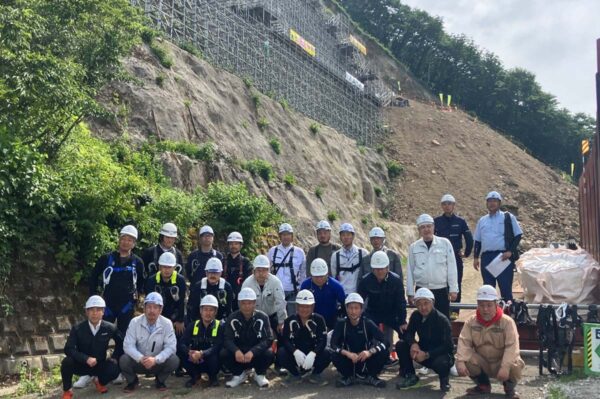
Membership Roster of the Multi-Angle Construction Method Association (as of February 2026)
- Kokan Build Co., Ltd. (Hokkaido)
- Sasa Sogyo Co., Ltd. (Iwate Prefecture)
- Ariga-gumi Co., Ltd. (Yamagata Prefecture)
- Akita Chuo Kiko Co., Ltd. (Akita Prefecture)
- Morishita Kogyo Co., Ltd. (Miyagi Prefecture)
- Mako Machinery Co., Ltd. (Niigata Prefecture)
- Shinsei Co., Ltd. (Gunma Prefecture)
- OGISHI Co., Ltd. (Saitama Prefecture)
- Wakasa Industries, Ltd. (Saitama Prefecture)
- Ogino Industries Co., Ltd. (Yamanashi Prefecture)
- ANT Co., Ltd. (Shizuoka Prefecture)
- e-works Co., Ltd. (Shizuoka Prefecture)
- Yari-gumi Co., Ltd. (Gifu Prefecture)
- Tobimasa Co., Ltd. (Nara Prefecture)
- Yamanari Kogyo Co., Ltd. (Wakayama Prefecture)
- H Co., Ltd. (Okayama Prefecture)
- Nagahama Kisei Co., Ltd. (Ehime Prefecture)
- Fukutomi Construction Co., Ltd. (Fukuoka Prefecture)
- Nissou Industries Co., Ltd. (Tokyo)