Hello, everyone
This is Enta.
I've got a lot of business trips this week, lol.
I'll be in Tokyo on Thursday and Friday, so please take care of me (what's that supposed to mean, lol).
But that's beside the point.
Have you heard of capillary action?
That's the point.
https://www.youtube.com/watch?v=vkK6_ErzbZU
This phenomenon is commonly observed on slopes.
Water is still seeping out even though grout has been injected after drilling for rock bolts and anchors.
The cause is capillary action.

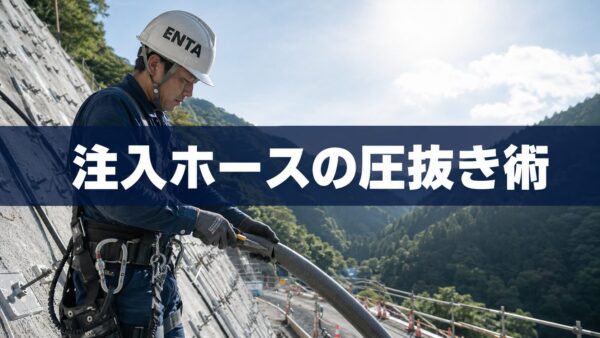
There is a water hose running underneath the PC steel strands shown in this photo.
This is because water is still flowing uncontrollably even after the concrete has been poured, so
I'm catching it with a hose.
This is,The areas where the grout adheres to the surrounding rock after injectionThe surface tension of the spring water and the surface tension of the grout, and
It rises due to capillary action. (It is drawn up.)
The narrower the gap, the better it sucks it up!
Furthermore, the fact that water is coming out means that the internal pressure is rising, and
Since they're already trying to get out, I think they'll keep coming out one after another.

People often tell me to stop doing this, but,I can't stop.
That means the water flow has changed as a result of the drilling.
From a geological standpoint, it’s safer to let the water flow out rather than stop it, as this helps maintain an unsaturated state.
If there's a lot of water, it looks better to connect a hose and drain it.
If possible, I think it would be better to install drainage boreholes, as they allow for more efficient water drainage.
By the way, there are times when they suddenly appear—several years after ground anchor installation or rebar insertion—due to heavy rain or earthquakes!
This is also just a change in the watercourse; as far as the mountain is concerned, the water is simply flowing from a place where it tends to flow easily.
We can't stop it, but there's a good chance the situation will change again if we carry out drainage drilling or similar work.
See you later.