Hello, everyone.
This is Enta.
Do you know what the drain pipe is for in spray-applied construction?
Well, as the name suggests, it's a pipe used to drain water.
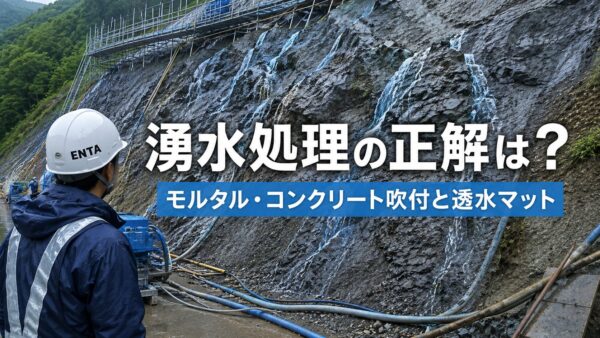
Water flows out of the drainage pipe from the mountain.
But the way it comes out is actually different from what you all think, lol.
And aren't you thinking that a drain pipe is just something you install and that's it?
I wrote something similar before regarding dewatering drilling.
It's going to be the same situation this time, so the answer is the same, but the picture is different lol
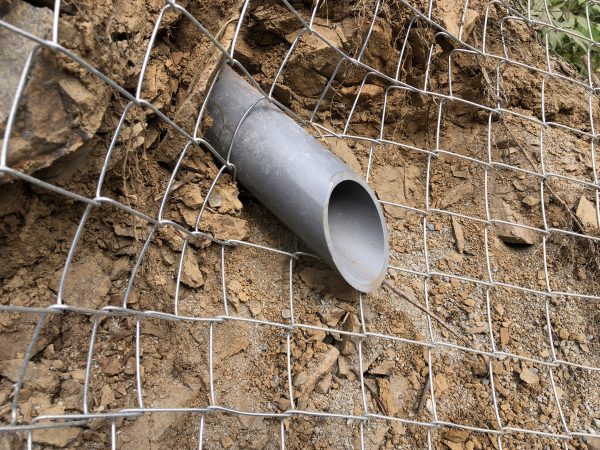
This is a VP50 PVC pipe used in sprayed concrete and sprayed mortar applications.
Generally, it is installed and sprayed on like this.
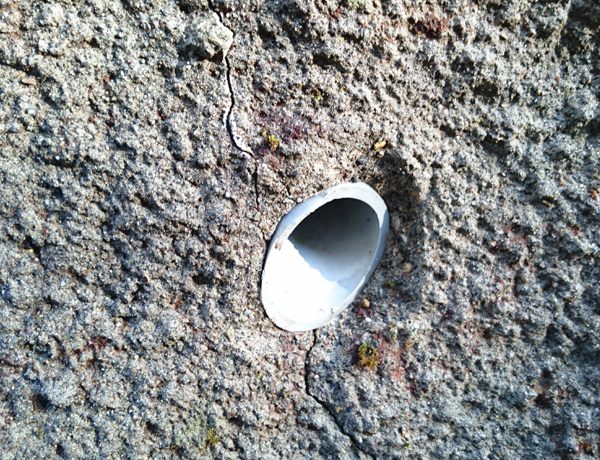
Most places are filled up like this.
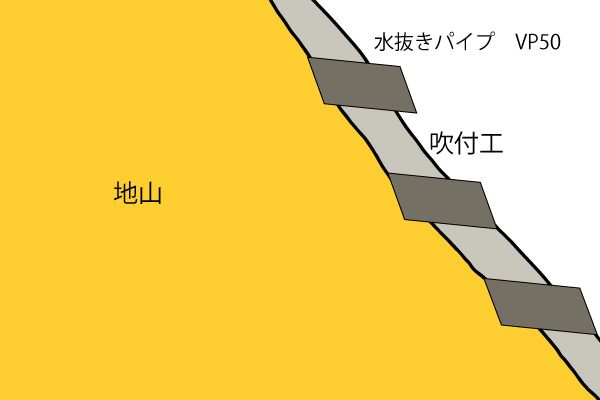
This is what it looks like in cross-section.
Fundamentally speaking, the basic principle of sprayed mortar and sprayed concrete work is adhesion to rock.
Rock anchoring is a construction method designed to minimize the weathering of natural rock by protecting it from direct exposure to wind and rain.
For that reason, we do not perform such construction work when the natural ground is classified as a soil section.
Basically, the process involves spraying the material onto sites where rocks and other surfaces are exposed to seal them off.
However, even through those sealed cracks in the rock, rain and other water seep out little by little.
The idea is to drain it out through the drain pipe.
That said, since the water coming down from above doesn't really gush out of the drain pipe, you might wonder if the upper drain pipe is even necessary, right?
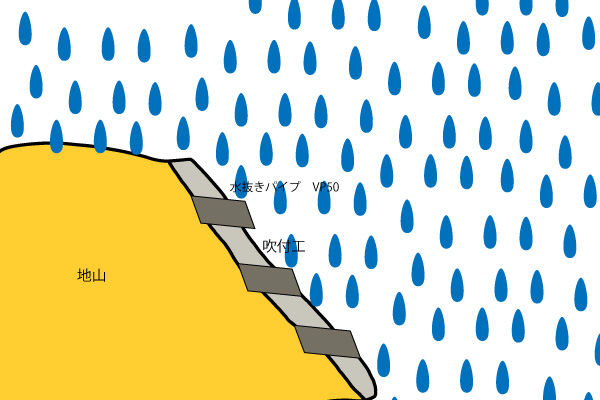
This is how it rains.
Rain is absorbed into the ground and accumulates there.
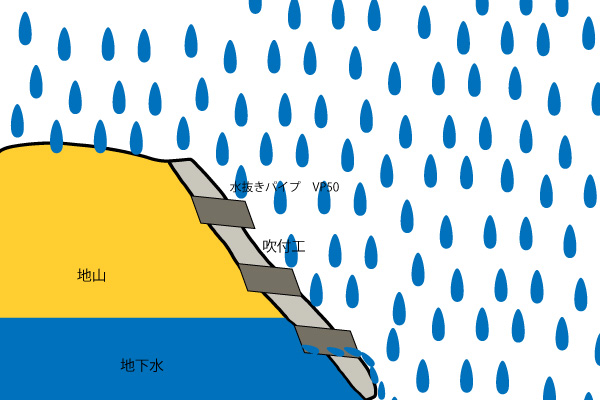
When the groundwater level rises, water begins to trickle out from cracks in the rock and other openings toward the drain pipes (where the pressure has been released).
To be honest, I can’t help but wonder if, for basic rock-anchored spray-applied concrete work, the drainage pipe at the bottom alone might be sufficient.
In some cases, water seepage can occur even in mountainous areas, and there are also many instances where spray-applied insulation creates an airtight seal, causing changes in internal pressure that alter the water seepage patterns.
I think it happens quite often that the water we’ve been supplying suddenly stops flowing.
When performing sprayed mortar or sprayed concrete work, where does the water come from?
If you keep this in mind when installing it, you’ll be able to achieve a better result.
That said, while it’s true that having them lined up looks better, it’s also a good idea to imagine where water is likely to pool when it rains—and then install a few extra drainage pipes in those areas.
However, it’s actually quite interesting to learn not only how to perform the work but also how to control water in sealing methods such as sprayed mortar.
I generally target areas facing the mountain that have a gentle slope and are experiencing significant soil erosion.
This means installing more drain pipes than usual.
Given recent landslides and other natural disasters, our workload is sure to increase in the future.
However, if we continue to carry out construction work in the same way as before, the results will be the same as before.
How can we prevent it from collapsing? How can we build a slope that won’t collapse? And how can we adapt flexibly to the mountain itself?!
I’d like to incorporate some behind-the-scenes control into even the most visible construction methods.
See you later.