Hello, everyone.
This is Enta.
When I was just starting out, I didn't really understand gradients.
Once you’ve worked with numbers for a while, you start to realize that you hear certain things more often, don’t you?
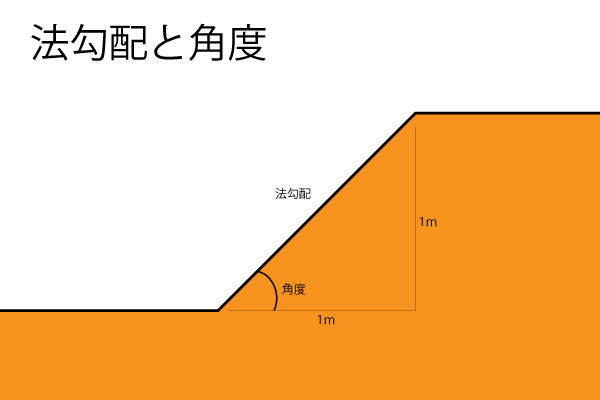
It's usually easier to understand when you draw a picture like this to explain it, isn't it?
Civil engineers (or "doko-ya") talk about slopes, don't they?
For example, a 10% gradient or a 5-minute slope.
As shown in the figure above, a 10% slope is a 1:1 gradient with the vertical axis (1) as the reference.
This is the slope when you move 1 meter horizontally and rise 1 meter vertically.
A 5-minute gradient means that, when the vertical component is set to 1, the horizontal component is 0.5.
The scale is indicated as 1:0.5 on the drawing.
If this is 0.3, the ratio becomes 1:0.3.
To put it another way, a 1-wari, 3-bu slope (ichi-wari, san-bu, kōbai)
Surveyors (civil engineers) sometimes say things like “1 warai, 3 bu, 5 rin.”
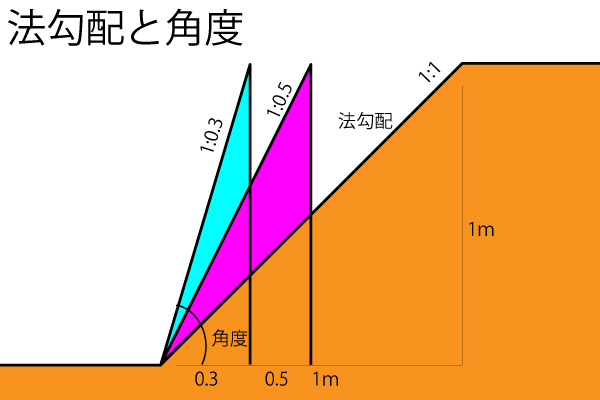
And for us slope engineers, it’s important to understand angles.
Some people may already remember it.
When expressing these ratios as angles, please use a calculator to perform the calculations as shown below.
=Atan(1÷1)
=45 degrees
Atan stands for arctangent.
It is sometimes referred to as tan-1.
Let's calculate the gradient for 5 minutes.
=Atan(1/0.5)
= 63.4 degrees
The angle of a slope with a 5-minute gradient is 63.4 degrees.
You might be wondering, “What’s the point of knowing this?” but when we insert rebar, there’s a specific angle at which we pour the concrete.
When designing that placement angle,Perpendicular to the slopeIt is often calculated this way, and
Sometimes, drawings even specify that something is perpendicular to a slope.
At that point, calculate the slope angle, andSubtract from 90 degrees to get the drilling anglewill be.
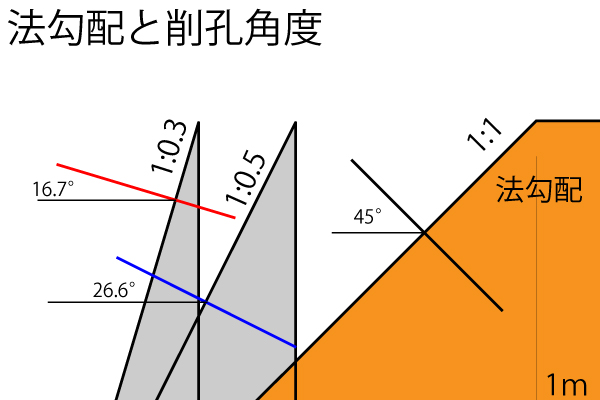
Since the slope angle for a 5-minute gradient is 63.4 degrees,
= 90 degrees – 63.4 degrees
= 26.6 degrees
This is the drilling angle.
It would be a problem if you didn't know this when you get to the site, so please make sure you understand this part.
You’ll definitely want to make sure you can at least use the basic functions of a scientific calculator, right?
By the way, sometimes (actually, quite often) the price is displayed as a percentage.
Also, the general contractor may sometimes refer to things in terms of a percentage.
You don't need to overthink it, but it's simply the ratio of the height to the horizontal, with the horizontal set to 1.
You don't really need to memorize this part, but it does appear on road signs.
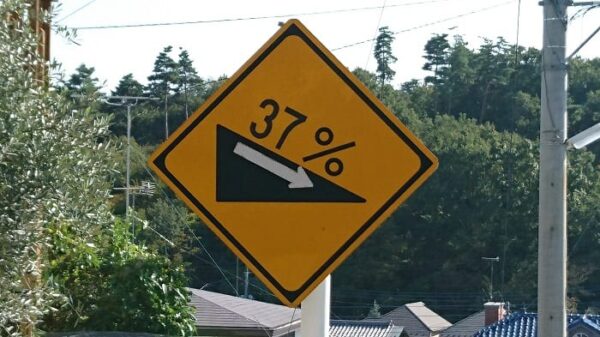
This means a gradient of 37 meters vertically, measured from a horizontal baseline of 100 meters.
You can tell that this road has an incredibly steep gradient.
See you later.
Should the road be sloped or level when installing ground anchors or reinforcing bars?