Hello, everyone.
This is Enta.
I really hope it stops raining soon.
It's been raining way too much this year.
The mortar work isn't moving forward at all, and the situation is getting really dire.
If my current project doesn't wrap up as scheduled, the projects I've worked on in collaboration with the general contractor will continue to be awarded as planned.
If that happens, I think that project will come into play as well, so if the project we’re currently working on doesn’t go according to plan, we’ll be in a very bad situation.
The slope stabilization work, in particular, is in a really bad state.
It's backed up right now, and it looks like traffic's starting to build up behind me too—it's terrifying, so I guess I'll just have to pretend I don't notice, lol.

But that's beside the point.
This is a follow-up to the recent post about construction defects; this time, we’ll cover sprayed mortar, sprayed concrete, and vegetation engineering.
Rather than focusing on detecting substandard work, it is more important to create conditions that prevent construction defects from occurring in the first place.
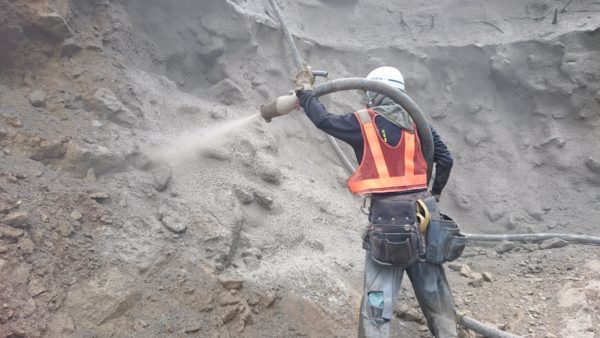
There are often many aspects of our work that go unnoticed.
The invisible part.
The mountain is too high. (It's a struggle whether you're going up or down.)
The cliff is extremely dangerous. (It’s a place people should avoid.)
That’s exactly where construction defects are most likely to occur.
Let's make sure we're well aware of those critical points.
Thickness is a crucial factor in processes such as sprayed mortar and sprayed concrete.
Anyway, this is extremely important.
Here's the finished product!
If you're thinking, "It must be the formula!!?"...
There is some truth to that, but that’s based solely on the results of test runs using that specific mix, and conditions vary from site to site.
This means that as long as you perform a test mix using a mix design that achieves the required strength within the specified range, there will be no problems whatsoever.
Ultimately, this results in the delivery of finished products that meet the specified quality standards.
Speaking of ensuring sufficient thickness, how do you all handle this?
For example, a 10 cm layer of sprayed mortar.
1. Although methods vary depending on the site, drive a 15-centimeter anchor pin into the ground and measure how far the head protrudes after the spray application.
That means it's fine as long as it's 5 cm or less.
2. Since the city office arbitrarily decides where to measure the spray thickness after the work is done, I’ll let the spray operator know in advance and give him a little warning lol.
3. Give the nozzle operator a pin pole for measuring, and have him blow while checking the measurements.
I'm sure different groups have different ways of doing things, but this is the easiest method.
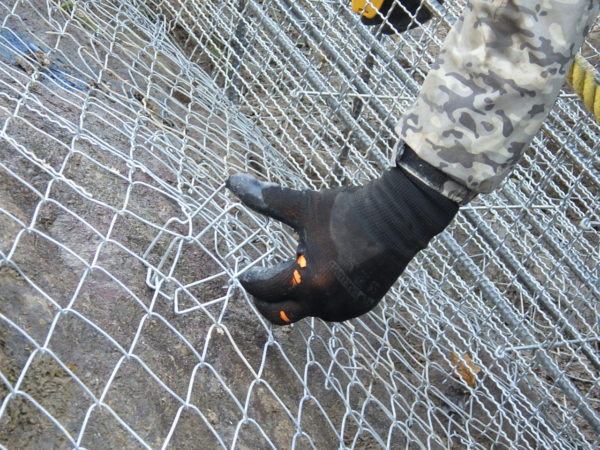
Put in as many spacers as you can!
This is the easiest way.
In the past, we used to install about 19 units per 100 square meters.
(The combined number of large pins and small pins)
Actually, putting this much in is pretty a lot, lol.
However, it does serve as a pretty good guide.
After all, if you hide the spacer, you can maintain the thickness.
If the material is thinner, material costs go down and the number of construction days is reduced, so in a sense you could call it a win-win situation, but that constitutes substandard construction.
This is one type of construction work you absolutely must not carry out.
My stance is that I’d rather run a deficit than cut corners on construction!
Well, before it gets to that point, we’ll have a meeting with the general contractor and the local government to discuss it, like, “This part’s going to turn out like this, so we can’t do the work—what should we do?” lol
Furthermore, especially at job sites with steep terrain, installing spacers on the pointed sections ensures that the required thickness is maintained.
The inspector also taps areas that appear to be thin with a hammer.
I’ll hit the really sharp parts, lol.
I think you should take a photo showing that, even with measures like that, you’ve used your ingenuity to add this many spacers, so you’re confident about the thickness.
It also serves as proof of thickness.
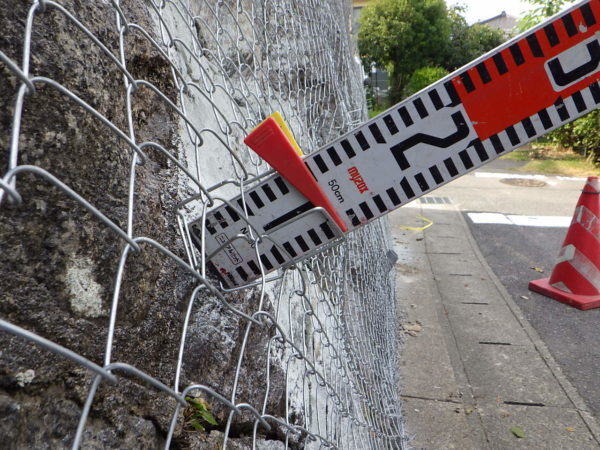
Construction management that prevents fraudulent work and ensures there are no construction defects is becoming increasingly important.
And sometimes, there are just things I absolutely can't do!
In situations like that, let’s stop work on-site if necessary and discuss it!
Accurately assessing the situation on-site and holding discussions will help prevent fraud and substandard work, so let’s make sure to manage things thoroughly!
See you later.