Hello, everyone.
This is Enta.
When installing rebar, are you sure the rebar lengths are correct?
You might be thinking, "Huh?"—but what I'm asking is, how do you handle the length during the design phase?
This is aimed at design consultants, but,
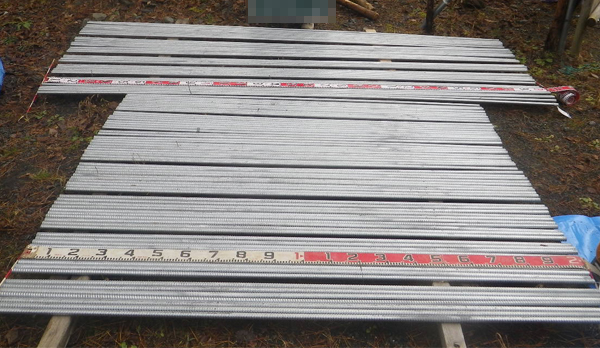
For example, if the rebar is specified as 5 meters long during the design phase,
Since 5 meters is too long, you might think about cutting it into 2-meter and 3-meter pieces and connecting them, right?
Actually, this is a huge hassle and a real pain to deal with on-site, lol.
And there is a risk that quality could decline.
The reason it's time-consuming is that, first, before inserting the rebar, you have to connect the 2-meter and 3-meter sections using couplers.
Next, connect the injection hose.
It's the hassle of connecting this coupler.
It's convenient because you can use it as is without this.
From the government's perspective, it should obviously be better not to have a coupler, since that would lower the cost.
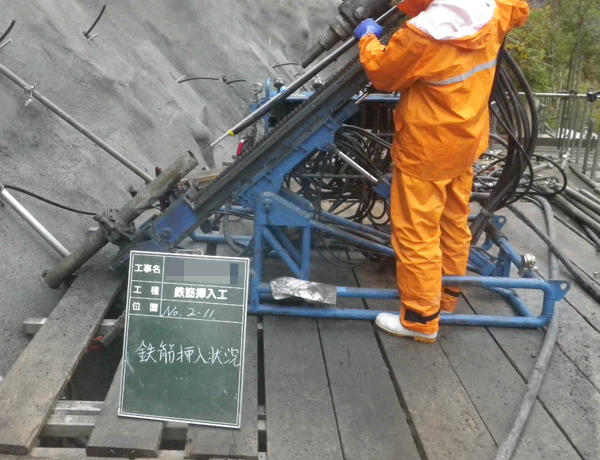
No matter how long the rebar is, if it’s at the level typically handled by a rebar inserter, one person can hold it, and even with machinery, it’s possible to insert the rebar.
If there is a structure behind the construction site that makes it physically impossible to insert rebar, then it would be better to cut it, but,
It's best to use a single piece whenever possible.
As for quality, the coupler tends to come off easily.
After drilling the holes, we insert the rebar, but the rebar couplers tend to come loose even with slight vibrations.
I imagine some contractors secure them with tape or something similar to keep them from coming loose. (Supervisors and contractors are generally aware of this.)
If you pour the mixture while it’s still runny and let it harden, it obviously won’t work, right?
In some cases, it might come loose, so you need to be very careful during installation.
The advantage of a single-piece design lies not only in its ease of installation but also in the fact that it allows for inspection.
That's what's commonly known as non-destructive testing, isn't it?
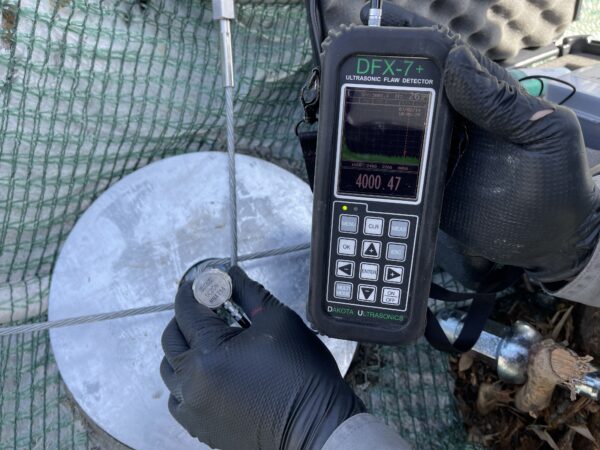
If it's split into two pieces, non-destructive testing isn't possible. The ultrasonic wave stops at the point where it's broken.
If it's a single piece, it can be cut to the specified length.
It may seem like a small thing, but I believe that when it comes to construction methods, materials, and workmanship, simplicity is best.
Therefore, I believe any unnecessary materials should be removed during the rebar installation process.
For example, sheaths and tip caps.
If anything, I don't even think I need a head cap lol
You don't need a sheath pipe for rebar insertion!
Survey of Reinforcing Bar Installers
Design consultants created drawings that clearly distinguished between what was necessary and what was not, without relying on outdated blueprints.
It would be great if you could make it, lol.
See you later.