



Hello, everyone.
This is Enta.
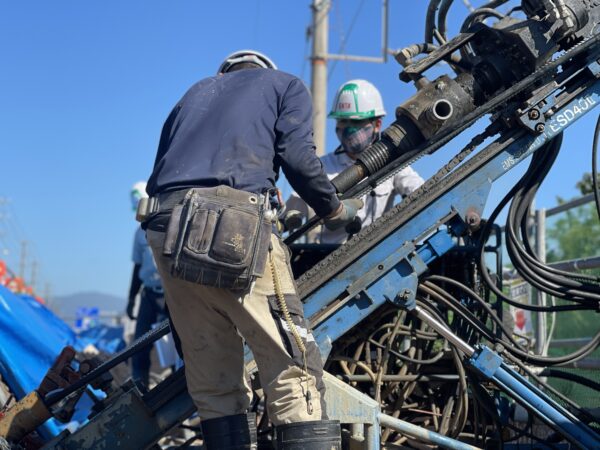
I often get asked this as a rebar installer: “How long should the rebar be?”
When drilling double-pipe holes, the machine's hammer can sometimes get in the way and make it difficult to insert the drill bit, but it usually goes in.
It can easily handle rebar lengths of up to about 5 meters. It can even accommodate 7-meter lengths with ease.
It’s never failed to fit. (Although it does scrape against the hammer side of the machine a little.)
The main problem with something that's too long is its weight.
For a 7-meter length with a D25 diameter, that would be 3.98 kg/m × 7 m = 27.9 kg
It's pretty heavy, isn't it? lol
However, if you cut a 5-meter rebar into two pieces—3 meters and 2 meters—it actually ends up being more work and a hassle.
You use a connector when making a connection, right?
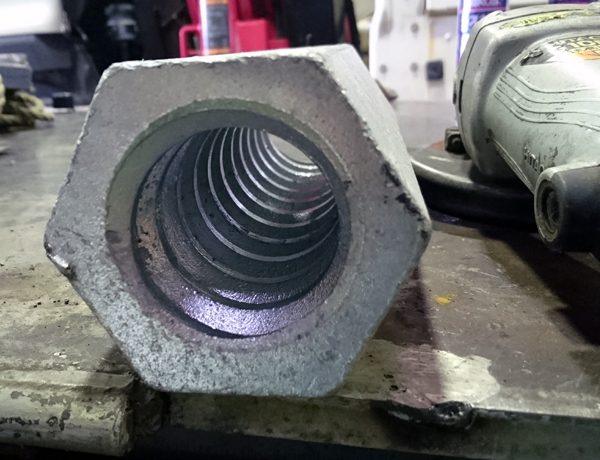
The photo above shows the D51's coupler lol
Since I didn't have a small coupler...
Well, you use fittings like these to connect the rebar.
But! Here's the problem: the threads on this coupler are extremely coarse!!
There are two types of screws: fine-threaded and standard-threaded. Fine-threaded screws are harder to remove once they're tightened.
Even with a standard thread, the design ensures that it won't come loose easily if tightened properly.
But the threaded rebar used by rebar installers is super coarse, lol.
For example, let's say you tightened it as hard as you could with a pipe wrench.
If you tap it a few times with a set hammer, it comes off easily lol
That's how easily it comes off.
Sometimes, when rebar is inserted into an outer casing and the casing is then removed, the rebar comes loose due to vibration.
To prevent such silly mistakes from happening, it’s better to install it using a single piece of pipe rather than a coupler, as this helps prevent installation errors.
Even if it doesn't come loose, this ensures greater strength than if it were slightly loose.
When installing rebar, we recommend using single-piece rebar whenever possible!
See you later.



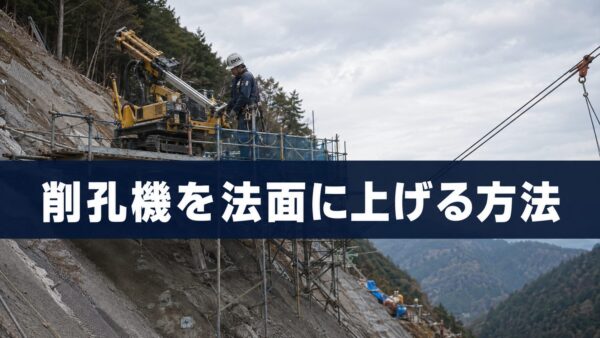
Your practical on-site know-how is always easy to understand and very helpful. This is a bit off-topic from today’s main theme, but regarding the worker operating the drilling machine up close—is a safety harness really necessary? Some general contractors might insist, “You’re on scaffolding, so you must wear a safety harness,” but there’s a risk of getting caught in the machine, isn’t there? On an anchor installation site, isn’t it possible to get approval so that the operator and the assistant don’t have to use safety harnesses, and to confirm this during the walk-through of the work procedures? Of course, we’ll still have them ready in case they’re needed for other tasks. I’m not sure what the current situation is in this era of full-body harnesses. I apologize for sounding presumptuous and coming across as know-it-all.
Thank you as always.
I thought it was a good topic, so I wrote an article about it.
Is a safety harness required for the worker operating the drilling machine?
We look forward to your continued support.