Hello, everyone.
This is Enta.
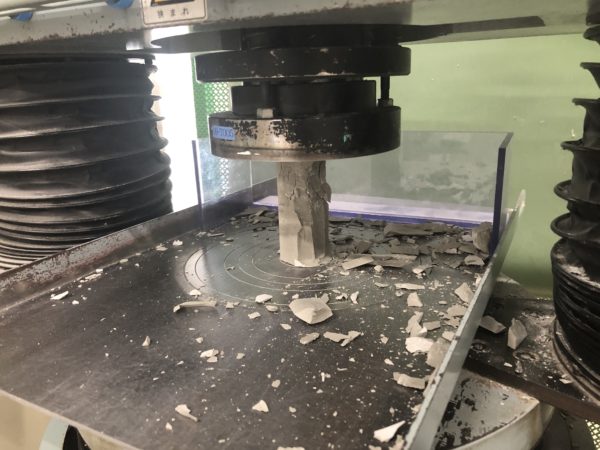
For public works contractors, conducting compressive strength tests on concrete is standard practice.
Furthermore, in our case as public works contractors, government officials are generally present when private JIS factory tests are conducted.
Well, depending on the situation, this step may be omitted if a site representative or a quality control officer is present, but,
In the case of private construction projects, compressive strength tests are often not performed at all!
I think it’s actually quite common not to conduct the test at all, but we’ve recently been using the Moldam method for private-sector construction projects.
Although this is a private-sector project, I’d like to know how strong the products we manufactured ourselves actually are, and,
On the contrary, I want our customers to really understand this! With that in mind,We always conduct strength tests.
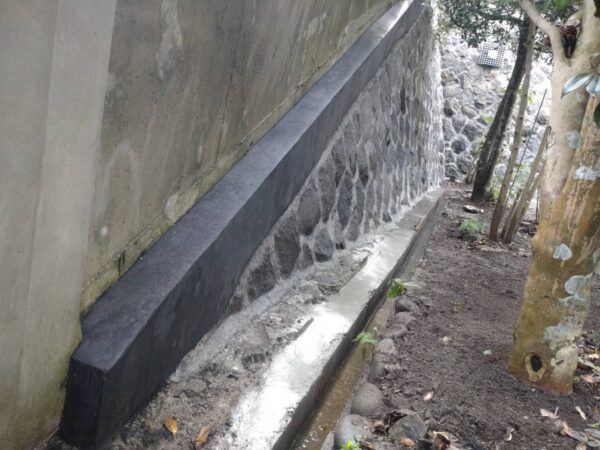
As part of the stone wall reinforcement work we performed previously, we also reinforced and repaired the upper concrete, which had deteriorated.
But I didn't take any test specimens at that time.
I had completely forgotten about it...
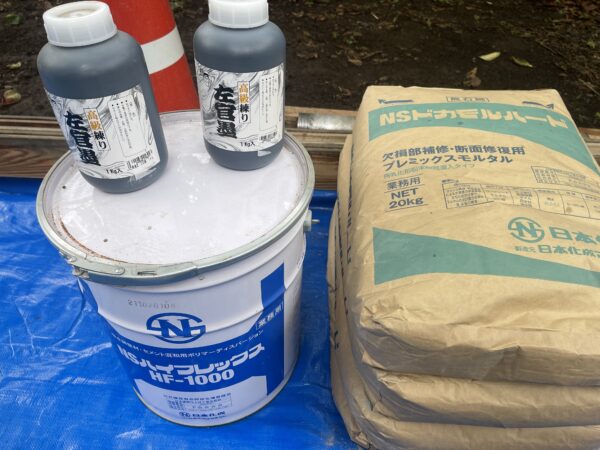
This time, we used a product called NS Dokamoru Hard and had the work done using plastering chalk lines.
It's a material that isn't very well known in our civil engineering industry, but,
It's a reputable manufacturer, and the specifications are clearly listed in the catalog. (But you shouldn't rely solely on the catalog.)
They thoroughly removed all moss and debris from the surface using a high-pressure washer and did a great job with the installation!
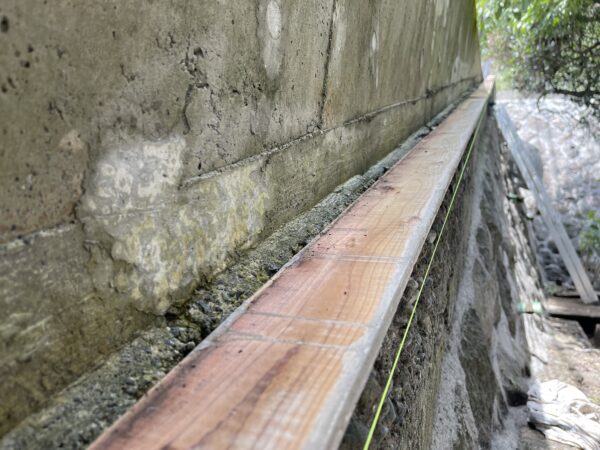
It had been neutralized quite a bit and was falling apart, but I pulled the threads tight to make it passable.
Of course, I've also applied glue to ensure good adhesion.
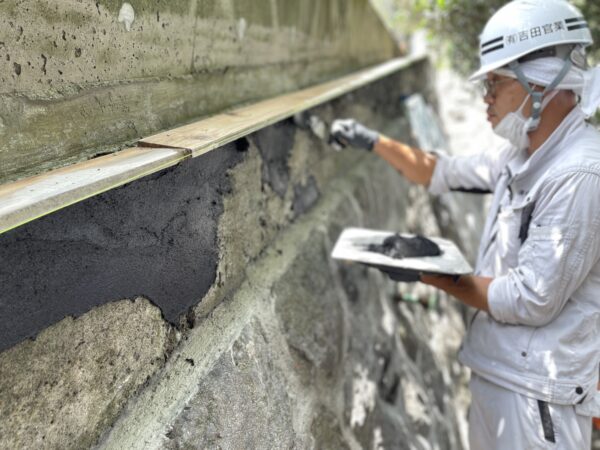
I think they did a good job with the construction.
However, as the construction manager, I had forgotten to conduct the strength test.
This part is strictly for reinforcement and repair!
Normally, concrete that has been neutralized would be replaced, but we can’t just replace parts of it here.
Therefore, we applied a topcoat approximately 10 mm thick to reinforce and repair the surface.
You’re probably wondering how strong the reinforcement and repairs are, right?
I think it’s fine as long as it’s stronger than the original concrete, but once it’s been poured, it can’t be measured.
Well, I think you could get some out by hitting it with a Schmidt hammer, but since that would only affect the surface, there’s a chance it might crack... (It’ll definitely crack, lol.)
I regret not taking a test specimen for the strength test.
Don't just trust the catalog! (For the second time, lol)
My philosophy is that whether it’s a private construction project or a public works project, we should use the same construction methods and deliver the same quality!
We approach every project—even private construction jobs—with the mindset that we absolutely won’t cut corners, so,
You really need the strength to prove it, don't you?
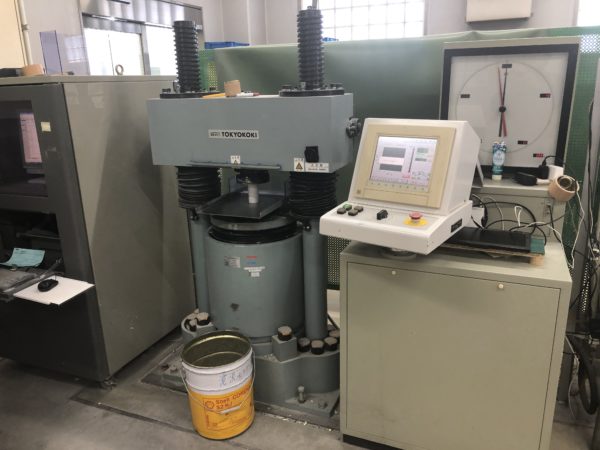
Furthermore, I believe that this strength testing must be conducted at a public testing facility.
Even in the public sector, as mentioned above, there are cases where the test is administered at a private testing center under the condition that an observer is present.
However, for private construction projects, we highly recommend using public testing facilities whenever possible! (Because they offer high reliability and credibility.)
Especially things like uniaxial tests on soil and stuff, lol.
Personally, I think the residential foundation construction exam is full of lies, lol (just my personal opinion and experience).
Like I said before, the results of the foundation inspection at my house are just one lie after another—it’s hilarious lol.
Compressive strength tests on residential foundations should probably be conducted at a public testing facility.
Furthermore, it’s best to have the client present and call in the testing lab on the day of pouring. (Be sure to film everything and check the ready-mix concrete supplier’s delivery slip.)
Going forward, we plan to implement quality control measures that ensure thorough strength verification even for private-sector construction projects.
This time, we haven't been able to verify the strength of Dokamor Hard, but we have verified the strength of all the other items.
Since the water-to-cement ratio is quite low, I think it’s probably quite strong, but simply “thinking” that doesn’t make me an engineer.
See you later.