Hello, everyone.
This is Enta.
This covers the basics of rebar protrusion when inserting rebar after spray-applied mortar work has been completed.
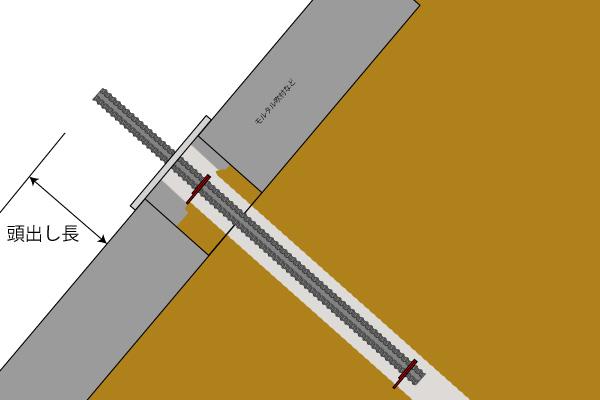
Generally, the protrusion length for rebar inserts is 100 mm.
When applying sprayed mortar, the most challenging surfaces are slopes with significant undulations.
If there are uneven surfaces, corner washers can handle it to some extent, but it gets tricky when a pressure plate is installed.
For example, when load-bearing panels such as green panels are installed, undulations within a radius of about 1 meter become a factor.
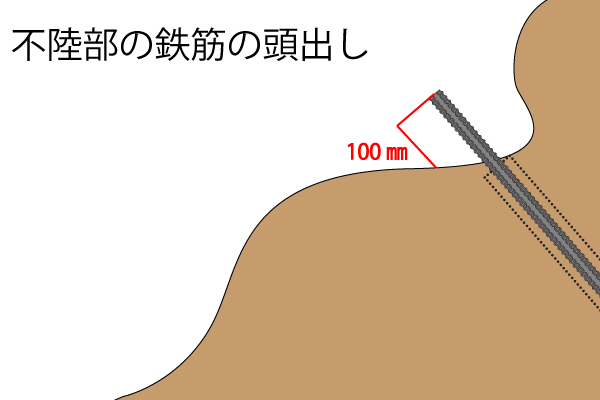
We’ve managed to find some square washers, but the pressure plate is going to be a challenge, isn’t it?
For that reason, it becomes necessary to make more adjustments based on the undulations.
If too much material comes out at that point, people tend to assume that the drilled hole is substandard, but in reality, that’s not always the case.
If there are only a few spots, I think the local government will understand if you explain the situation to them, and worst-case scenario, you can just fill those areas with mortar and level them out. (The raised areas will be considered part of the natural ground.)
Also, while there are design-related reasons why this is acceptable, we generally round off the decimal places to the nearest 500 mm.
For example, if the design calculation yields a length of 3.15 meters, the length of the rebar at that point will be 3.5 meters (including the protrusion).
I think 3.67 meters would be 4.0 meters.
Please check the design specifications for this part. There should be a little leeway.
This is because some consultants may use different rounding methods.
If you’re aware of this margin of flexibility, it’ll be easier to explain things to the authorities if something comes up, and they’ll be more likely to understand.
In particular, if you can assess the undulations and condition of the slope during spraying and use the sprayed concrete to some extent to reduce the labor required for rebar installation, it will make the subsequent processes easier.
For a company like ours, where the same crew handles the entire project from start to finish, we can usually work things out, but on sites where the contractors for shotcrete and rock bolts are different, the site supervisor will need to coordinate between them.
Being a manager is tough, but it’s best to keep that aspect under control.
See you later.