Hello, everyone.
This is Enta.
We reinforced the company's door.
The door won't open unless you cut it with lightning or oxygen. lol
I doubt a thief would go that far, though...
But that's beside the point.
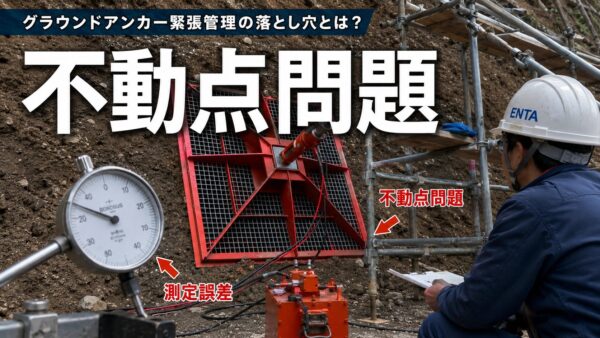
When installing ground anchors, should we use a bearing plate or a retaining frame?
As long as it's within legal limits, I don't think you need to worry about the load-bearing parts, but when it comes to load-bearing plates, it does give you pause, doesn't it?
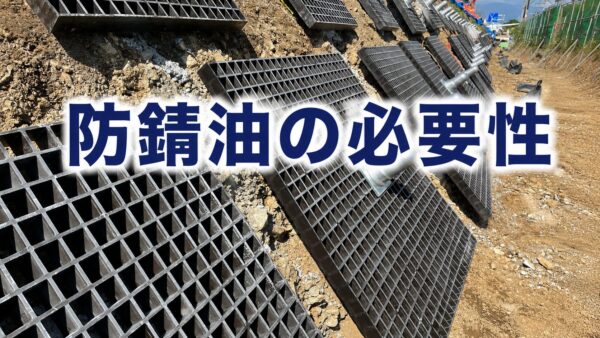
For example, if the natural ground has significant unevenness, we’ve been using zabuton frames lately.
For minor unevenness, use EPS (expanded polystyrene) or sponge-like materials.
So, assuming we've figured out the pressure-receiving plate and the back of it, what about the back of that?
If there are any voids, uneven settlement may occur, causing the structure to tilt or the load-bearing plate to shift.
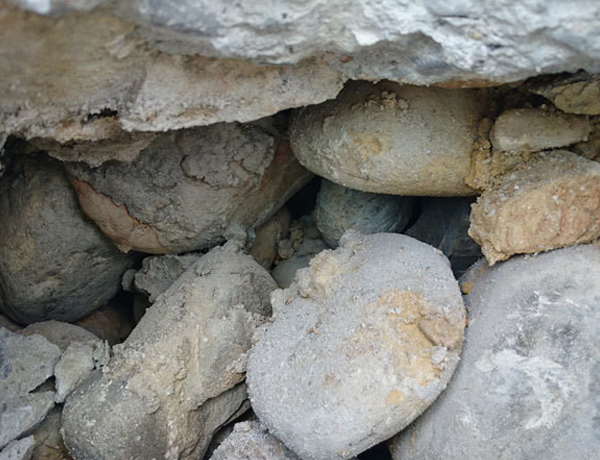 What would you do if the back of the pressure plate were this hollow?
With fairly old interlocking blocks, the bottom part is pretty well packed, but the grout at the top is wide open.
Over time, the soil and sediment at the bottom are washed away, causing the structure to gradually sink lower and lower. As a result, the upper part becomes hollow.
As a solution, filling it in would be the quickest option, but I have no idea how much it would cost lol.
Filling gaps is pretty tough work, and it costs money.
And above all,I have no idea how much will fit in there!
Even if I were to include it,There's no way to verify itThat's right.
Knock Detection? Core Drilling?
This part is pretty much a load of nonsense.
(I'll explain how to check that another time.)
It's like gambling.
Even for grouting, there are various options: CB injection? Air-entrained mortar? Cement slurry?? Suspension?
What you pack is important, but you can also keep the weight down.
For example, if the design tensile load is 200 kN and there is a slight margin in the safety factor, you could use 80% for the tensile application.
Complete the structure at 160 kN in a standby state, and address issues such as differential settlement and deformation.
However, since there is a possibility that it could be unloaded unexpectedly, this needs to be carefully considered.
It will also be necessary to consider the installation of drainage systems after backfilling and the increased weight of the structure.
Civil engineering really is incredibly deep and complex!
I guess the next topic will be soil bearing capacity...
See you later.