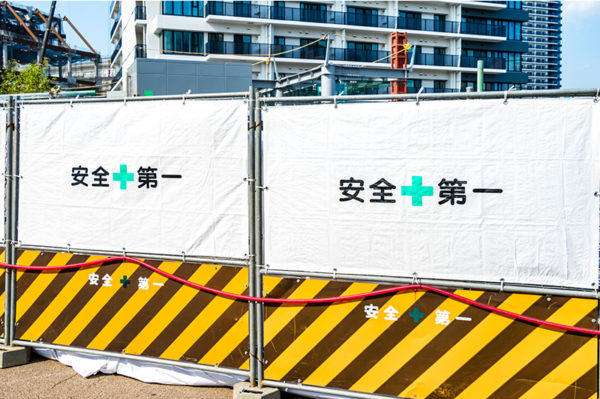
Do you really think a single piece of paper can reduce accidents?
I'm currently at the plant site. The construction and civil engineering work I'm in charge of is already nearly complete.
Although it is the super-general contractor—which operates as a subcontractor—that is actually undertaking and carrying out the on-site construction and civil engineering work, I’ve heard that there has been a recent string of accidents that just won’t stop, and the headquarters is in a state of chaos trying to deal with them.
Just as I was saying that, I heard that another plane crash had occurred.
I’ve worked for many general contractors over the years, but I’ve never seen one like the one at my current job site—they create new slogans, posters, and notices every single time an accident occurs. They then post them throughout the site office and conference rooms, practically forcing the contractors who come and go to take note of their content.
Now, all four walls of the meeting room are completely covered with newly created posters.
It seems that the staff on site have also been given strict orders from headquarters to “make sure this is followed without fail!” and are repeatedly telling the workers the same thing over and over again.
To be honest, I'm fed up.
If a single piece of paper can reduce accidents, there’s nothing easier than that.
We're tied up in a web of rigid rules!
Circumstances vary from one worksite to another. The more headquarters imposes rules devised from behind a desk—insisting on a one-size-fits-all approach with directives like “Do this, do that” or “Don’t do this, don’t do that”—the more those on the front lines feel shackled and unable to respond flexibly to changing situations.
Even so, as professionals, they should be implementing safety measures by fine-tuning the instructions they’ve been given and, when necessary, adding their own innovations. But if they’re criticized for not following instructions to the letter, the workers will end up being treated like nothing more than robots.
What’s more, inexperienced workers, in particular, don’t think for themselves; no matter what the situation on site may be, they’re simply too overwhelmed just trying to carry out the instructions they’re given. They stop thinking for themselves and end up doing only what they’re told. And this applies not only to safety but to their work in general.
The foundation of safety is taking responsibility for your own safety. No matter what others may say, if you think, “This is dangerous—I need to do something!” you should act on that thought and carry out the work in a way that you feel comfortable with.
Of course, the vast majority of these safety measures end up being a waste of effort. But that’s okay. Site supervisors must never, under any circumstances, criticize workers by saying, “Why are you going out of your way to do that?” If they do, the workers will lose their sense of initiative. They should clearly tell the workers, “It’s okay to go the extra mile!”
We should recognize on-site workers as professionals and, first and foremost, respect their autonomy and opinions. Rather than imposing our views unilaterally, we should give top priority to the suggestions made by the workers, who are most familiar with the conditions on the ground.
Detailed instructions should really be given later on. At first, you should probably limit yourself to just the basic points.
Proposals from the general contractor’s headquarters are fine, but they must be acceptable to the workers on a case-by-case basis.
It’s easy to end up giving detailed instructions right from the start, but the basic approach is to always keep the fundamental sequence in mind and provide guidance that encourages workers to think for themselves.
Costly safety measures are being put off
As I mentioned above, workers must be treated as professionals. Without this mindset, the number of accidents will never decrease.
There are accidents that happen no matter how careful you are, but even those are preceded by warning signs. If you overlook those signs, the accident is bound to happen.
However, whether the proposal comes from the safety department or from the workers themselves, upper management often scrimps on expenses, saying, “That’s overkill. We don’t need to go that far—it’ll be fine,” and frequently postpones a decision. While they pay lip service to “safety first,” when costs rise or the process is disrupted, headquarters isn’t exactly thrilled.
This is entirely a matter of the company's stance, and there's nothing we can do about it at the worksite alone. If the safety officer is a contractor, it's even more likely that our concerns won't be taken seriously.
There are all kinds of companies, but I feel that those where many executives have risen through the ranks from the field tend to place relatively high value on the voices of frontline workers, whereas in companies where that isn’t the case, profit takes precedence and the voices of the field are often ignored. There’s a strong tendency to follow the crowd, with plausible-sounding arguments like, “Other sites aren’t doing that,” “We can’t be the only site doing that,” or “We’re complying with the law—anything beyond that is overkill.”
To begin with, safety involves anticipating potential hazards at each specific worksite and taking measures to address them. As a result, while the basics may overlap, safety measures at one site are fundamentally incomparable to those at another. Even if they happen to be the same, that’s merely a coincidence. Therefore, the very idea that it’s acceptable for a site to be the same as another is flawed.
The most important factors in creating a safe workplace are ensuring that it is a place where workers actually performing the tasks can speak up when they feel “This is dangerous!”—and that their voices are clearly heard all the way up to the site manager, who then takes action in response.