Hello, everyone.
This is Enta.
It's already a poem today lol
I wrote this for newcomers and those who are about to take on a new challenge.

The first step is one you take without knowing the answer.
When people enter the construction industry, very few actually come in with clear goals, such as “I want to work on slope stabilization” or “I’m definitely going to be a paving worker.”
Many people say things like, “I’m just a dumbass, so I ended up working in construction,” “A senior colleague invited me,” “There was a job opening,” or “A senior colleague tricked me.”
For that reason, I ended up taking the first job listing I came across and joined a construction company, where I was assigned to a job site. (I ended up working in landscaping, since that’s where the job opening was.)
That's not a bad thing at all.
After all, unless you actually get behind the wheel of heavy equipment or pour some ready-mix concrete yourself, you won’t really understand anything, right?
For now, I'll start working at the site where I've been assigned.
At first, I worked as a laborer, spending my days simply digging, hauling, and compacting soil (not as a slope engineer or a supervisor, lol).
At first, I didn't understand why we were digging this deep or why this slope was necessary, so I just did as I was told.
But something will definitely come out of it.
"Ah, so the precision of this floor installation affects the next step," I think to myself, and the workflow on site starts to make sense. The big picture is gradually coming into focus.

And from there, you realize something.
"If this earthwork isn't done properly, it'll make it difficult to install the next well-frame block."
"If the positioning accuracy of the pile work or the driving process is poor, all the structures built on top of it will be out of alignment," or something like that.
How does my work connect to the next role, and what kind of structures does it ultimately support?
It is that realization that becomes the driving force behind the next challenge. It’s what helps us move forward.
When we achieve that—in other words,When You've Mastered a Single Trade
Isn't this when I—who was once nothing—begin to take shape for the first time?
Even if you think of yourself as “still just a craftsman” or “just a director,” the way others see you has changed.
"If it's about slopes, ask Enta," "You can count on him to mix the cement right (lol)"—people on the job site will start referring to you by name when it comes to specific technical skills.
That’s what will become your identity. (If you make that guy organize the empty cement bags, there won’t be a single one left on the right!) lol
That guy's legal moves are seriously fast!
The best part about his trowel finishing within the legal limits is that the edges are so sharp they can cut your fingers! And stuff like that...
What I Want to Tell Young Artisans
It's okay if there isn't a specific type of work you want to do. It's okay if there isn't a specific job you want to do!
If anything, I think that's normal.
The most important thing is to start by giving your all to the tasks at hand at the workplace where you’ve been assigned.
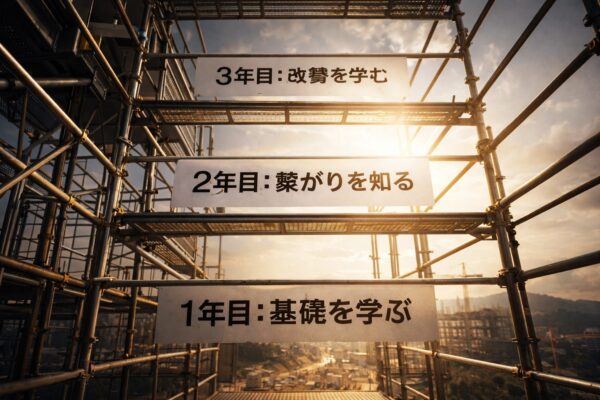
If you do it for a year,...and you begin to see the bigger picture surrounding that type of work.
What started out as simply “tying rebar” gradually becomes a task where you realize, “This rebar placement determines the strength of the structure.”
If you're a paving contractor, you'll understand the relationship between the subgrade, base course, and surface course.
You'll be able to see how your specific task relates to the tasks that come before and after it, and where it fits into the overall process.
If you do it for two years,I can see how what I'm doing is helping.
In the field of retaining pile construction, it’s the knowledge that the retaining piles you drive will continue to support this mountain and prevent it from sliding for decades to come.
For a slope engineer, it means that the slope protection structures they’ve built will protect people’s lives from landslides.
For earthwork professionals, the ground they compact serves as the foundation for all structures.
Little by little, I begin to see the "users" who are on the other side of the worksite.
If you do it for three years,You'll start to figure out how to make it more useful, how to do it faster, and how to improve the quality.
At this point, you're not just an apprentice anymore, are you?
"For a slope like this, there's a more efficient way to apply the spray."
"The quality of this pavement could be improved by adjusting the timing of the compaction."
And so, areas for improvement become apparent.
By now, you should have become a supervisor or craftsman who doesn't just wait for instructions from your seniors, but takes the initiative to make suggestions.

If you don't go out to the field, you won't understand anything (you have to try it yourself).
In the construction industry in particular, there are so many things you just won’t know until you try them. (This is true for every industry, all over the world!)
You can't learn how to operate heavy machinery just by looking at blueprints.
You can't determine the consistency of ready-mix concrete just by reading a textbook.
There are some things you can only understand by actually getting your hands dirty and working up a sweat.
I’ll write about it on my blog, and I hope that by reading it, people in the field will come to understand.
And yet, “The working conditions at this site are terrible,” “This company pays too little,” “That foreman is a lousy teacher.”
There are craftsmen who say this, yet make no effort on their own to hone their skills.
That’s such a waste. (Blaming others won’t get you anywhere, and you won’t learn anything!)
It’s only when you get out into the field and take on a challenge that you really understand something.
"Civil engineering is the right fit for me."
"I'm not good at working at heights."
"I enjoy the finishing touches on paving."
"I'm good at ensuring the accuracy of formwork."
You can only make that decision once you’ve actually held a trowel, operated a backhoe, and laid out the lines!

How can you not do something you can only understand by actually doing it?!
The more you challenge yourself, the more your potential for growth expands infinitely!
Is a life as a craftsman—one spent simply waiting for someone else to make the arrangements—really interesting?
Is there any real sense of fulfillment in a daily routine where you just go through the motions of doing only the tasks you’re told to do?
That's not right, is it?
What makes the life of a craftsman or director truly interesting is the process of thinking for oneself, coming up with creative solutions, and honing one’s skills.
Whether it’s a general contractor’s supervisor, a subcontractor’s worker, or an independent contractor, the essence remains the same.
No matter what your position is, there are always constraints.
Instructions from the general contractor, the construction schedule, the budget, and safety standards—these are the guidelines that must be followed.
But within that framework, how can we produce high-quality work, improve efficiency, and develop our people?
That is precisely the process that will transform you from “just a worker” into a “professional in [field].”
Everyone starts out as a beginner!
Even the director, who acts so high and mighty, was a complete novice at first. And now he’s a senior who’s got his own unique worldview… lol
The moment when I, who am nobody, become somebody
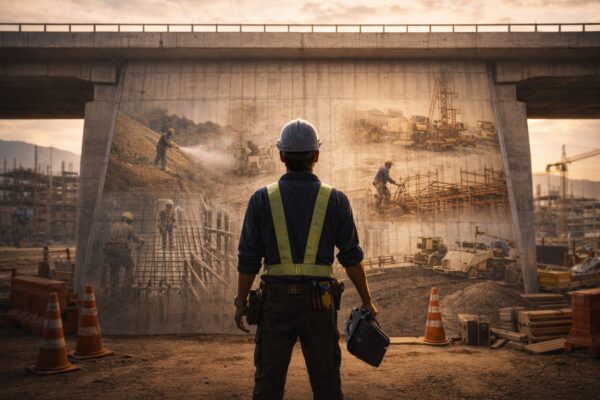
When selecting craftsmen, the supervisor tends to think in terms of “So-and-so for slope work” or “That guy for paving,” and so on,
The praise he has received from other craftsmen and what he has seen with his own eyes are etched into him like layout lines.
Ultimately, you can’t decide for yourself “what kind of craftsman you are” or “what kind of director you are.”
Your reputation will be shaped by the work you do and the attitude you display in your interactions with other craftsmen and site supervisors.
I’ve said this many times, but this has nothing to do with the industry! It’s something common to every job around the world.
A rookie who started out as a complete unknown spends three, five, or ten years working in a single trade, and before they know it,
"If it's anything to do with slopes, leave it to him."
"〇〇 produces the best-looking finish for pavement."
"When it comes to pile-driving accuracy, △△ is the best."
It has become a presence that is recognized on-site.
It’s not about the number of certifications, nor is it about the size of the company,
The irreplaceable identity and track record you have built as a supervisor and craftsman—one that is the result of every single task you have carried out on-site.
It’s said that a craftsman who started out as a laborer eventually came to be known as the “master of retaining piles,” or something like that,
A young man who started out as a general laborer could, ten years later, become a foreman who is relied upon as “the backbone of this site.”
You have become "someone" that you could never have imagined back when you were an apprentice.
So, even if you don't have a specific trade or job in mind right now, there's no need to panic.
At the job site where you've been assigned, all you have to do is dig the soil right in front of you, pour concrete, and tie rebar.
All you have to do is do the work you're given!
Beyond that, you’re sure to discover your true self as a “professional in [field].”

It's not about "What do I want to do?", but rather,Let's just give it a try!
Just do what you're told without making a fuss.
You are the one who shapes your own life.
That's exactly why it's a good idea to start by following someone else and explore from there.
You could try looking for it yourself.
The important thing is to keep at it until you fully understand it.
Don't quit without understanding what's going on.
People around you will try to confuse you with all sorts of things.
With sweet words.
Please don't let that get you down.
Even if I fail, I'll just try again.
Let's get into the habit of taking on challenges with a lighthearted attitude, thinking, "It's okay to fail!"
Let's keep challenging ourselves until you, who are nobody right now, become someone!
See you later.