

Hello, everyone.
This is Enta.
Golden Week is over, and we're back to our regular business hours.
It really is easier and better to be working, isn't it?
This is a continuation of my previous post.
The other day,Turning Theoretical Concepts into DrawingsI did.
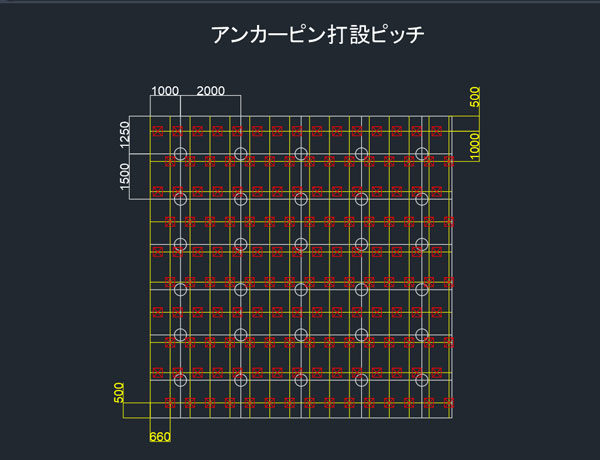
This is it.
The white circle indicates the main anchor pin (φ16 × 400).
The horizontal spacing is 2 meters, and the vertical spacing is 1.5 meters.
The red square indicates the auxiliary anchor pin (φ9 × 200).
The horizontal spacing is 0.66 meters, and the vertical spacing is 1.0 meters.
This is just how it looks since I assigned the parts based solely on the drawings.
As for the main anchor pins, it would be safest to install them at 1.8-meter intervals along the sides, at the overlaps of the laths.
When you put it like that, it seems like I have more time on my hands than you'd expect, doesn't it?
Actually, when it comes to the last pin, I’ve been hitting it way too much, lol.
In terms of design, people tend to assume the final factor is 1.4, but it’s actually fine to leave it at 1.0.
That's because the Las wire mesh has a 10-centimeter overlap, which results in some waste.
However, in the case of a perfectly flat slope, there will be no loss if the concrete is poured exactly as shown in the drawings. (Theoretical)
Therefore, for the anchor pins, it is sufficient to use material equal to the designed area.
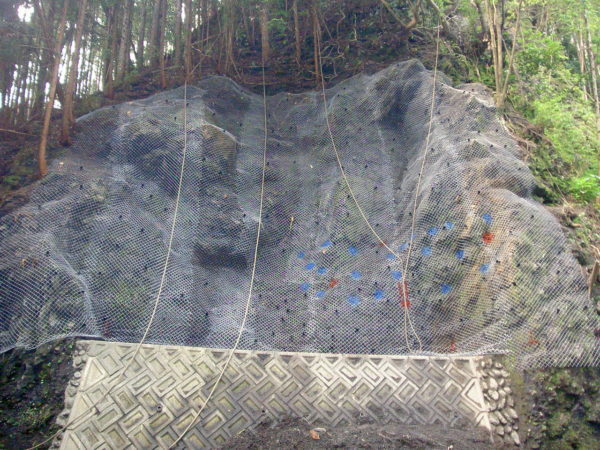
But there's practically no mountain like that, lol.
There’s probably about a 20 percent loss, and the director has factored that into the order when ordering materials.
It's better than having a shortage that brings the site to a standstill, after all.
By the way, the photo above showing the completed roof sheathing was taken at a site I managed as a representative about 15 years ago. (It was a site affected by a minor disaster.)
I think it's best to have just a little extra material. (Having an absurd amount left over is a sign of the director's inexperience.)
If you have a general idea of the pitch, you can tell—even if it's just a rough estimate—that he's hitting the ball solidly, right?
It makes it easier for the supervisor to manage the project if they’re aware of these details, and it also makes it easier for the workers to understand.
See you later.
Concrete Placement Intervals for Formwork Installers (Part 1)