Hello, everyone.
This is Enta.
It's time for the labor cost survey.

This is such a hassle, too. The office staff, lol.
I grumble about this every year. The office staff, lol
Plus, since I get accepted to several places at once, I end up turning down a bunch of them to go to just one—but honestly, it’s a hassle.
I’m thinking, why don’t we use Construction CALS and ICT to do this online?
Some kind of vested interest... ?
But that's beside the point.
It's only been about a week since the blog was migrated.
Actually, the site itself isn't finished yet; I just went ahead and launched it in a state where it can at least be operated for now.
I think it'll gradually stick to the side, but here's what I attached the other day.
Did you notice? lol
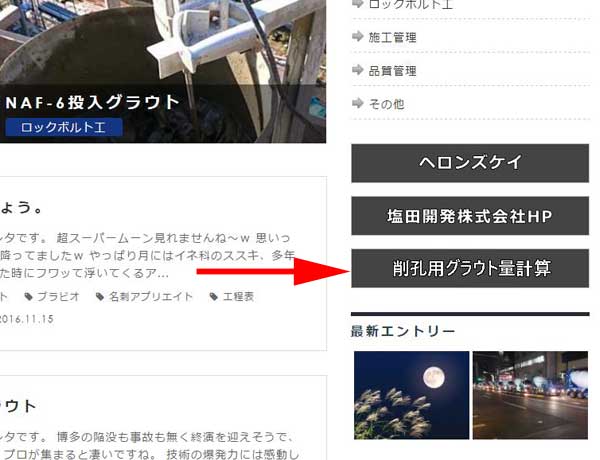
I'd like to explain this in this post.
This is what the site looks like when you open it.
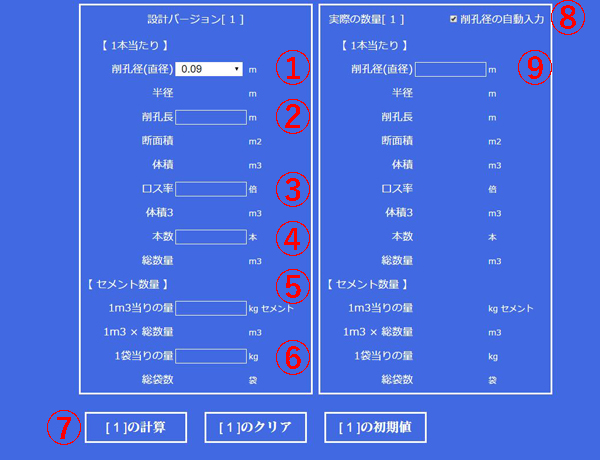
I'll go through them in order, starting with ①.
① Select the nominal drilling diameter.
For example, a borehole diameter of 90 mm is equivalent to 0.09 m.
The unit is meters.
② Enter the drilling depth.
If the drilling length per hole is 4.0 m, then it is 4.0 m.
That's exactly right.
Please note that for formwork, the designed drilling depth is calculated after subtracting the width of the formwork.
③ The loss rate.
It varies depending on the mountain, but I think using the same loss rate as in the design should be fine.
For example, 3.2.
④ Number of piles driven.
If the design calls for 100, then it's 100, lol.
⑤ The amount of cement per cubic meter.
As usual, 1,230 kg is fine.
If you want to increase or decrease the amount of cement, please enter the amount here.
⑥ The amount of cement per bag.
A standard bag of cement weighs 25 kg.
Is that 900 kg for a flexible container bag?
⑦ Press this to calculate.
⑧ Automatically enters the actual diameter of the borehole specified in step ①.
If you uncheck this box, you will not enter the actual drilling diameter.
⑨ If the value is not automatically entered in ⑧, please enter it here in meters.
That's all.
What this means is that the design quantity differs from the actual order quantity.
The design dimensions are based on the nominal diameter, but since the actual diameter is larger, there is a difference.
Wouldn't it be a problem if we included that in the design during the budgeting process?
As an extreme example,
Drill hole diameter: 90 mm
Drilling depth: 2,000 m
Quantity: 1
Loss ratio: 3.2 times
There might actually be 400 pieces that are 5 meters long, but as long as I know the total, that's all I need.
That's how you can use it, as shown above.
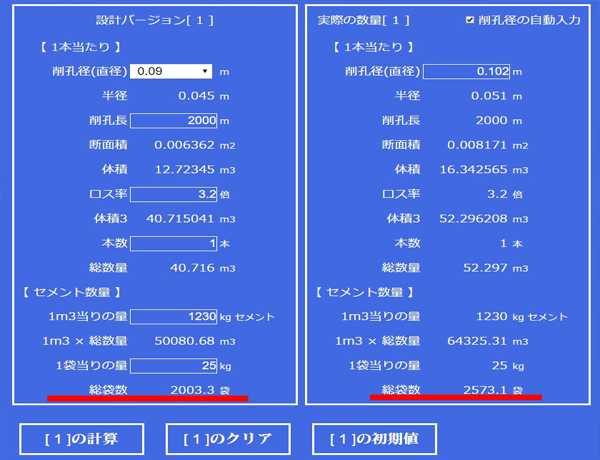
Based on the above calculation, there’s a difference of about 600 bags of cement between the design quantity and the actual quantity.
I just made this to get a quick grasp of this area lol
By the way, the same goes for the bottom section—you can perform all three types of calculations at once, and
I've set it up so that the total appears at the very bottom.
Well, that's it for now.
*Please use this only if you understand it and are willing to assume full responsibility for your actions.