We have added a banner to the top of the site.
We hope you'll join us.
Participants: Currently 15
Hello, everyone.
This is Enta.
March—the last month of the 2022 fiscal year!
Let's do our best to avoid any accidents!
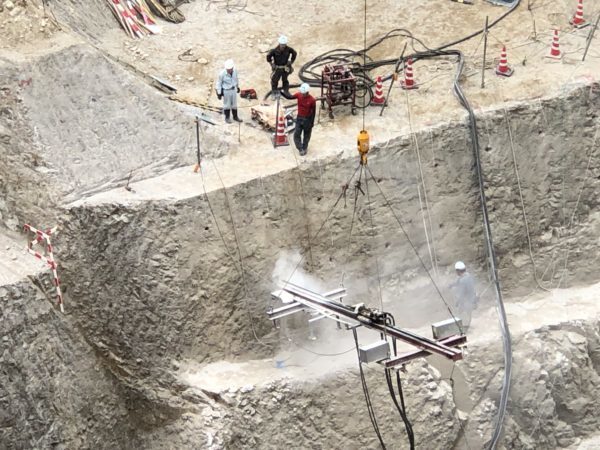
We're currently working on a site where the clay is too hard for the suspended drilling rig to drill through.
On top of that, the hole wall won't stand on its own...
Under normal circumstances, it would probably be better to use a double-pipe system.
However, since it’s impossible to make design changes at that point, we often find out what we need to know by simply drilling a hole.
There are mountains that look like they’d be stable, but when you actually drill into them, they turn out to be unstable, or mountains where the clay is so dense that air can’t escape.
It varies.
Even if you ask, “Why can’t you dig it up?!”—you just can’t dig up something that can’t be dug up.
Since we base our design calculations on the N-value, we should be able to excavate it.
It can't be helped.
So, what can we do? We have no choice but to use water.
We drill the hole while blasting away the clay with water pressure.
A water swivel is typically attached to the end of the drilling rod.
However, few vendors carry it, so you can't get it right away in an emergency. (And it's super expensive right now.)
In such cases, attach a high-pressure washer or similar device to the air stream coming out of the drill bit during drilling to use water.
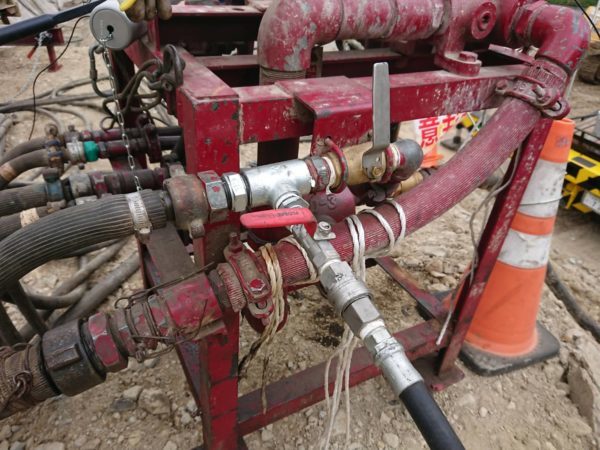
This air line exits directly from the bit tip without passing through the Euler (oil tank).
I can already hear people saying, “But the inside will rust, right?!”—but honestly, I don’t think it’ll have that much of an effect. (Just my personal opinion.)
The reason is—as anyone familiar with the machine’s design will know—there’s a single air pipe running right through the very center of the machine.
Since the air flows through there, it doesn't affect the other gears.
So I think it should be fine if it's just a few days' worth of water. (At your own risk, lol)
As long as you make sure to oil it thoroughly at the beginning and end of each day, you should be just fine.
At the end of the job, it's enough to blow a small amount of oil into the rod using compressed air.
Rather than just saying, “I can’t do it,” I’d like to get the job done on-site by using my ingenuity.
However, there are some things you just can't do, so when that happens, just let it go and move on to the next method!
See you later.