Hello, everyone.
This is Enta.
We had an accident at our worksite the other day.
It was just a minor incident, but since accidents keep happening, we need to be careful!
I'd like to stay focused from here on out.
But that's beside the point.
This time, we’ll be looking at the question: “Is the technical expertise of major general contractors on the decline?” It all started with a recent news story.
The Yaesu Steel Frame Collapse Accident and Strength Calculations for Shoring Structures
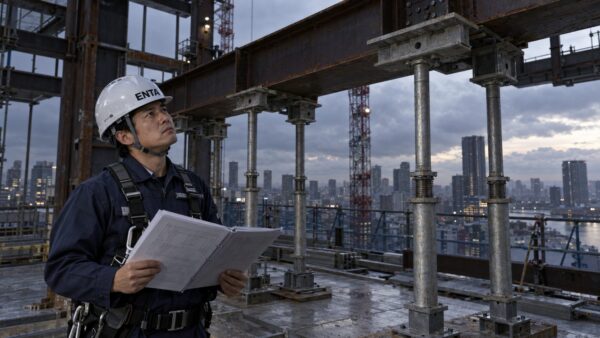
In September 2023, a steel beam intended for the 7th floor fell at a construction site in Yaesu. Five workers were injured or killed; two died, and three sustained serious injuries.
According to a report by the Yomiuri Shimbun (published September 18, 2026), the Tokyo Metropolitan Police Department has referred two employees of a major general contractor to prosecutors on suspicion of professional negligence resulting in death and injury, alleging they made errors in the strength calculations for the temporary supports (shoring) holding up the steel framework. One is a man in his 30s who served as the on-site foreman, and the other is his supervisor, a man in his 50s. The employee in his 30s has admitted to the charges, while the employee in his 50s has partially denied them, stating, “I could not have noticed the error in the strength calculations based on my subordinate’s words and actions.”
To be honest, when I saw this news, I suspected that the subcontractor might have done the calculations.
I think that's standard practice at construction sites run by general contractors these days.
The headline of the Sankei Shimbun’s follow-up report read: “Site Supervisor Performed Strength Calculations Himself to Prioritize the Construction Schedule; Failed to Verify External Claims That the Calculations Were ‘Inadequate.’”
It was the general contractor's site supervisor himself who did the calculations, and apparently, he was told from outside the company that there wasn't enough.
Even if it turns out the subcontractor made a mistake, it's a scary situation for both sides...
The supervisor made a mistake in his own calculations, his boss didn't notice, and even after someone from outside pointed it out, the construction work didn't stop.
If the news reports are accurate, that means not a single person at the scene felt that the figures in the calculation sheet indicated a danger.
Criminal liability will be determined by the upcoming investigation and trial.
What I’ve written here are my thoughts based on what I’ve read in the news.
Even though some people might say, “What about the craftsmen…?”...
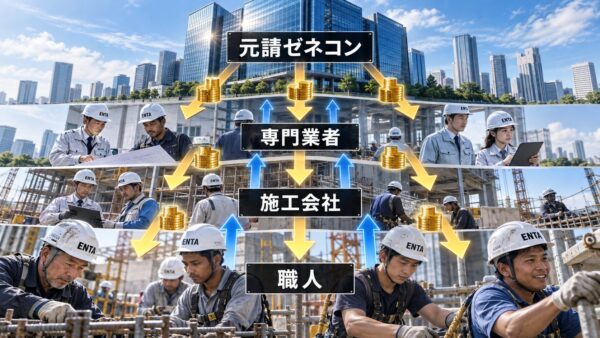
The Transformation of General Contractors into Trading Companies and Multi-Tiered Subcontracting
It is often said that general contractors these days are becoming more like trading companies.
We select and secure large projects, then break them down by trade and assign them to specialized contractors. We focus on managing the schedule, safety, and costs.
We split up large sums and sell them on to others, and the difference is our profit—so what we're doing is exactly what a trading company does, lol.
I used to refer to major general contractors as "banks."
It's because people see them as taking in large sums of money, passing it down the chain, and making a living off the profit margin.
It doesn't really matter whether it's a trading company or a bank—we're just hanging on for the ride, lol.
When a slope-construction company like ours works on a project for a major client, the hierarchy is usually: general contractor, major specialized contractor, and then us.
Since we're in the same line of business as the specialist in the middle, we can communicate easily.
What’s really tough is meeting with the general contractor. We just can’t seem to see eye to eye very often.
Is it that we lack the technical skills (or experience), or is it simply that we haven't discussed it enough? It's probably both.
Even so, I notice at every meeting that there are fewer people on the general contractor’s side who have actually done the construction work themselves.
I don't think the division of labor can be stopped, nor do I think it needs to be.
The problem is that general contractors' supervisors no longer handle the actual materials.
Only people who have actually handled the physical items can tell when the numbers in a calculation sheet are off.
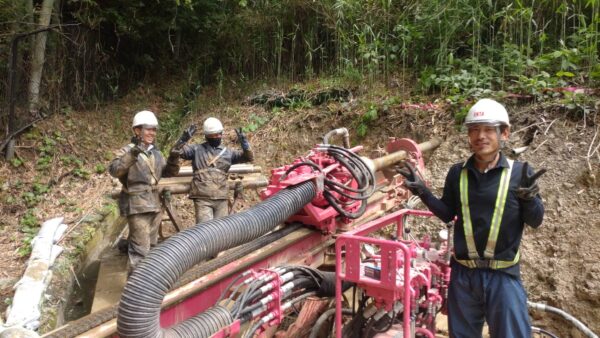
Subcontracted Construction Sites and Trainees and Skilled Workers with "Specific Skills" Status
When I was young, the director worked as just another craftsman.
When I’d go around the job sites helping the craftsmen, the foreman would treat me to meals or buy me a drink.
It would be out of bounds these days, but that's just how things were back then lol
On the other hand, since I handled all the construction management myself, it was definitely a lot of work.
At one point, we were told to leave the construction work to the craftsmen, but since I didn’t mind working on-site, I just kept doing it anyway.
I still rely on what I learned through physical experience back then.
Drawings don’t tell you about things like whether the anchor hole is hard or soft to drill, whether it’s easy or difficult to drill, whether there’s a lot of spray rebound, or whether the material is hard or soft—those kinds of nuances aren’t apparent from the drawings.
Young employees at major general contractors today likely have almost no opportunity to gain this kind of experience.
So where does the craftsmanship remain? With the subcontractors and the young artisans who work there.
Among them are many foreign workers, including technical interns and those with "Specific Skilled Worker" status.
There are still organizations and people who say that the Technical Intern Training Program is a form of slavery, aren't there?
My impression, having worked alongside them on the job, is different.
They have solid technical skills, and our worksite simply couldn’t run without our technical interns and Specific Skilled Workers.
I think this is getting pretty close to the original intent of the program—to learn a skill and bring it back to your home country—lol.
That’s because, whether it’s a major general contractor or a small or medium-sized business like ours, we can’t do our work without them.
If anything, we already have Nepalese and Vietnamese people working as foremen here, lol.
We are successfully passing on our technical expertise.
By the way, according to a report from the Immigration Services Agency, the Technical Intern Training Program is set to be replaced by the Skills Development and Employment Program starting April 1, 2027.
Even if the name changes, it doesn't change who actually has the technical expertise on the job.
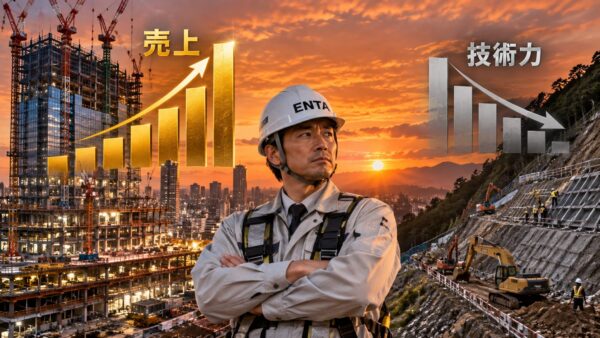
Technical Capabilities and Revenue of General Contractors and Subcontractors
If I were to describe the current state of the construction industry in a single sentence, it would be this:
General contractors see their technical capabilities decline while their revenue increases.
Subcontractors maintain their technical capabilities while their sales decline.
Those who possess the technology don't make money, while those who lose it do.
If this keeps up, the technical capabilities of general contractors will just keep declining, won't they?
And small and medium-sized enterprises with technical expertise—including ours—will go out of business.
I feel like I've gotten caught up in a crazy spiral.
As seen in this accident, if the general contractor cannot halt construction even when an outside party (a subcontractor) reports that resources are insufficient, accidents cannot be prevented no matter how skilled the subcontractors may be.
To make matters worse, interest rates have also started to rise.
For companies like ours that rely on loans to keep our operations running, these gradual blows are really taking their toll.
It looks like this year and next year are going to be tough...
I don't intend to tell general contractors to handle all the construction work themselves, like they used to.
However, every worksite needs at least one supervisor who can look at the calculations and say, “Something’s wrong here.”
Without that, it’s not a trading company at all—it’s just a paper-pushing operation.
All we can do is hold on to our technical expertise (by handling all construction in-house) and speak up clearly—even to the general contractor—if we think something is wrong.
People might not always appreciate it, but I want to stick with it—out of pride, just like a testicle hanging there—and also to protect our own employees.
See you later.