Hello, everyone.
This is Enta.
The other day, I was talking with a scholar about legal frameworks.
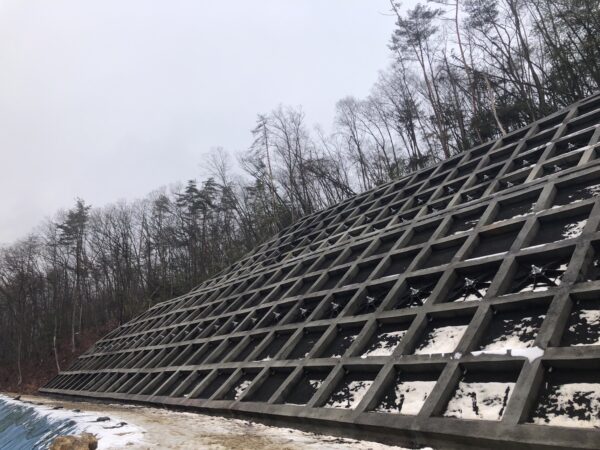
When I said, “That’s actually really easy to make!” he replied, “No, no, that’s really hard,” as if to say.
Since scholars focus primarily on research, they generally have no idea how we go about making things.
Since they're conducting research on the more micro and macro aspects of our work, the construction projects they're involved in are different from the ones we can actually see.
Today, I’d like to write about how to install retaining walls for those who aren’t scholars or slope engineers.
Placement of Frame Workers

We're going to install formwork on this natural ground, so let's start with the first one!
This is extremely important.
We recommend installing one solid bar in the cross-section shown on the drawing.
The reason I recommend this is that it’s designed based on its cross-section, making it easy for government agencies to understand.
Also, since those points generally serve as survey markers, it makes construction management easier.
The basic technique is a downward swing.
Here's how to install the first retaining wall in the cross-section under consideration!

I'll use a line and a sinker to cast from a little ways off! (I'll aim for it!)
Sometimes we set up survey points by aiming at them with a total station (TS), but if we do that, they end up tilted.
People's stares are gross
Align it straight with the human eye!
This is the option that looks the best in the end.
Once you've installed this first one, you'll space them out evenly and continue installing them side by side.

While checking the start of each frame with a downward sweep, I make visual adjustments of a few centimeters.
From a distance of several dozen meters, I watch as the target shifts slightly—5 cm to the right or 3 cm to the left—while I swing the rod downward.
I tweak it so much that I end up thinking, "Is that movement for real?!" lol
This step determines the entire legal framework!
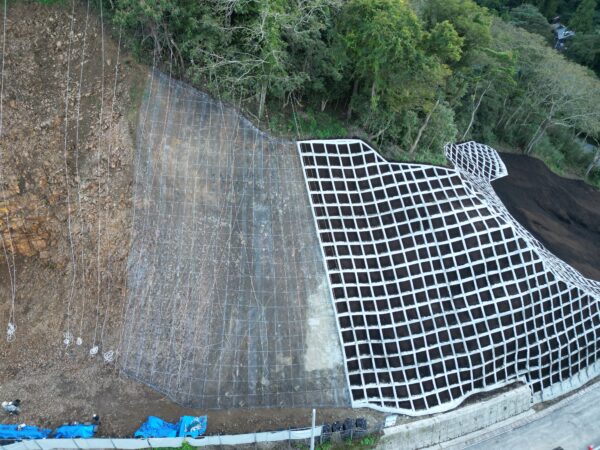
In this way, use thread to mark the positions of all the legal frames.
The reason all the window frames look perfectly straight when you're driving is that you're checking them with your own eyes.
If you draw a line using only TS, it looks like it's falling over.
And by doing this, anyone can easily set up a legal framework.
Even technical interns who don't understand the instructions can't go wrong—all they have to do is place the rebar along this line.
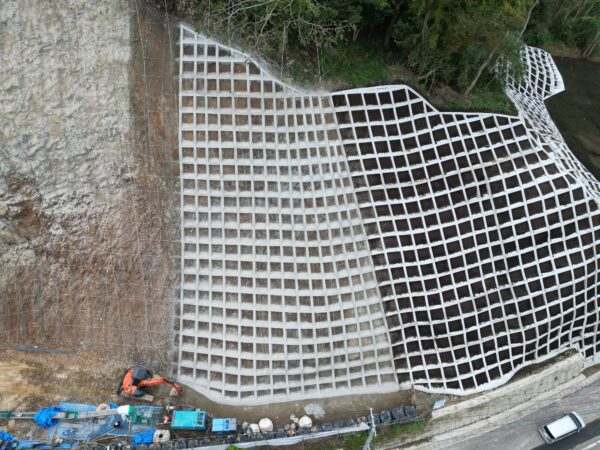
The layout of the legal framework is as follows.
People in other industries tend to think we’re doing things in a much more impressive way, but in reality, we’re pretty old-school, lol.
It really shows how amazing the human eye is, doesn't it? ^^
See you later.