Can a water level gauge be installed for as little as 30,000 yen per month?
Amnimo Co., Ltd., a Yokogawa Group company that provides sensor- and cloud-based solution services, announced its “Simple Wireless Water Level Measurement Service” in January 2020. This is an exceptionally affordable service that offers an all-in-one package—including a wireless water level sensor, communication, and cloud services—with no initial setup fee and monthly fees starting at 30,000 yen.
With regard to water level gauges, the Ministry of Land, Infrastructure, Transport and Tourism has been promoting their installation by formulating guidelines and other measures in response to the large-scale flooding that has occurred in recent years. However, conventional water level gauges are expensive, and installation has been slow to gain momentum.
The installation of water level gauges is essential for the early prediction of and preparedness for flood damage. However, due to the high cost of the equipment and installation, progress has been slow, particularly in smaller rivers and municipalities.
Amnimo, a member of the Yokogawa Group—Japan’s largest manufacturer of measurement and control equipment—developed and began marketing a niche product known as a water level gauge driven by a strong desire to keep installation costs low and “promote the widespread adoption of water level gauges as quickly as possible to help prevent flood damage.”
We spoke with Takashi Arai and Yoshihiro Suzuki of the company about the development process and the fundamental challenges faced by conventional water level gauges.
I want to measure the water level more easily.
Why did Amnimo develop a water level gauge? Surprisingly, the impetus for this was not the frequent flooding that has occurred in recent years.
"Three years ago, a client approached us with a problem. 'The irrigation ditch on our factory grounds floods several times a year,' they said," (Mr. Arai)

Generally speaking, factories are often located on land adjacent to rivers or the sea, where land conditions are frequently less than ideal. If flooding occurs, the factory will be unable to operate, resulting in a catastrophic loss of business opportunities. Therefore, water level monitoring is an essential preventive measure for ensuring the stable operation of the factory.
However, installing existing water level gauges would have required time-consuming wiring work, and the cost of the units and installation was also high.
"As we listened to their stories, we began to see a need among construction companies to use the system for short periods, such as during river construction projects. We racked our brains to figure out how we could meet their request to 'measure water levels more easily and conveniently,'" said Mr. Arai.
Mr. Arai, a consummate engineer who had spent many years developing sensors for industrial plants, began to wonder, “If we could adapt Yokogawa Electric’s core pressure sensor technology for use in water level gauges, wouldn’t that provide the right solution?”
In 2017, Yokogawa Electric began developing water level gauges as a new business initiative. One year later, Amnimo, Inc.—which bundles and provides sensors, servers, and cloud services—was established as a spin-off from Yokogawa Electric. After merging with Amnimo, the company moved forward with the development of a cloud-based water level measurement service.
Why We Insist on Plug-In and Battery-Powered Models
Development proceeded using actual rivers as the testing ground. A key focus of the development was to ”power the device with batteries.”
Initially, the system was designed to use an external power source, but when I visited the river myself, I discovered that the effort required to install the wiring for the power supply was placing a burden on the operators.
“There are still very few water level gauges that run solely on batteries; many of them inevitably require a large power source. While solar panels have become the mainstream option these days, in mountainous areas and other such locations, sunlight is often scarce, and performance is easily affected by weather conditions. As a result, there are inevitably concerns about the power supply,” said Mr. Suzuki.

For this reason, we decided to use batteries for power, but with a battery-powered system, there are concerns about battery life. As with cell phones, battery consumption is highest during data transmission. Therefore, when measuring water levels, the system operates in monitoring mode—taking measurements and transmitting data every 20 minutes—and switches to observation mode if the threshold is exceeded, immediately notifying the cloud server. We have achieved energy-efficient operation that minimizes battery consumption and allows the device to run maintenance-free for over a year.
The measurement method is the submersible type. With the ultrasonic method, ultrasonic waves are emitted directly from above the river and the reflected waves are received at the water’s surface for measurement; this requires installation on structures such as bridges, which limits the conditions under which it can be used. Furthermore, for data communication, the system employs 3G mobile networks—anticipating use in remote locations—and is designed to allow for easy future upgrades to technologies such as LTE.
Mr. Arai says, “We are planning for all kinds of sites across the country.”
“Cheap and lousy” is pointless.
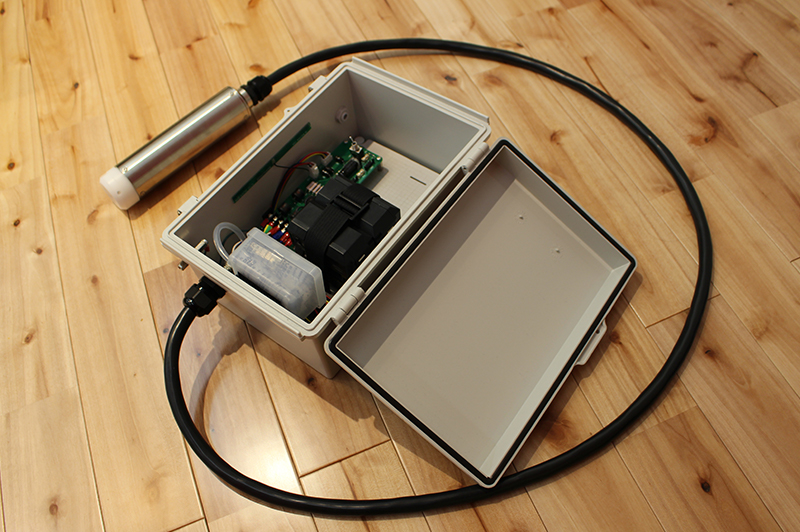
Traditionally, installing wireless water level sensors required a huge investment. According to Amnimo’s estimates, installing a typical wireless water level sensor requires an initial investment of around 4 million yen—including up to 800,000 yen for the unit itself, 3 million yen for communication contracts and cloud development costs, and several hundred thousand yen for electrical work to connect the power supply and installation costs.
On top of that, monthly communication and maintenance costs were added to the bill, which—no matter how convenient the system might be—was the biggest obstacle to its installation and operation.
Amnimo also considered a one-time purchase business model during the early stages of development, but given these circumstances, the company shifted to a subscription model where fees are paid based on the period of use. While operators must cover the installation costs for the water level gauges, there are no other upfront costs; the only expenses are monthly communication fees and maintenance costs. These amount to as little as 30,000 yen.
"Large construction companies can purchase water level gauges and set up their own systems. However, for small and medium-sized construction companies, purchasing the water level gauges themselves is a significant financial burden since they only need them on a temporary basis, and setting up a cloud-based system is also a major hurdle."
"Our water level measurement service is an all-in-one solution that includes both cloud and communication features—all you have to do is install it and flip the power switch, and it’s ready to use right away," said Mr. Arai.
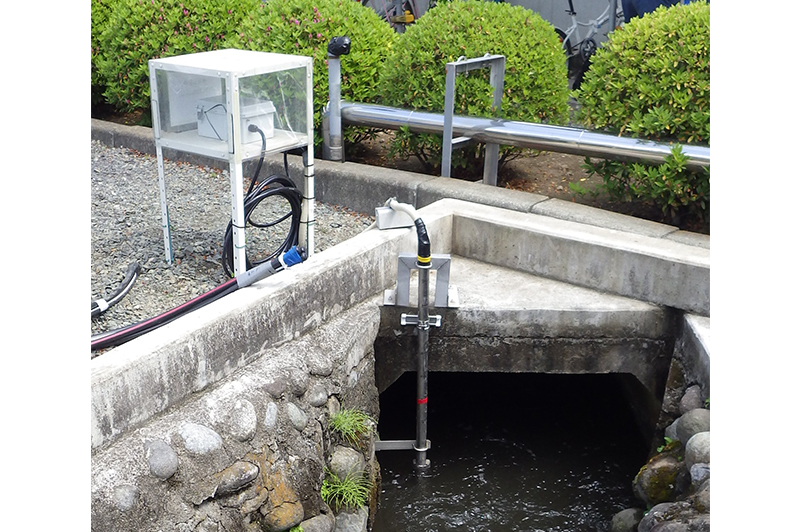
Installation Status in the Factory's Irrigation Canal
Particularly in river construction projects, many small and medium-sized construction companies choose not to install water level gauges at their sites, claiming that “the cost outweighs the benefits.” The reality is that site supervisors must rush to the site to check water levels every time it rains—even on their days off—and, depending on the weather, they sometimes have to stay overnight at the site to monitor water levels.
With wireless water level gauges, you can check water levels remotely using a computer or smartphone. Keeping costs down through a subscription model and lowering the barrier to adoption will ultimately contribute significantly not only to the safety management of engineers and workers on-site but also to reducing labor costs.
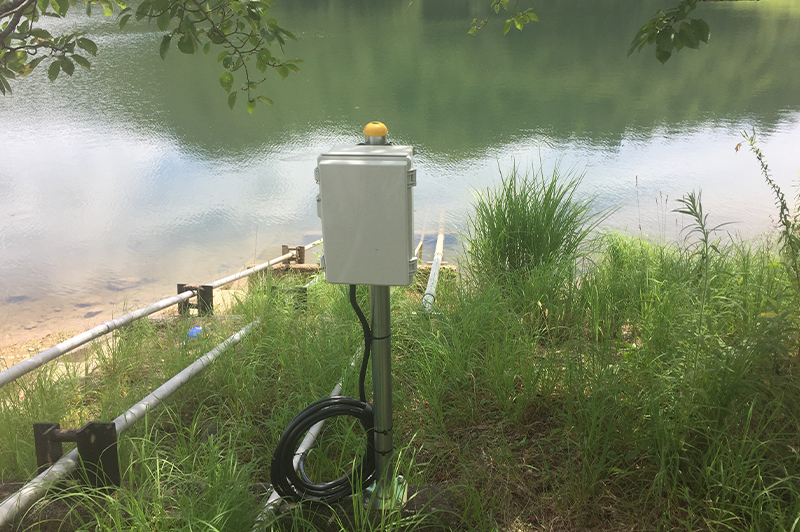
Installation at a reservoir. Installation takes about an hour and a half to complete.
However, water level gauges are devices that protect human lives. The ”cheap and shoddy” approach serves no purpose whatsoever. The pressure sensor used in Amnimo’s wireless water level gauges is a battery-powered version of the ”silicon vibrating sensor” independently developed by Yokogawa Electric and used in the plant and instrumentation fields. They embody “the pinnacle of Yokogawa Electric’s 30 years of technology,” and the company proudly claims their accuracy is “world-class” (Mr. Arai).
Amnimo’s wireless water level sensors have already been introduced on a trial basis as part of a pilot project for a remote monitoring system for irrigation ponds in Hiroshima Prefecture—which suffered extensive damage during the 2018 torrential rains in western Japan—and their advantages have been confirmed.
I hope it becomes standard practice to install water level gauges during river construction projects.
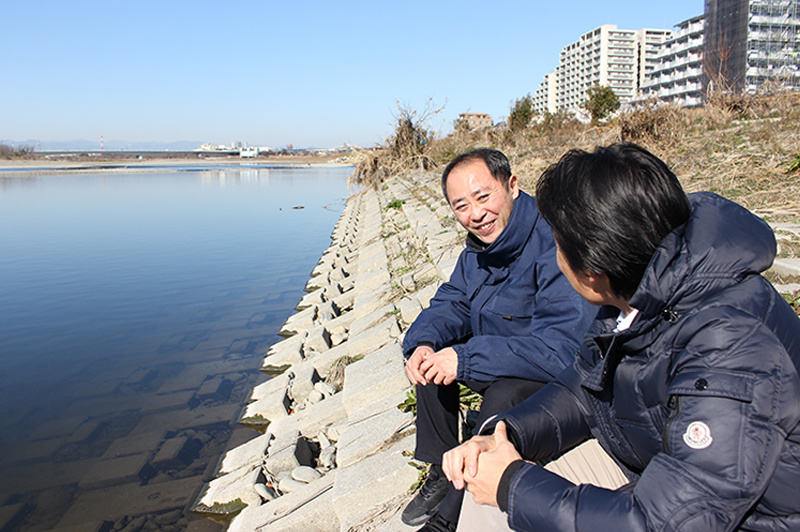
Mr. Arai, who lives in Kawagoe, Saitama, witnessed firsthand the flooding in the Iruma River basin caused by Typhoon No. 19 last year. Some of his friends are still living in evacuation shelters due to the flood damage. That is precisely why he has such a deep personal connection to the water level gauge he developed this time.
“Flood control measures cannot be implemented overnight. However, given the recent extreme weather events, this is also an urgent issue. I believe the installation of water level gauges should be expanded as soon as possible. I would like to see them used first at construction sites along rivers and waterways where ensuring the safety of surrounding areas is a major concern,” said Mr. Arai.
Cost must never be allowed to become an obstacle to safety management—and, by extension, to the protection of human lives. We look forward to a future in which Amnimo’s wireless water level monitoring service helps accelerate the advancement of Japan’s flood control measures.