Hello, everyone.
This is Enta.
The other day, something really awful happened!
Well, it’s been a while since I’ve been this angry—or whatever you want to call it...
I don't usually get that angry, but the other day I was just so mad!!!
So, I vented to my bosses about it. lol
Thanks to that, I feel much better now.
Thank you!
But that's beside the point.
As I mentioned the other day, regarding stress management in ground anchor construction,Can compress or shorten timeI wrote that.
So, since I was asked where that is written and how it should be interpreted, I will answer those questions.
Design and Construction Standards for Ground Anchors and Explanatory Notes JGS4101-2012 I'll base my writing on this.
P181
2) Loading Methods and Measurement Items
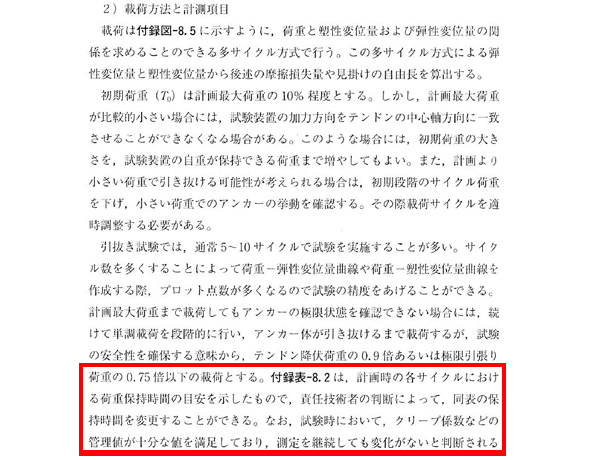
It states that the retention period can be changed at the discretion of the person in charge.
However, this assumes that the creep and relaxation values are stable.
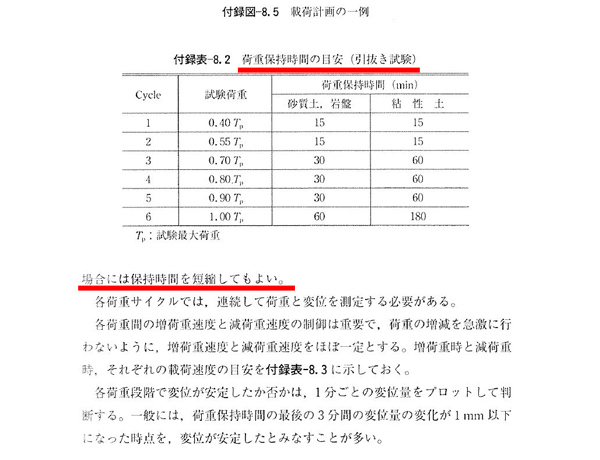
So, this "stability" refers to...
It is often considered stable when the displacement during the final 3 minutes of the hold time is 1 mm or less.
Since it says that, I think you should aim for about 1 mm every 3 minutes.
Another important point here is that,Please note that this load-holding time is only a guideline.That's it.
It definitely doesn't have to be at this exact time.
GuidelineIt is a possibility, but not an absolute certainty.
Even though the situation is stable on site, there are often people who keep holding it for 60 minutes or so.
I'm not saying it's bad, but,A waste of timeThat's it.
Once it has stabilized, the data will not change.
Next, the aptitude test starting on page 188
The aptitude test follows the format of the basic survey test, and the confirmation test follows the format of the aptitude test.
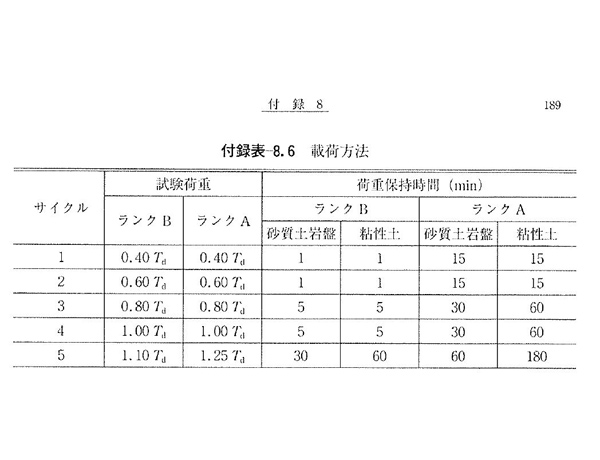
This table on page 189 alsoGuidelineThat's it.
And there’s something important written here, but,
Rank A: Design anchor force (Td) × 1.25
Rank B: Design anchor force (Td) × 1.10
Since this is the maximum score on the aptitude test, as long as you don't exceed it, there's no problem.
I base my decision on the condition of the mountain and the drilling conditions, but at most sites, I use a factor of 1.20.
The reason is this: Is it really necessary to pull with a force greater than the anchoring load—a force that won’t cause the anchor to come out?
Determining that the construction is proper means that if the design loads can be applied, the construction can be deemed proper.
In reality, there is such a thing as seismic loading, so it’s important that the fasteners don’t come loose even when subjected to large, temporary (instantaneous) loads, so
Taking that into account, we use 1.2 times as a general guideline.
It is also permitted for the person in charge to set a lower limit in this area at their discretion. (p. 190)
As for the loading time, as a rough rule of thumb, for anchors between 10 and 20 meters in length, about half of the above guideline is sufficient. (Based on my personal experience.)
For anchors longer than 30 meters, I think even the recommended holding time should be sufficient.
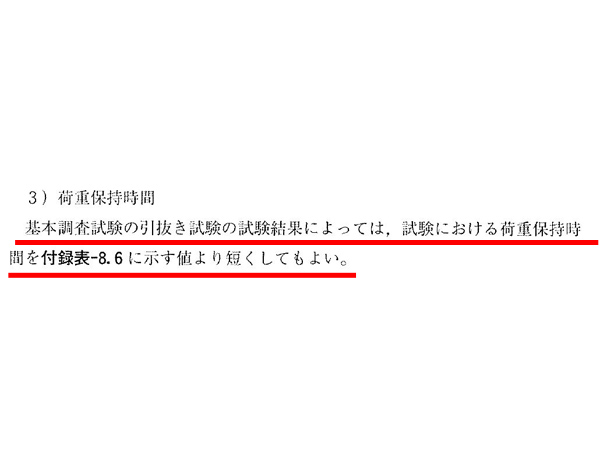
As long as creep and relaxation aren't stable, you can simply keep extending the time.
I wonder if it makes more sense to set the maximum time to about 30 minutes and allow for extensions? (It sounds a lot like a hostess club, lol.)

So, that was the reason—to save time.
Strictly speaking,The fundamental premise is that this must be done under the direction of a certified ground anchor installer.That's it!
Another way to physically shorten the process is to use two jacks. (This really cuts down on the tension time. Haha.)
See you later.