



Hello, everyone.
This is Enta.
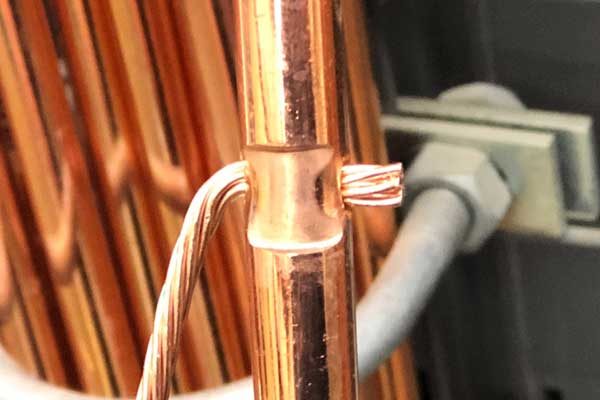
I went to see it!
That's the clamping section of the A's rod, isn't it?
That said, all I did was drill a hole in a round steel rebar and thread a ground wire through it.
I also took a look at the head section.
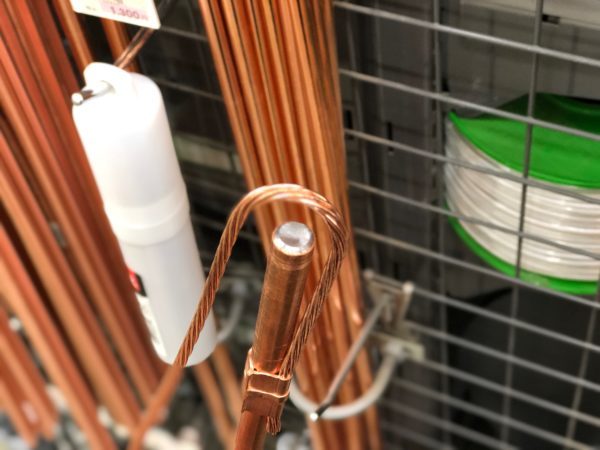
It was definitely rebar! lol
And look at this.
It's just a ground rod with the ground wire crimped onto it!
To put it bluntly, if we were to attach a ground wire to the familiar φ16×400 main anchor,
That means it's okay to wrap it around and secure it with cable ties or wire.
People will probably say you can't ground it this way, but it actually works. (As long as it's made of iron, it's fine.)
A Class 1 Electrician (from a certain major electrical contracting firm) said this, so it must be true.
I've decided I'm definitely going to make it out of thick round bar from now on, lol.
However, it appears that zinc plating has lower electrical conductivity than copper plating.
Since the material is of inferior quality, it seems important to pour a little extra to increase the surface area.
See you later.





I look forward to your daily updates. Since resistance is the key factor in grounding, it all comes down to how much electricity can be conducted to the earth (ground) and how much can be dissipated. This also varies depending on soil type and geology. At civil engineering sites, if large generators aren’t properly grounded, an electrical leak can result in an electric shock. It’s extremely dangerous if the ground is wet from rain and there’s a ground fault. I recommend not drawing power directly from the generator; instead, install a ground-fault circuit interrupter (GFCI) as an aftermarket addition and draw power from that. Even in major companies’ safety management departments, many people in civil engineering aren’t very comfortable with electricity, you know~
Thank you as always.
In our case, the power goes from the generator to the distribution panel first.
All the equipment passes through two circuit breakers, so it should be fine. There are grounding points for both the generator and the distribution panel.
However, since the hydraulic unit for the large-scale drilling machine is a 60-kVA Captyre unit, that’s the only one that’s connected directly to the generator.
Well, when it comes to grounding—or rather, since electricity is invisible, it’s kind of tricky, lol.
Well, I learned a lot this time since the pros taught me all sorts of things.
I'll make sure to let our employees know about this too! lol