



Hello, everyone.
This is Enta.
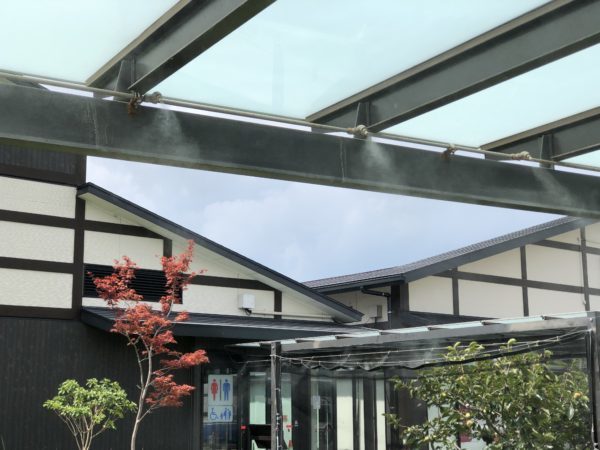
You know this, right?
This is the kind of mist you often see at various public facilities.
What do you think?
You see some of them installed on fans at construction sites, too, don't you?
What do you think?
Do you think it'll work?
"Ah, it's cool!"—that feeling only lasts a split second, right?? lol
Especially on-site.
The reason is that it isn't directional!
If anything, most products place an emphasis on diffusion.
It spreads out, so the wind blows it away somewhere.
All that mist just goes right away! lol
Especially on set! lol
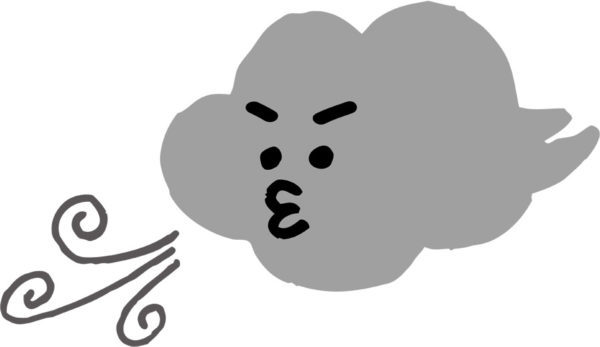
Directional MistI think it would be cooler if you could just blow the air on a specific part of me.
Diffusive mist doesn't actually cool you down at all in real-world situations, does it!?
It's still okay, though, because I can actually feel the breeze from the fan.
Compared to that, the shadows are nice.
It's really cool as long as you can just avoid direct sunlight.
The temperature fluctuations on site are also quite extreme.
I'm hoping they'll release some other products besides the Shadow! Hey, manufacturers!! lol
I'm not sure if it will happen starting next year, but there are signs that government officials are planning to allocate funds for construction work during extreme heat waves.
It is possible that costs related to heatstroke prevention measures and construction during extreme heat will be included in the cost estimate at some point.
I guess that means we've reached a point where it's okay to invest heavily in that area.
See you later.
Preventing Heat Stroke Starts with Taking Care of Your Health
Preventing heatstroke might not just be about your body!
Now is the time to make sure your heatstroke prevention measures are in perfect order!
The Best Ways to Beat the Heat! (Part 1)
The Best Ways to Beat the Heat! (Part 2)
The Best Ways to Beat the Heat! (Part 3)

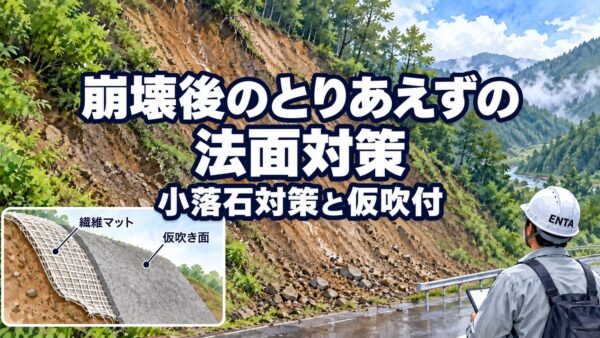


Good evening. Thank you for always teaching me so much, from technical matters to work ethic.
Since I was unable to provide an answer to the customer, I would like to ask for clarification. According to the Guidelines for Road Earthwork Slope Stabilization, under which category is “warashiba” classified? Based on the descriptions provided by various manufacturers, Warashiba seems to be categorized as “laid turf,” but on Isabou Net, the explanation for “vegetation sheet systems” states that they are “made of straw, mats, etc.”, so I’m confused as to whether it should be classified as a vegetation sheet or laid turf. While the material unit price for warashiba is lower, the design unit price appears to be consistent across manufacturers. Could you please clarify this for me?
A customer asked me, “What’s the difference between straw mulch and vegetation mats? Do they have different uses?” and all I could come up with was that straw is biodegradable.
Our company doesn't deal with market prices, so I apologize for asking such a basic question.
Thank you in advance.
Kaori Honda
Thank you as always.
I apologize for the delay in my reply.
It seems opinions are pretty divided on this point.
I suspect few people would be able to draw a clear line here, but I’d like to share the results of my research.
In my opinion, it seems perfectly fine to classify Warashiba as a type of Zhangzhi.
Wara-shiba is most commonly used in flat areas or on sites with a slight slope.
And it's a cold region.
Isn't Warashiba the one specifically designed for cold climates?
It seems that the presence of straw creates an air layer, which helps protect the soil (and the seeds).
It gives the same impression as a stainless steel glass that stays cold forever.
Air is a poor conductor of heat.
Thermal Conductivity
The objectives of the grass-paved road are to prevent erosion, prevent ice from breaking off and falling, and promote comprehensive greening.
If the slope is gentle, the soil is loose, the entire area is to be landscaped, and the location is in a cold climate, would Warashiba be the recommended choice?
That's what I thought. (I can't say for sure that it's completely accurate.)
As I was looking into it,
Was Warashiba the inventor of vegetation mats and vegetation sheets?
I thought that, too. I wonder if vegetation mats and sheets are the result of making warashiba more practical?
When I think about it, I just go, "Hmmmm..." lol
I apologize for my lack of preparation.
Based on a quick search, this is the only answer I can give...
I guess since it's such a simple job, there isn't much to it—it's probably more like, "Just lay it down and the grass will grow, right?" lol
We look forward to your continued support.
Thank you for your reply.
It was very educational to have you clearly explain the points I was unsure about and to be able to confirm the characteristics of Warashiba in writing. I also felt the joy of being able to share this firsthand information with our customers.
Likewise—I look forward to working with you in the future.
Kaori Honda