Hello, everyone.
This is Enta.
The other day, I wrote a post on this blog about the contact area on the back of the bearing plate in ground anchor construction, but,
This time,"Is it necessary to level the unevenness on the back of the pressure plate?"I'm going to write about that part.
I actually get asked about this quite a lot.
I often get asked, especially by construction consultants, “Is grade adjustment really necessary?”
There are actually quite a few cases where it's pretty much necessary, lol.
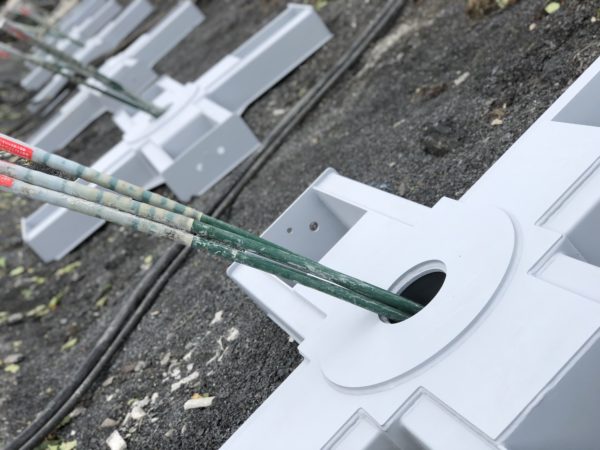
What determines whether or not leveling is required?
First of all, is grade adjustment even necessary?It depends on where the pressure plate is installed.。
Let's organize this section.
Cases Where Leveling Is Not Required
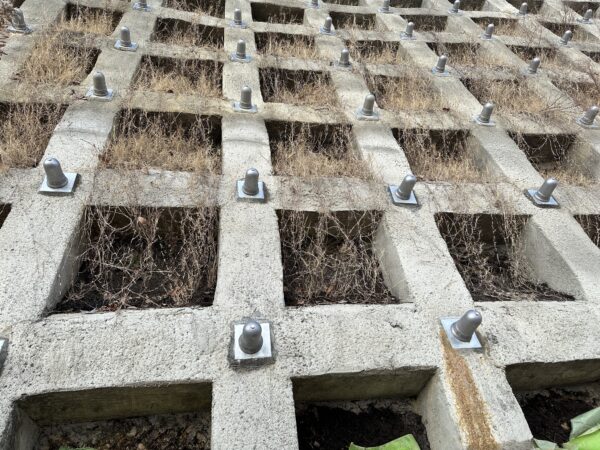
① When installing anchors on top of a formwork frame
In the case of formwork frames, the frames themselves are formed from mortar.
Therefore, the pressure-bearing structure serves as the legal framework.
Since the anchor will be located at the intersection of the legal framework,Leveling is generally not necessaryThat's it.
However, caution is required when the angle is quite steep in the horizontal direction.
② When installing on a retaining wall surface
The same applies to concrete retaining walls.
Since the retaining wall surface is generally flat, the pressure-bearing plate will fit snugly against it once it is placed.
*The photo shows a rebar installer.
Cases Where Leveling Is Required
Now, let's get down to business.
① When installing directly on the ground
This is the most common scenario, but among designers, there are some who..."The mountain will sink down a little and settle nicely, right?"Actually, quite a few people think that!
No way, it's not that easy, lol.
The ground is actually pretty bumpy.
Well, that goes without saying—it’s a natural mountain, after all! (No matter how much excavation we do.)
It's an artificially created flat surface, but there are stones and tree roots in it...
If you place the pressure plate, the underside will be uneven, causing the tension to be applied with an extremely small contact area.
As I mentioned in my blog post the other day, if the contact area is small,It sinks in。
And the worst part is...Deformation and buckling of the compression plateI will.
② When the placement angle is steep
A steep placement angle can sometimes mean that the slope angle is shallow, or vice versa.
Steep slopes tend to be either rocky or have been cut away, so they’re usually quite uneven. (Soft rock)
Plus, because of the angle, the pressure plate tends to slip out of place. (Getting the angle right is actually pretty tough, lol.)
It’s uneven to begin with, and on top of that, it tends to shift—that’s a double whammy of a hassle, lol.
③ When the bearing capacity of the soil is questionable
If the bearing capacity of the soil is uncertain, the contact area between the bearing plate and the soil should beEspecially importantwill be.
What if the ground bearing capacity is already at its limit, and uneven ground reduces the contact area?
I guess I'm out of the running now, lol.
In cases like this, make sure to level the surface thoroughly and, as much as possible,Adhesion of 90% or higherWe need to aim for that.
(90% or more, taking into account calculation discrepancies)
④ If the mountain at the installation site is missing a piece
There are actually quite a few of these, too.
You know that scenario where, after drilling a hole, you look at it and think, “Huh? Isn’t there a chip here?” or “The pressure plate sticks out, doesn’t it?” or “It actually sticks out on the drawing to begin with.”
If it's missing, that means the pressure plate is lifting up there.
Since the raised areas cannot transfer force, they must be filled in during leveling.
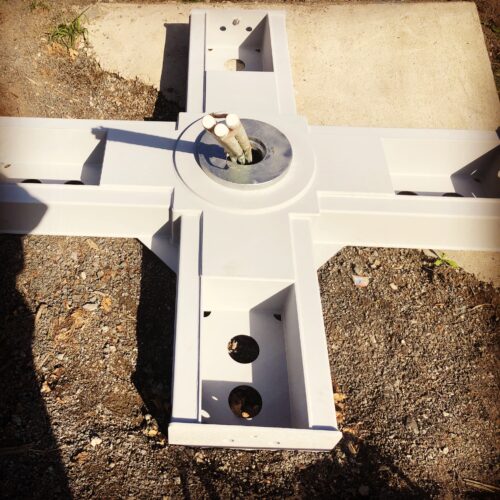
However, please take a look at the photo above.
Only the top right corner is made of concrete, lol.
This is the first time I've done leveling in my career as an anchor!
They’re building it by pouring concrete only into the missing sections of the mountain, but it’s highly likely that it will shift out of place eventually.
I wonder if earthquakes are the cause of the misalignment?
Rain washes away the soil, doesn't it? ^^
This was a NEXCO project site, and I clearly remember how the consultant in charge—who was working under a contract—was so high-handed that we couldn’t even have a proper meeting lol.
⑤ When the placement area consists of rubble stone
Machi stones are the epitome of bumpy, aren't they? lol
It's impossible to get the pressure plate to fit snugly against the stone wall surface just like that.
Uneven joints, the curvature of the stones, gaps… It’s just full of unevenness!
In the case of Machi stones,Leveling is always requiredThat's it.
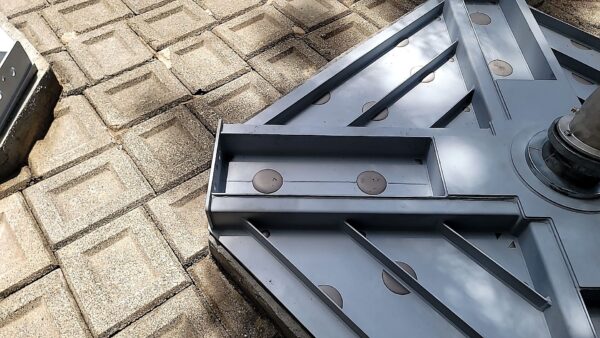
Which is better: mat or mortar?
Broadly speaking, methods for leveling can be categorized as follows: weather resistanceMatte-finishとMortarThere is.
Basically, there are no standards for the backfill behind a load-bearing slab.
I'll outline the criteria for making these judgments based on my experience.
When the unevenness is 100 mm or more
If the unevenness is 100 mm or more,Mortar Spraying WorkerThat's better.
There are limits to how much you can fill in with mats. It's not impossible, but I think we're close to the limit.
In that case, it would be more reliable to simply create a perfectly smooth surface using mortar.
It fits better on the pressure plate if you build it properly using a zabuton frame or something similar.
It takes some effort, but,The level of certainty is in a league of its ownThat's it!
When the unevenness is 100 mm or less
If the thickness is 100 mm or less, a mat is often the better choice.
With a mat, there's no curing period, and it's less expensive.
You can use a single 100 mm mat, or you can stack several 30 mm mats as needed to achieve the right height.
In terms of on-site efficiency, mats offer a speed advantage.
| Back-filling of the pressure-receiving plate | Whether or Not It Is Necessary | Mortar | Matt | Notes |
|---|---|---|---|---|
| Framework Engineer | Unnecessary | — | ○ | The joints should be finished with a trowel; a matte finish is acceptable. |
| Spray Applicator | Required | ○ | ◎ | It would be even better if there were a mat. |
| Natural Ground | Required | ◎ | △ | We can't level the uneven ground. |
| Retaining Wall | Unnecessary | — | — | If the surface is rough, use a mat. |
| Machi Stone | Required | ○ | ◎ | The paving stones are also less likely to shift. |
| The Missing Mountain | Required | ◎ | × | Made using the entire surface of the pressure plate |
| The pouring angle is steep | Required | ◎ | × | Also to adjust the angle |
What I Want to Tell the Design Consultant
It is up to the consultant (designer) to determine whether grade adjustment is necessary.
Let me be clear about this:Generally speaking, it's better to have grade adjustment.That's it.
It's definitely better to have it than not to have it.
That's because natural mountains aren't flat.
On the drawings, you’d draw the pressure plate so that it fits snugly against the slope, right?
But the reality is different!
The slopes of the natural terrain are full of bumps and dips.
"The mountain will sink and blend in, right?"That way of thinking is dangerous.
Whether a mountain sinks or not depends on the geology; if it's bedrock, it won't sink even 1 mm, lol.
Whether or not you include ground leveling in the design makes a huge difference in the subsequent quality and safety of the anchors.
Especially in cases where the structure is installed directly on natural ground,We strongly recommend incorporating grade adjustment into the design.。
While the contractor can submit a design change request, it’s better to include it from the start so that work on-site proceeds more smoothly.
Ultimately, rather than constructing without leveling and having to redo the work later when problems arise, it’s better to plan for proper leveling from the very beginning.It's also inexpensiveThat's right.
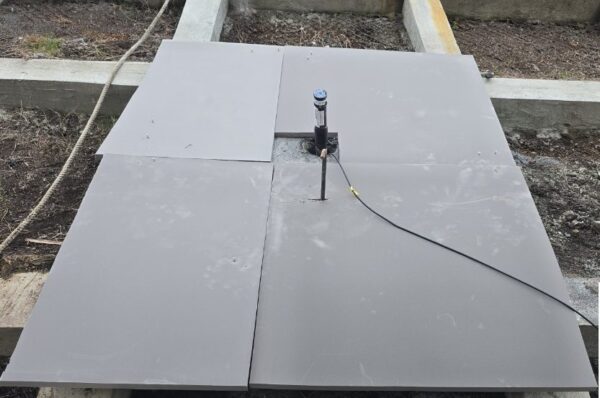
Leveling the load-bearing plate is a critical step that determines the quality of ground anchor work.
Instead of leaving the decision of “needed or not needed” up to the people on the ground, I want you to thoroughly consider this from the design stage onward.
We contractors do our best on site, but the accuracy and speed of construction can vary greatly depending on whether something is included in the design or not.
An anchor is something that works behind the scenes, deep within the mountains.
That’s exactly why we want to make sure the load-bearing plate—which is visible—is installed properly.
I've included the Excel file with the evaluation criteria in the download!
See you later.