


Hello, everyone.
This is Enta.
Lately, I’ve had many opportunities to visit private homes to inspect stonework repairs and the like.
That makes me think about a lot of things, lol.
There are quite a few impressive houses, but even though they’re very nice, many of them are located in pretty sketchy areas.
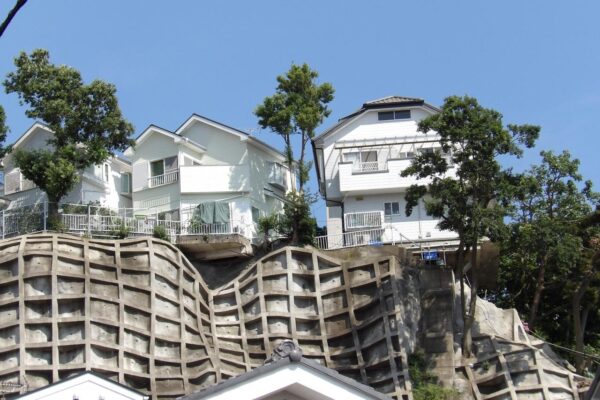
It’s fine where safety measures are in place, but in places where they aren’t—just because the view is nice or it’s on a corner lot—
We're building our house with that kind of vision in mind.
And over time, depending on the weight of the house (live load), it will gradually settle, causing the house to tilt or the ground to collapse, right?
One characteristic of houses like this is that they usually have trees in the yard.
It looks pretty overgrown, but from our perspective as slope maintenance specialists, this is the absolute basics, and,
Cut down the tree at Hoken!
However, even though ordinary homes are located near cliffs—on land where the ground has been raised on only one side by earthworks—people still plant trees in their yards.
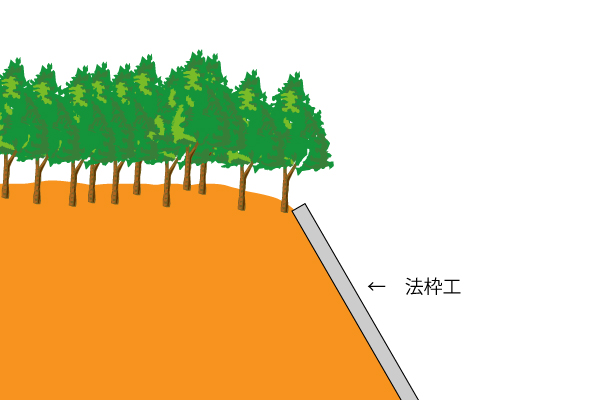
In public works projects, when slopes are stabilized using legal frameworks or similar measures, I believe this is what they look like when viewed from below.
However, the actual situation is as follows.
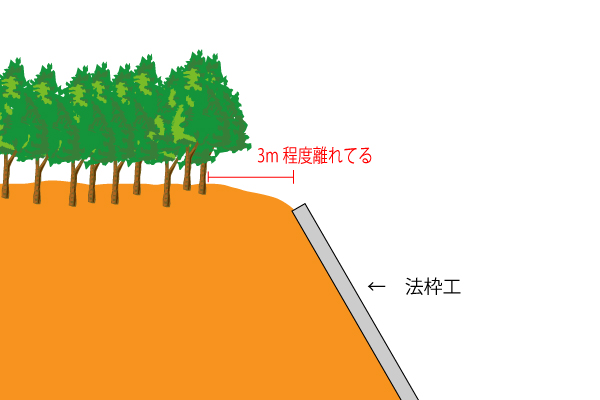
When a typhoon or something like that comes, it's usually raining, isn't it?
In situations like that, if the wind is causing the trees to sway and it’s raining, the ground becomes loose and unstable.
If trees sway at the top of the slope, it will affect the slope reinforcement structure and make the slope more prone to collapse.
To prevent this from happening, we clear the area up to a point slightly inside the legal boundary.
However, in luxurious private homes, the gardens always face the cliff, so you can always enjoy a beautiful view.
Naturally, since there's a yard, there are trees in it.
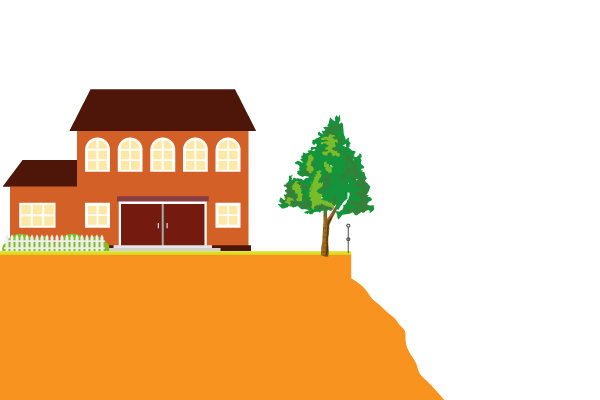
There are trees like this.
Basically, they tell me, “There are some abnormalities in this embankment area and the slope under the house, so please come take a look and investigate,” lol.
It is quite common to find stone walls or dry-stone walls in this area.
When we conduct a survey, the soil pressure is directed toward the slope side. (That's the only option.)
As a result, the stonework may be pushed out of place, cracks may form, or—in the worst-case scenario—loose stones may fall out.
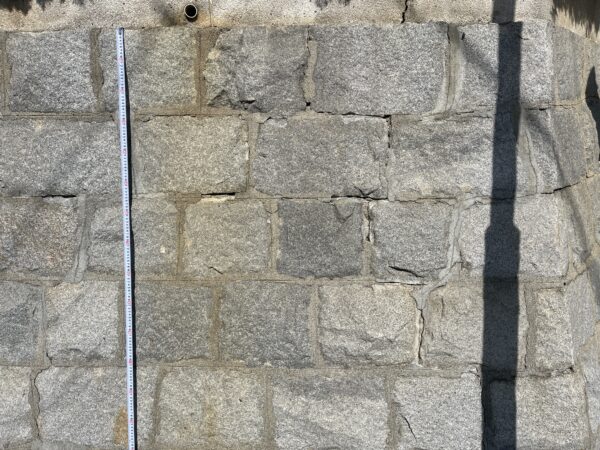
This stone wall is also starting to lean to the right.
There are trees near this house, too.
Trees aren't the only cause of the pressure, but they are one of the causes!
Another issue is that we’ve been asking local contractors to fill these cracks with grout from above,
The problem is that I don't know exactly where I'm pressing from and to.
Ideally, it would be best if you could show it to me while it’s still in its damaged state, but there’s a 99% chance it’s been repaired multiple times.
Regardless of whether or not you decide to take measures against loose stone piles, a temporary solution would be to:Cutting Down TreesThat's it.
I don't need any trees in my yard, lol (they cause the ground to shift).
In fact, it makes me wonder if the foundation of a house with several trees in a backyard the size of a cat’s forehead isn’t completely crumbling.
For now, if you have a garden with trees that sway in the wind to the point of shifting the soil, please cut them down if possible.
If we do that, the ground movement should subside for the time being.
I hope the movement in the stone walls and on the slope side will settle down, even if just a little.
After that, I think it would be best to carry out slope protection, surface protection work on the stone walls, and measures to address pore water pressure.
See you later.