



Hello, everyone.
This is Enta.
I learned something very clearly from the survey we’ve been conducting over the past few days.
There was a lot of efflorescence (white deposits) at that site. (Retaining wall)
(Hereinafter referred to as "Efro")
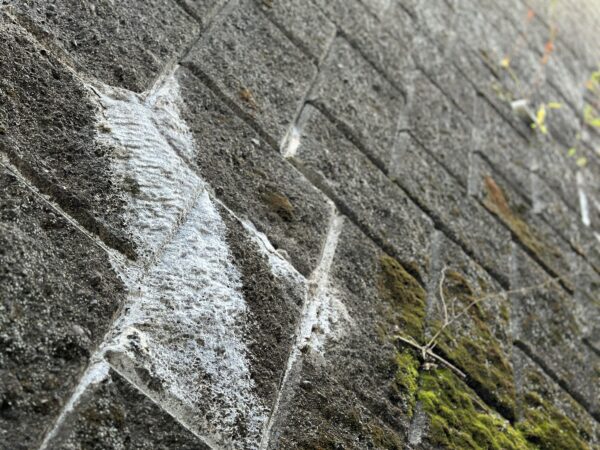
I was investigating that.
There were other abnormalities as well.
And here is the result after removing the core
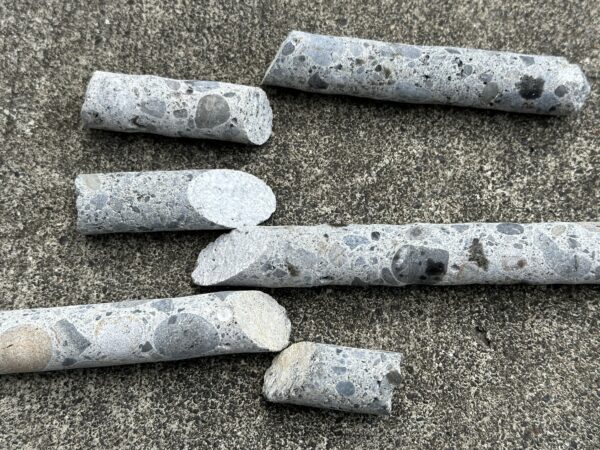
Isn't this amazing?
I know some of you might be completely confused by this, but these are the cores from three different locations.
All ties have been severed.
Possible causes include concrete construction joints or cold joints.
| Weld Seams and Cold Joints
A cold joint is an unexpected seam that occurs when the lower and upper layers of concrete fail to bond during this “consecutive pouring” process, whereas a “consecutive pour” refers to a planned joint.。 by Google Search |
The lines on the Eflo are all over the place, so I'm thinking it's probably a cold joint.
That said, the construction took place a little less than 50 years ago—did the concept of a cold joint even exist back then?
I wonder what the quality of structures has been like since the Tokyo Olympics.
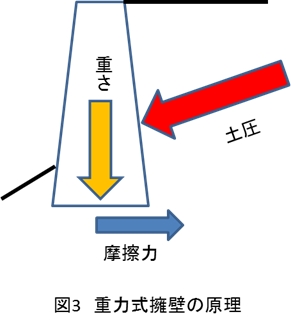
This is a gravity retaining wall built shortly before I was born.
The concrete seems to have achieved sufficient strength, so there doesn't appear to be a problem, but,
I have to figure out what to do with this mille-feuille-like concrete structure in just one week—that’s pretty tough, lol.
Well, what should I do... lol
I feel like I've been doing nothing but designs like this lately.
Well, it's fun, but it's hard and I'm always running out of time lol
It’s only fun while I’m saying things like this, lol.
See you later.


I found your discussion of cold joints very interesting. In this case, since it’s a gravity retaining wall, I assume the concrete joint runs horizontally, so I believe core drilling is being performed vertically from the top of the wall. Wouldn’t it be possible to use those holes to drill vertically as well—for example, to insert rebar and perform grouting? If you want greater strength than rebar can provide, you could consider inserting steel pipes and grouting both inside and outside the pipes. Essentially, it would be similar to the large-diameter bored piles used in landslide mitigation works. It’s just an idea off the top of my head.
Thank you for your hard work.
I was thinking the same thing.
It really is better to stab from above, isn't it?
Since it’s pretty heavy, I was wondering if it would be okay to secure it with an anchor from above.
Considering things like slippage, I think it won’t be worth it unless I at least use a gravity-type foundation, so I’m thinking it might end up being pretty long, but I’ll finish it by the end of this week lol.