Hello, everyone.
This is Enta.
Are you all already on your Obon break and heading back to your hometowns?
I have a job interview in Nagano today.
This is a referral from Hello Work.
It's always fun when new people join, isn't it?
Plus, as you learn to do more things, it’ll be even more fun in the future!
But that's beside the point.
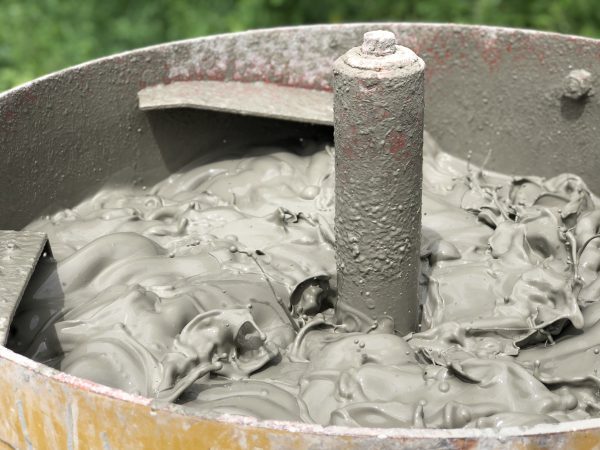
Often, when grout is being injected, the pressure causes the hose to burst, preventing the grout from being injected.
How do you handle situations like that?
Basically, the main causes of clogs in injection hoses—such as those used in rebar insertion work—are the entry of soil and sand or the hose breaking inside.
As a result, fluid cannot be injected, causing pressure to build up, which can lead to hose ruptures and other problems.
So, how do you ensure the liquid is injected properly? It’s simple: just make a small cut (to release the pressure).
That's all there is to it.
But there's actually quite a bit of a trick to this!
It's a simple method that doesn't take much effort.
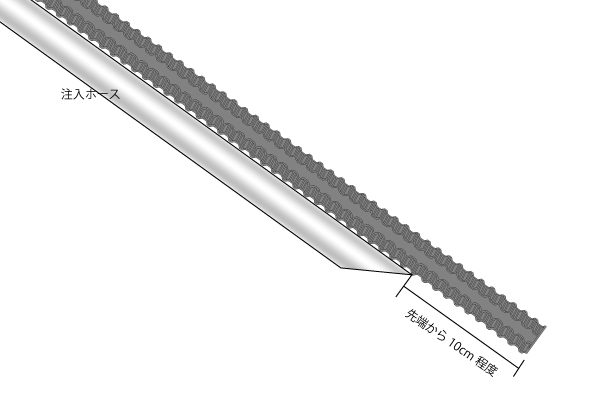
Install the injection hose slightly above the tip.
This makes it less likely for the tip to become blocked, and a beveled cut also reduces insertion resistance.
So, here's a method I've been using for a long time.
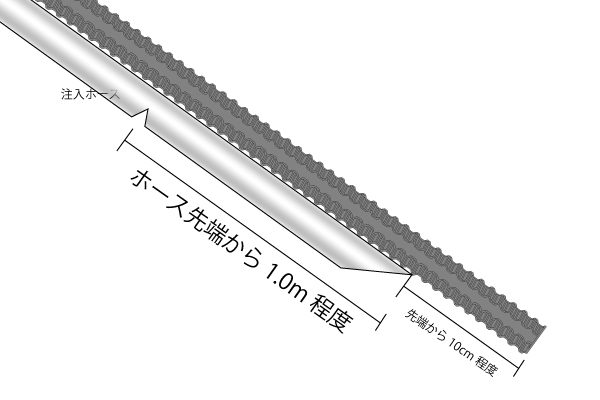
There's a cut about 1 meter away. It's a V-cut, isn't it?
However, this V-cut is actually quite a hassle.
Then, cement slurry comes out from the V-cut location, just ahead of the tip.
If possible, there's a better method that's easier than this V-cut.
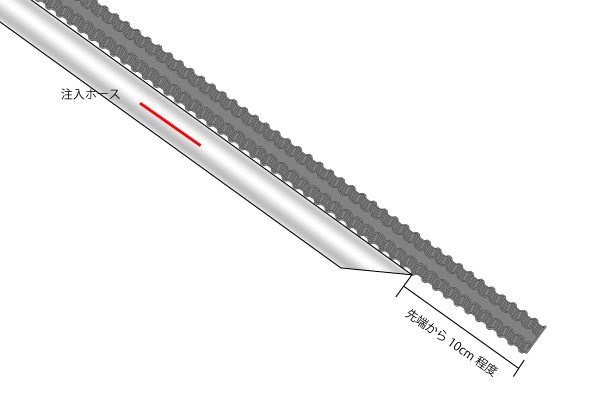
I wrote this in red because it's a little hard to read, but,Just make a vertical cut with a utility knifeThat's it.
Add them in appropriate amounts—1 m, 2 m, and 3 m. One spot is fine. (If pressure builds up easily, add more to adjust.)
That's all.
If cement slurry comes out of the lowest part as usual, nothing will come out of the cutter's cutting edge, and
Pressure escapes with a "psst" sound from the cutter's cutting edge only when pressure is applied, so it won't burst.
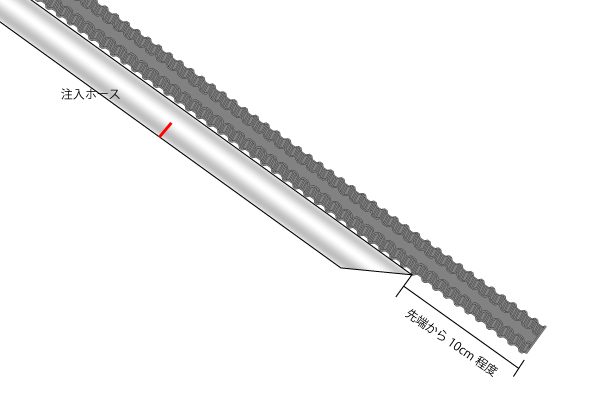
Since it escapes at a lower pressure horizontally than vertically, it provides a greater sense of security.
V-cuts can be time-consuming and dangerous. However, this method is relatively simple and safe because you can make the cut just by firmly pushing the cutter in.
For the sides, it's even easier—you just use pruning shears to snip them off cleanly.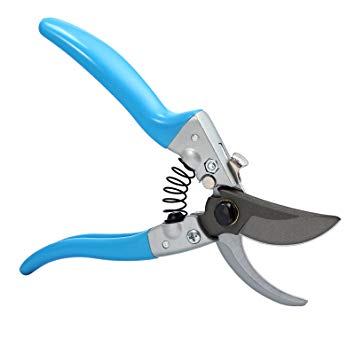
However, if you cut too much off the side, the hose will be ruined, so it takes a little practice.
Some people are really particular about the V-cut, but it serves the same purpose. Let’s ditch those silly quirks and just do it the way that makes things even a little bit easier, lol.
See you later.