

Hello, everyone.
This is Enta.
It's been getting colder in Azumino lately.
The long autumn nights have begun!
We recommend switching to work clothes with reflective strips, etc.
People don't see as much as they think they do.
But that's beside the point.
Ground Anchor Construction: What Should You Do in Situations Like This? (Part 1)
Here are the answers from the other day.
If it is not possible to flush the borehole while the casing is in place up to the set depth,
It seems likely that the ground conditions are quite poor.
Joints have formed in the rock mass due to factors other than drilling, and there are voids and other features.
As a solution in cases like this, well, it’s generally standard practice to use a packer.
That's because it's a critical issue if the cement slurry doesn't rise in the anchoring section.
If this were a free length segment, it would be fine to gradually increase the pressure over a few injections, but that won't work for the anchorage segment.
Some people say, “Just raise it gradually. It’ll all work out in the end anyway!” But that won’t work.
The reason for this is that ground anchor systems rely on friction between the natural ground and the cement slurry, and between the cement slurry and the prestressed steel strands.
Extremely Rare!! The Moment a Ground Anchor Worker Slipped!
For more details, please see ↑.
Let's say it was injected into such a vital area multiple times and then came back up.
Don't you think there's a good chance that anchor will come loose eventually?
The reason is that a cold joint has formed.
It’s not possible to construct the anchorage body when there’s a cold joint in the anchorage section, is it?
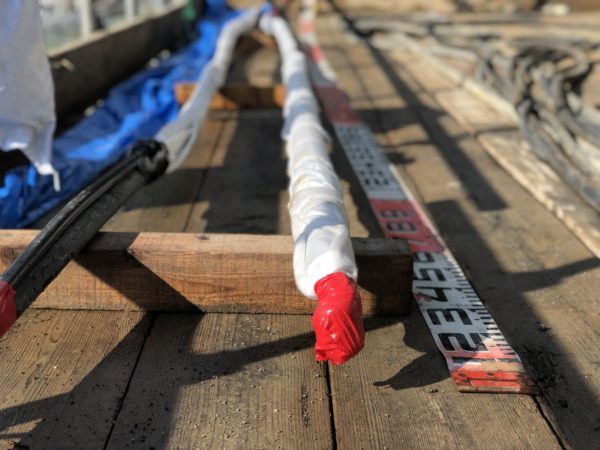
Only the anchoring section needs to be injected in a single step.
The only solution is to use a packer. (At least for the next 20 years.)
I have no idea what the frictional resistance between hardened cement slurry and hardened cement slurry is, so I’m just feeling anxious, lol.
We should change the design to a packer, even if it means stopping production for a week.
If design changes aren't possible, should we negotiate with the government agency or with the general contractor?
Although it varies depending on your role in the construction process, if you’re the general contractor, you should ask the government office for written instructions—even though you can’t guarantee compliance if they’re omitted—and you must absolutely submit the meeting minutes.
If you are a subcontractor, ask the general contractor for instructions on whether to renew the contract based on the labor costs for installation by the packer, etc.
In the case of subcontracting, it’s best to always keep a written record to avoid disputes over what was or wasn’t said. Be sure to have them send you a written confirmation via email or similar means.
Apart from that, there are other methods, such as using fiber, but these are really just a matter of getting creative.
It's not a surefire method.
Should we use an all-packer or a fixed-section packer?
That depends on the on-site supervisor's judgment, but it's an important matter.
By the way, at our site, we halted work for a week and made a design change to install packers at the anchorage points.
On-site, it is necessary to make accurate judgments at that moment.
That’s something that should be done even if it means halting operations on-site.
If you make the wrong call there, it can lead to serious consequences later on, so knowledge and experience are extremely important for a coach.
Conversely, if you don't have it, please accept it from those who do.

The worst thing a director can do is listen only to the opinions of the technical staff.
I’m not saying the craftsman’s opinion is wrong. After all, he’s been through this himself. It’s an important opinion.
However, let’s have the director make a comprehensive assessment of whether this aligns with the source material and evaluate it from both a technical and quality perspective.
That’s how the technology evolves to address specific issues and on-site conditions.
See you later.