Heavy Rain Disasters Continue to Strike Various Regions This Year as Well
Just when I thought the rainy season had ended early this year, a series of torrential rain disasters struck in August. Damage occurred in various areas, including bridges being washed away, landslides triggering mudslides, and flooding that reached above floor level.
Among these, the disasters caused by the torrential rains in Niigata and Fukui were particularly severe. Landslides occurred in various areas, cutting off roads.
On National Route 8, landslides occurred at both tunnel portals in Fukui Prefecture, and a landslide also occurred on the Hokuriku Expressway, resulting in road closures on both routes. In addition to these, other national highways were closed, forcing drivers to take major detours from the Hokuriku region to the Kansai region.
In Murakami City, Niigata Prefecture, water levels rose above floor level for the first time in 55 years. Although no deaths or missing persons were reported—thanks to lessons learned from past floods—many homes were flooded, resulting in significant damage. The impact on crops has also been severe.
Case Studies of Disaster Recovery Efforts Following Landslides Caused by Heavy Rainfall
In recent years, disasters caused by heavy rain have been occurring in various regions. And each time, we’ve been scrambling to carry out disaster recovery efforts. There are too many examples of disaster recovery to list them all.
Among them, one paper caught my eye. It was a paper published in the journal of the Japanese Geotechnical Society, describing a disaster recovery case involving the torrential rains caused by Typhoon No. 19 in Reiwa 1.
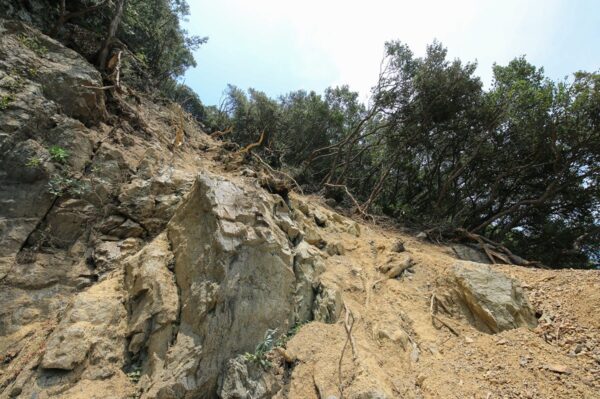
A slope alongside the highway collapsed, causing soil and debris to flow onto the road and forcing its closure. In this case, emergency repairs were carried out to reopen some lanes as soon as possible, and full-scale repairs were conducted while restricting traffic to a single lane.
The details of the restoration work are as follows. First, a retaining wall using parent piles and horizontal sheet piling—a construction method for which materials can be procured relatively easily—was erected to prevent further slope collapse. This allowed the main line to be reopened quickly. Behind the pile-and-sheet pile retaining wall, space was set aside to contain any collapsed soil and debris in the event of a landslide.
Next, as part of the full restoration, slope reinforcement using ground anchors and other methods will be carried out. Since a rise in the groundwater level was considered a possible cause of the slope collapse, the ground anchors were designed with this rise in mind, and a safety factor for saturated conditions was established.
In addition, drainage boreholes were drilled in the sections that had not yet collapsed to help prevent the groundwater level from rising. The slope gradient is steep in the area where ground anchors were installed, while the lower portion of the slope has a gentle gradient.
We should also consider utilizing past cases.
Speed is essential in disaster recovery. This applies not only to construction but also to design. While accuracy is necessary, it is even more important to work quickly. We must complete the planning, design, and cost estimation as quickly as possible so we can move on to construction.
With that in mind, why not consider drawing on past examples? Some of you might say, “No, no—we’re already doing that!” but surprisingly, it’s often not being done as effectively as it could be.
Perhaps we’re so caught up in the work right in front of us that we don’t have the bandwidth to look into past cases. I can understand that. However, I think it’s especially effective to take a step back when things are busy and ask, “If there was a similar case in the past, how did we handle it?”