CAD operators are in high demand when changing jobs, especially at general contractors
Currently, there is a growing demand in the construction industry for certified and experienced CAD operators. This is especially true for AutoCAD.1Highly skilled CAD operators are in high demand at major general contractors, consulting firms, and other companies. In fact, some staffing agencies specializing in construction engineers are recruiting 1,000 to 2,000 recent graduates and mid-career hires because they cannot keep up with the demand for experienced personnel; these agencies provide in-house AutoCAD training before placing the staff with general contractors and consulting firms. The reliance of general contractors and consulting firms on staffing agencies is expected to continue growing, and the number of female CAD operators in the field is also expected to increase.
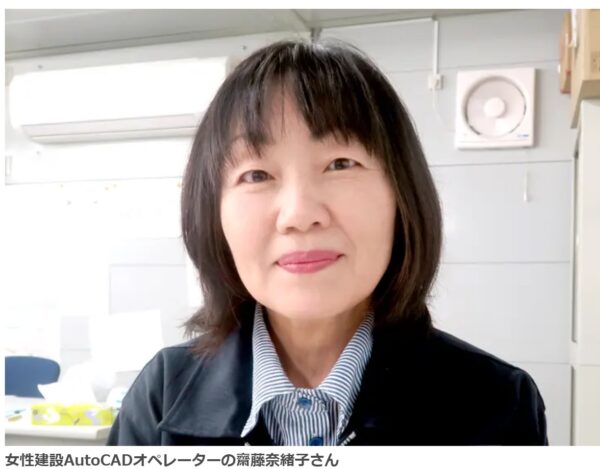
So, for this article, we spoke with Naoko Saito, a female AutoCAD operator in the construction industry, about the nature of a CAD operator’s work, the job market for career changes, the reality of temporary staffing, and the status of women’s advancement in the industry.
Naoko Saito has been working in the construction industry for over 10 years as a professional AutoCAD operator. Originally a temporary office worker in an administrative role, she was assigned by chance to the research laboratory of a major steel manufacturer. This led her to interact with people of various ages and professions—including engineers, mold designers, architectural designers, mechanical designers, service staff, and salespeople—whom she would never have encountered in a typical administrative role. It was there that she gained practical experience as an AutoCAD operator across a wide range of fields, including civil engineering, architecture, and building systems.
Workflow and Days Off for Construction AutoCAD Operators
―― As an AutoCAD operator, what kind of projects are you currently working on, Mr. Saito?
Saito I’m in charge of assisting with the creation of rebar drawings at a thermal power plant construction site. Creating these drawings is quite challenging because of the complex way the rebar is arranged, and I think this is the most difficult site I’ve worked on so far. But that’s the beauty of AutoCAD—the more challenging the task, the more interesting it becomes.
―― What's the atmosphere like on set?
Saito Since most of the staff are in their 20s and 30s, the workplace has a bright and lively atmosphere. There are people from various trades—such as roofers and rebar workers—and they really energize me. I’m always in awe of the heavy equipment operators’ skills. Construction sites are a true showcase of incredible technical expertise. We even have a Vietnamese CAD operator, so the construction site is becoming increasingly international.
―― Please describe a typical day’s schedule and the nature of your work as an AutoCAD operator.
Saito My commute from home to the job site takes about 50 minutes by car. When I arrive at the office, the first thing I do each morning is review the distributed drawings—which will be converted into CAD data—and the responses to the requests we submitted. I file any additional or revised drawings, highlight the changes with a marker, and circulate them for review. I take care to ensure that this process does not interfere with on-site work or meetings.
After that, as part of my support work for creating rebar drawings, I’ll begin adding symbols and dimension lines to the drawings. The challenging part is having to interpret the lengths, diameters, and types of rebar from the rebar fabrication drawings.
Since the team works together to create the rebar drawings, it’s important to stay in close communication to ensure the work doesn’t get held up.
―― Are there any skills that you feel are particularly useful in your current role?
Saito In addition, I work with Excel functions and VBA programming. While some major general contractors use specialized software for managing drawings and site photos, it hasn't been implemented at my current job site.
In such cases, if you can create macros in Excel, you can easily search for drawings and photos and paste them at specified sizes—even without specialized software. This reduces work time and allows you to work more efficiently.
Once the function is set up, it’s easy to calculate the volume of excavated soil and the mass of rebar, and I can even import entire tables of calculations from Excel directly into AutoCAD. The office automation skills I developed when I was younger really came in handy.
―― What are the rewarding aspects and challenges unique to AutoCAD work in the construction industry?
Saito I think one of the real joys of being an AutoCAD operator is being able to see the floor plan, interior, and exterior of a building before it’s even completed. Since I get to see them before the general public, it feels like a real perk. It really boosts my motivation to think, “A building this wonderful is going to be built!”
The aspect I pay the most attention to in my AutoCAD work is ensuring that the drawings I produce are easy for anyone working on-site to read. In particular, I’m very careful about how I draw dimension lines, since drawings can be hard to read if there are too many or too few of them.
In addition, drawing management is important. A CAD operator’s job isn’t just about drawing. Drawings must always be up to date. It is absolutely unacceptable for a drawing to be out of date.
From the outside, the job of a CAD operator might seem like it involves working independently, but since work on a construction site is all about teamwork, I always keep the big picture in mind as I work.
―― I imagine an AutoCAD operator’s day is quite busy, but if you don’t mind, could you tell us how you spend your days off?
Saito I usually have Saturdays and Sundays off, so on my days off I often go to the park or shopping with my kids. I guess Aeon Mall is the place we go to most often. It’s pretty much what a typical family’s weekend looks like (lol).
Also, since both my kids and I love sweets, we’re always on the lookout for new convenience store desserts.
Reasons for Switching to a Career as an AutoCAD Operator
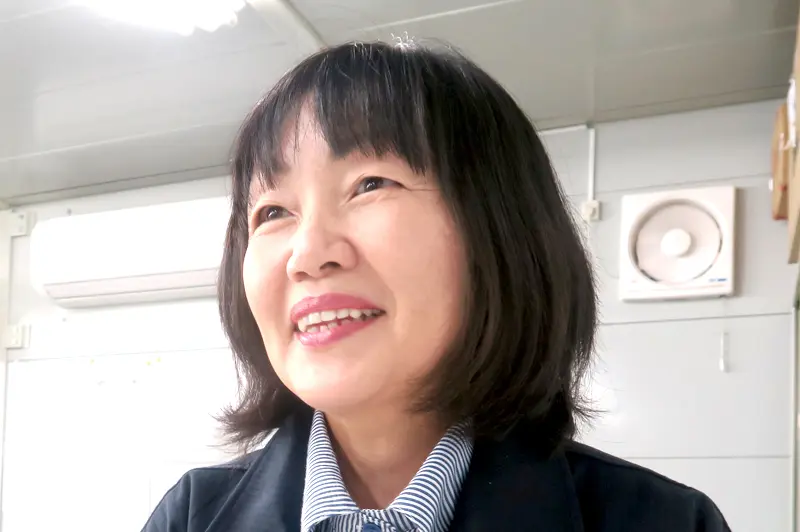
Naoko Saito, a Female AutoCAD Operator in the Construction Industry
―― To begin with, what prompted you, Mr. Saito, to switch careers to become an AutoCAD operator?
Saito After graduating from junior college, I joined a computer-related company and worked as an office administrator. Even after getting married, I continued to work on developing systems for inventory management and import/export management while raising my children. I had some experience as a computer instructor and had been exposed to CAD for some time, but I didn’t start seriously learning AutoCAD until I was assigned to the research laboratory of a major steel manufacturer as a temporary employee. I was completely hooked by the thrill of seeing designs I created at my desk come to life (laughs).
Since then, as a temporary employee, I have gained experience in AutoCAD tasks such as tracing large-scale experimental machinery, assisting with the design of residential door and window fixtures, revising civil engineering drawings, and creating overlay drawings for civil engineering excavation plans.
―― Is there a particular workplace experience that has left a lasting impression on you?
Saito I’ve gained experience at construction sites of all sizes, primarily with major companies such as homebuilders and general contractors, but the project that left the strongest impression on me was the new construction associated with the relocation of a private hospital. During that project, I worked as a CADwe’llTfas operator on the plumbing and sanitation installation work. I learned a great deal, as there were many aspects—such as the hospital’s unique plumbing systems and piping configurations—that I was encountering for the first time. Working on a large-scale project for a major general contractor, I met professionals in fields I had never encountered before. While design and construction are, of course, crucial, I realized there are many people behind the scenes supporting them, and this project reaffirmed for me just how important teamwork is in the construction industry.
Secrets to a "Successful Career Change" for AutoCAD Operators
―― I imagine there’s a lot of demand for temporary AutoCAD operators right now. Are there any key factors to consider when choosing a staffing agency?
Saito Because it’s difficult for women to relocate for work, I had trouble becoming a full-time employee. However, my current staffing agency hires me as a full-time employee and then assigns me to construction sites run by general contractors, so I always feel secure knowing I’m protected.
A support representative from the company makes regular visits to the worksite and always takes the time to listen to feedback on conditions there—such as overtime hours—so I can discuss any concerns I have as well as my future career plans.
―― Do you have any advice for CAD operators who are considering a career change, Mr. Saito?
Saito I imagine that many of you consider changing jobs when you feel unfulfilled in your work or are struggling with workplace relationships, but I think it’s very difficult to determine the right time to make the move. When considering a job change, I believe it’s important to first clearly define for yourself why you want to make the move.
If you imagine what you want to achieve by changing jobs—what kind of practical experience you’ve gained, what skills you possess, what certifications you hold, and where you see yourself in five or ten years—you might find the answer more easily. I hope you won’t be too timid and will open the door to your future. Even just switching staffing agencies can make a big difference in your work environment and benefits.
The Construction Industry Through the Eyes of a Female AutoCAD Operator
―― By the way, when you first switched careers to the construction industry, Mr. Saito, what was your impression of the industry?
Saito Before I joined the industry, I had the impression that the construction business was an all-male field, but once I actually entered the industry, I remember being surprised to see several female site supervisors actively working there. It made me realize that women are also present on construction sites. Seeing them working alongside the men, wearing hard hats and safety harnesses, was truly impressive and wonderful.
Also, perhaps because we’re always working together on jobs that involve danger, the bonds among us on the job site are very strong. Regardless of which company we work for or what our job titles are, it feels like everyone looks out for one another.
I get the impression that the number of female CAD operators has been increasing recently, but compared to other industries, there aren’t nearly enough of them yet. In my circle, the reality is that men still make up the overwhelming majority of those working in design.
―― Recently, there’s been a joint public-private effort to increase the number of women working in the construction industry by referring to female engineers as “Kensetsu Komachi.” As a female AutoCAD operator, what are your thoughts on this initiative?
Saito I think this is a very good thing. Having women on the job helps create a more pleasant atmosphere at construction sites. I believe the days of rough-and-tumble job sites where people constantly yelled at each other are over. I also think the reality is that this kind of workplace image is one reason why so few young people want to enter the construction industry.
AutoCAD, CADwe’llTfas, 3D CAD, and the Future of CAD Operators
―― While we often use the term “CAD” as a general term, there are various programs, starting with AutoCAD and including Jw_CAD1There are various types, such as CADwe’ll, Tfas, and 3DCAD. Mr. Saito is well-versed in all things PC-related, having worked as a computer instructor, but are there any other CAD programs besides AutoCAD that you can use?
Saito I used CADwe’llTfas for designing plumbing layouts and creating plot drawings. I used it to check the coordination between architectural, HVAC, plumbing, and electrical systems on master drawings, as well as to verify the placement of plumbing fixtures. I think the biggest difference between CADwe’llTfas and AutoCAD is how layers are used. I find CADwe’llTfas more convenient for creating architectural master drawings (overlay drawings).
―― With the recent emergence of 3D CAD and other technologies, how do you think the work of CAD operators will change in the future?
Saito The specialized role of “CAD operator” might eventually disappear. CAD software will likely become more user-friendly and accessible to everyone over time. Going forward, I think CAD operators will mainly shift toward a design-oriented role that requires specialized knowledge. In fact, when working on-site, a considerable amount of knowledge in civil engineering and construction is required. It’s a daily learning process.
―― Mr. Saito, how do you personally hope to grow as an AutoCAD operator from here on out?
Saito Not only do I want to further improve my AutoCAD skills, but I also want to take it a step further and study surveying and design. To be honest, I can’t keep up with younger people when it comes to tracing speed. However, I hope to pass on what I’ve learned from my experience—not just to those aiming to become CAD operators, but to all young people who are about to enter the workforce—so that it can be of use to them.
―― Finally, could you offer some advice to those who are planning to become CAD operators in the construction industry?
Saito First of all, I think you should try using any CAD software to learn how to draw blueprints. While you’ll learn a lot on the job, you won’t be much help on site unless you can draw blueprints to some extent. On site, temporary workers are expected to be ready to contribute right away. When I first started, I also learned AutoCAD through self-study and e-learning.
I hope to see more AutoCAD operators who are always mindful of collaborating with those around them and can ensure their work flows smoothly. I’d also be delighted to see more female AutoCAD operators in the construction industry.
―― Thank you very much.