Hello, everyone.
This is Enta.
For trades such as anchor installation or rebar insertion, what would you do the day before if heavy rain is forecast for tomorrow?
The other day, I came across a situation just like that.
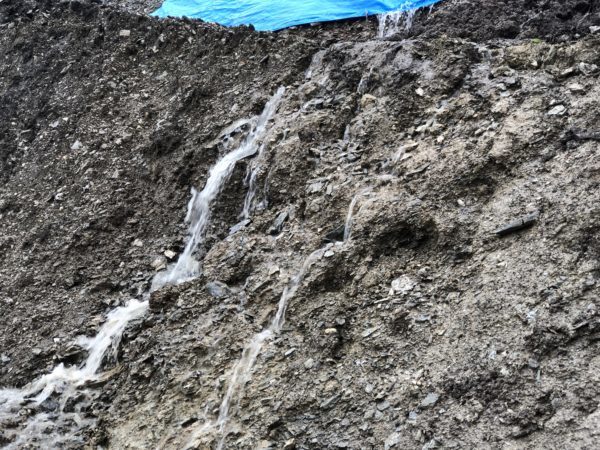
The soil itself was of a type that easily absorbs rainwater, and it had just rained.
On a mountain where erosion occurs every time it rains, the surface treatment work involves reforestation.
It was just a rebar installation job on a particularly steep section of the slope, but I was thinking to myself, “This slope is gonna be rough,” lol.
In fact, even a 45-degree slope—considered a "safe slope"—will collapse once it reaches saturation.
This tendency is particularly pronounced in the case of landslides.
This mountain was no exception. The surface layer consists of loose soil.
The slope was fairly gentle. (Though it seemed steeper than 45 degrees...)
Since heavy rain was forecast for the coming days, I suggested that we should halt construction.
The reason is that,
1. Even though it is known that heavy rain is coming, they proceed with drilling to temporarily loosen the mountain.
2. Some people say you could use grout, but it’s impossible for it to reach full strength in just one day.
3. Since water is used during drilling, this method is only suitable for those who are experienced.
4. If work is performed and that area becomes slippery, it is highly likely that liability will fall on the contractor (general contractor or subcontractor).
5. The above issues can be avoided if addressed before construction begins.
When I relayed this to the general contractor, they decided not to proceed with any construction work that day and instead covered the entire area with blue tarps for protection. I snapped a quick photo of the protective covering.
Evidence photos are extremely important, so be sure to take photos whenever you do something.
When I went to the site a few days later, it had collapsed just as expected.
That said, it was in a different area from where the work was being done, but the fact remains that it had collapsed.
I'm glad I didn't go through with it lol

It may seem like a small thing, but it’s an important part of dealing with government bureaucracy.
Who is responsible?
If the site isn't properly secured after excavating the mountain, the general contractor will likely be held liable, and
If you drill holes knowing that the mountain is unstable, the contractor may be held liable.
If anything comes up, check with the local government before proceeding with the work.
Just charging ahead with everything and anything is the height of folly.
The decision to halt or continue work on-site depends on the situation at the time.
Let’s proceed with construction after thoroughly assessing the on-site conditions and making informed decisions!
See you later.