Hello, everyone. This is Enta.
I've been really into this lately!

You use this to really massage the soles of your feet, and it feels amazing!!
Stimulating the soles of your feet is good for your health, and—after all—it just makes you feel great!
Foot Reflexology Roller, Foot Roller
I highly recommend it!
It's especially good for people who sit all day.
Ready for the Job Site! A Roundup of Amazon's Top Picks for Slope Workers
But that's beside the point.
We get a lot of requests for quotes around this time of year, don't we?
But it’s not over once you’ve prepared and submitted the estimate, is it?
Especially when dealing with major general contractors, the construction or sales representatives will initially...
"Please give us a quote for this job," someone says.
In this case, we prepare a quote by taking into account labor, machinery, materials, transportation, overhead, and our company’s profit.
I want to take it.
But there's no point in running a deficit.
That’s exactly the kind of quote we construction companies end up putting out after agonizing over it for a while, lol.
However, the real work often begins after the quote is submitted.
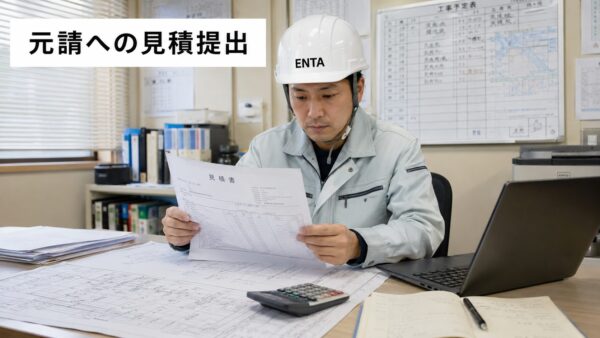
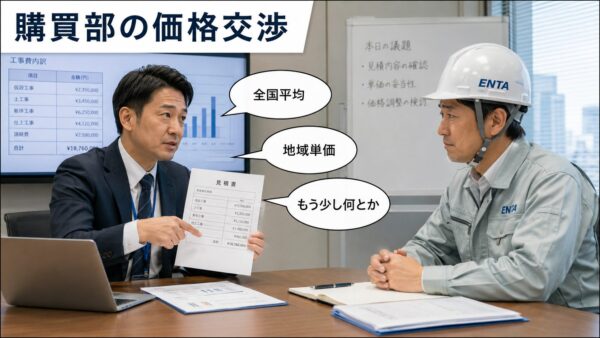
First, the initial price negotiation begins in the purchasing department.
In large companies, there may be a department called the Purchasing Department.
Of course, not every company has a purchasing department, but if a company does, you’ll usually start by talking to someone in purchasing.
That’s when a story like this comes up.
"This is about our company's national average."
"Given the price range in this area, could you lower the price a little more?"
"This project is really tight on profits, you see."
Well, there are lots of ways to put it, lol.
Some even resort to a "pleading" approach, saying, "It's really going to be a problem for me if you don't lower the price even a little bit. I'm sorry to ask this, but please try to work something out."
Conversely, there’s also a more assertive version: “At this unit price, it will be difficult to continue doing business with you.”
It’s quite common to experience a drop of about 1% to 5% here.
However, this is not based on statistics; it is simply something we have frequently encountered in our negotiations with major companies and general contractors.
If you can move forward with the strong determination that “I absolutely cannot lose here!”—then I think that’s fine.
However, in reality, negotiations rarely break down completely at this point; once the purchasing department is reasonably satisfied with the price, the process usually moves on to the next stage.
Next, the Construction Department will review the unit prices and expenses again.
Once the purchasing is complete, the next step is a meeting with the construction manager and the construction staff.
Just when you think you're about to finalize the details of the project, it sometimes turns into another round of price negotiations.
"Can't we do something about the expenses?"
"You're going to transport it with your own truck, right?"
"If we can do the whole job at once, this unit price would go down, right?"
It looks something like this.
From the contractor’s perspective, it’s true that efficiency can sometimes be improved if the work can be completed all at once.
If you use your own delivery service, it may be cheaper than outsourcing the transport.
However, that’s only if all the conditions are perfectly aligned.
And above all, it's down to the company's own efforts!
You start wondering, “Is it really okay to just drag my feet at work?” lol
On actual job sites, it’s quite common for things not to go according to plan due to factors such as the weather, access routes, temporary structures, the surrounding neighborhood, waiting times, and coordination with other contractors.
So if costs are cut just because people assume, “Since we’re doing it ourselves, it should be cheaper, right?” the construction company ends up having to cover everything later on.
You really need to be careful here.
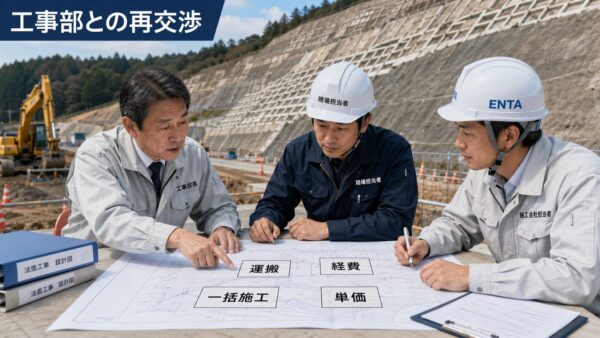
Finally, the person in charge on site will follow up with another message.
And right at the very end, the person in charge on site might say something like this:
"You made a pretty good profit this time, didn't you?"
"Things are tough at our site, too."
"I'd really like to be able to pull back at least this much."
That happens, right? lol
From the contractor's perspective, this is actually quite tough.
It's one of those things where you're like, "Wait, that's not right, is it?"
That's because they cut costs in purchasing, then in the construction department, and finally on-site as well.
In other words, our profit margin is being cut multiple times for a single quote.
Of course, the general contractor has its own circumstances as well.
The contract amount, the relationship with the client, the on-site budget, and the company’s profits. There are probably many factors to consider.
However, subcontractors also have employees.
We also have machines.
I'll buy the ingredients, too.
We also pay social insurance premiums.
I want a raise, too.
I want to give them a better life this year than last year, and next year than this year—even if it’s just a little bit better.
To do that, we need to make a profit.
The Ministry of Land, Infrastructure, Transport and Tourism’s Guidelines for Compliance with Construction Industry Laws and Regulations also outline the relationship between prime contractors and subcontractors.
The bottom line is that while it’s only natural for quality, workmanship, and processes on-site to be subject to strict standards, if we unilaterally impose our terms regarding payment, our subcontractors won’t be able to keep up.
While major companies are turning a profit, small and micro businesses are going under.
Let's take a look at the overall figures for the construction industry here, lol
According to Teikoku Databank’s “Bankruptcy Statistics: FY 2025 Report,” the number of bankruptcies in FY 2025 was 10,425.
It is reported that the number has exceeded 10,000 for two consecutive years.
Within that, the construction industry saw an increase from 1,932 cases in the previous fiscal year to 2,041 cases. This represents a 5.6% increase and is the highest figure in the past 10 years.
Another point worth noting is the issue of scale.
According to the same report, there were 6,475 bankruptcies involving liabilities of less than 50 million yen, the highest number since fiscal year 2000, the earliest comparable year.
Looking at capital stock, there were 7,580 bankruptcies in the “individual + less than 10 million yen” category—the highest number since fiscal year 2000!
In other words, rather than seeing a sudden wave of major bankruptcies, it looks more like small and micro-sized companies are gradually going under.
Looking at these figures, it seems to me that they closely reflect the feelings we experience on the front lines—that “we’re busy but not making a profit” and “we have work but no cash left over.”
On the other hand, among the major general contractors, there are companies that are generating high levels of revenue and profits from large-scale construction projects, urban redevelopment, overseas projects, and real estate development, among other areas.
Of course, circumstances vary from company to company, and I’m not saying that all major companies are the same.
However, from the perspective of subcontractors on the ground, it’s easy to get the impression that “while the higher-ups are making a profit, those further down the chain are getting squeezed by price negotiations.”
I think this is the biggest problem.
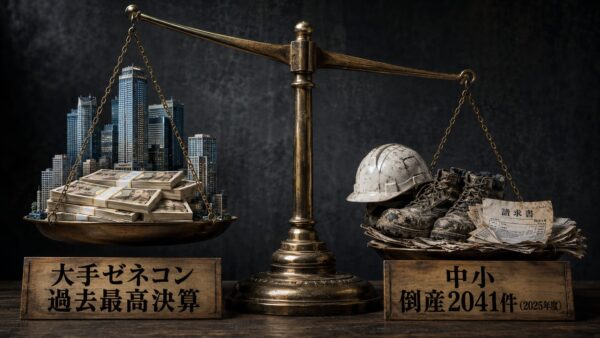
It is not inherently wrong for a general contractor to make a profit.
Since it's a company, it needs to make a profit.
Large companies have employees, shareholders, and social responsibilities.
However, the question is whether the way those profits are generated is undermining the efforts of subcontractors.
We finished a job that was supposed to take 10 days in just 7 days.
This isn't just a coincidence that I happened to have three days off.
Planning, craftsmanship, machine coordination, material delivery, and on-site decision-making. These three days were packed with all of that.
If someone were to say, “Since you made a profit for three days, cut the price by one day’s worth,” it would be as if the fruits of the company’s efforts were being used to fund the discount.
If we keep doing that, what will be left?
And if they end up cutting the amount we agreed on at the start again, you’d be like, “What was the point of that first contract, then??” lol
The fact that the project was completed ahead of schedule and costs were kept down is a result of the subcontractor's efforts.
What's left when you cut back on your efforts?
I'm exhausted!!
If companies that work hard to finish early end up losing out, no one will bother to be creative next time.
The significance of refining the workflow, training craftsmen, and improving machinery all diminishes.
What the general contractor really wants isn't just a company that's cheap, but one that does the work properly and completes the project quickly.
In that case, I think ensuring that subcontractors are left with enough profit to survive is also part of the prime contractor’s on-site management responsibilities.
That is precisely why I believe that the current price negotiations are not just about the amount—they are about whether to preserve or cut support for the construction industry.
Keeping costs down isn't the only thing that matters.
I think that's what the on-site unit price covers.
A situation where only one side—whether the general contractor or the subcontractor—makes a profit cannot last in the long run.
The top is lush, while the bottom is barren.
With a structure like that, I think the operations themselves will eventually grind to a halt.
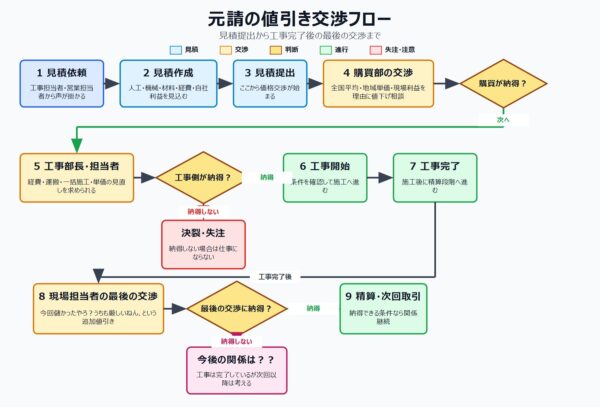
A job that doesn't turn a profit is...
To be honest, you should think twice about doing business with a company that offers multiple rounds of discounts every single time.
However, the major companies have work.
They also have strong sales capabilities.
There are also a number of sites.
So the reality is that it’s not that easy to just say, “I’m quitting.”
But the key question here is: Is this a job worth doing even if it means cutting into our company's profits?
Revenue is recognized the moment an order is received.
But if we don't make a profit, we can't raise our employees' salaries.
We can't upgrade the equipment either.
It also becomes harder to spend money on safety measures.
As a result, this affects on-site quality, processes, and personnel.
I think that going forward, general contractors will also face a tough time if they don’t consider rates that allow construction companies to stay in business, rather than just driving prices down.
We received the order, but there's no company to do the work.
By the time things get to that point, even if you raise the unit price, both the craftsmen and the company may already be gone.
I feel like it’s already starting to happen in some places.
It really is nice to have a kind general contractor, isn't it? ^^
A "lenient" general contractor does not mean one who is lenient about everything.
Quality, Workmanship, Process, Safety.
It's good that this place is strict. In fact, it has to be strict.
However, when it comes to money, unless the general contractor is one that considers an amount that allows subcontractors to make a living, the relationship won’t last long.
Anyone would want to do their best for the people who put food on the table for them, right?
On the other hand, if someone asked me, “Do you really want to keep hanging around with someone who always pushes things to the absolute limit?”—well, that’s pretty much it, lol.
Going forward, I think general contractors who can partner with companies that actually turn a profit and do quality work will be stronger than those who simply look for the cheapest option.
It’s an era in which subcontractors, too, must carefully discern which jobs to accept and which to turn down.
Profit over sales.
Consistency over price.
Work that protects our employees and the company, rather than just focusing on short-term orders.
If you get this wrong, no matter how busy you are, the company will start to decline.
A quote isn't just a number—it's a statement of intent for the company's survival.
See you later.