Hello, everyone.
This is Enta.
It's Christmas, isn't it? lol
It's not just that it's barely related—it's actually completely unrelated.
But it's just a matter of my child asking me for money...
Rather than a gift as a distraction, cash...
It's a tough world out there.

But that's beside the point.
The other day, I was talking to someone, and we were joking about how confusing the terminology in design can be, lol.
It’s not like I’m confused—I’ve actually forgotten what the word even means, so it’s not really a problem—but I just thought it might be good to know...
This is a term that often comes up in slope design, so let's review it again ^^
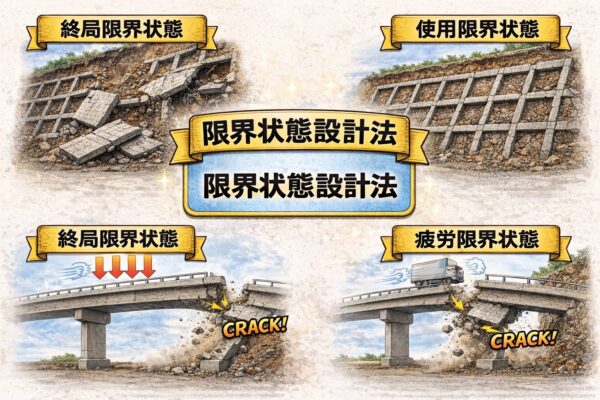
The Three States in Limit State Design
The limit state design method is a design approach that defines “limit states”—conditions under which a structure would fail or become unusable—and verifies the structure’s safety against those states.
1. Ultimate Limit State
This refers to the critical condition at which a structure or its components can no longer physically withstand the load.
Phenomena: Failure, overturning, buckling, large deformations, etc.
Result: The structure completely loses its stability and functionality.

I picture the frame snapping in half and falling off the slope, or being severely crushed so that it can no longer support the soil and debris.
2. Serviceability Limit State
This refers to a condition in which, even if the structure itself is not damaged, issues arise with its appearance or usability, rendering it unusable.
Symptoms: Excessive cracking, displacement, deformation, vibration, etc.
Result: Durability is compromised, causing concern for users and preventing normal use.
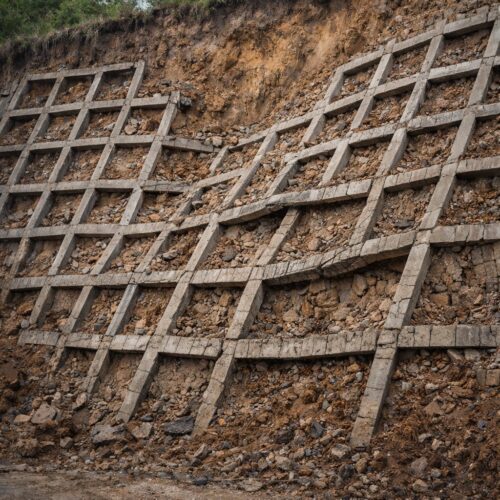
The frame has countless tiny cracks on its surface and is slightly warped, giving the impression that “it looks dangerous if left as is.”
The pictures generated by AI already look like they've surpassed their limits, though lol
3. Fatigue Limit State
This refers to a condition in which a material weakens due to repeated application of force over a long period of time and eventually fails.
Phenomenon: Fatigue failure caused by fluctuating loads (repeatedly applied forces).
Result: Even a force that would not cause failure on a single application can lead to the failure of the component when applied repeatedly.
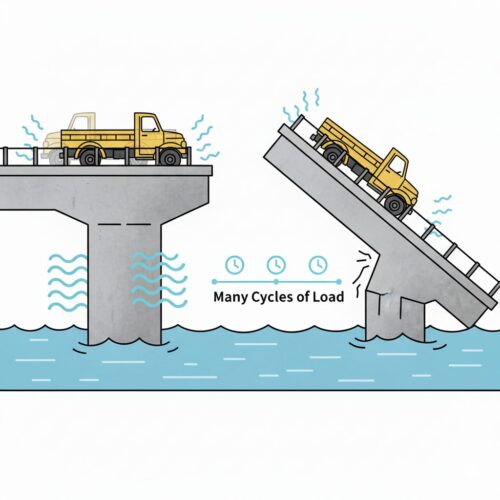
The way a part snaps suddenly one day after being subjected to the same load repeatedly—such as vibrations from a moving vehicle or recurring wind pressure.
Here's what it looks like.
It’s good to know, but since I don’t use it much outside of work, I tend to forget all about it lol.
Let's just remember it as "something happened, I guess."
See you later.