Hello, everyone.
This is Enta.
Well, the first three days of the New Year—when everyone’s still in the holiday spirit—are over, lol.
I'm living my life as usual, so not much has changed.
If it weren't for COVID-19, it seems like a lot of people would be traveling abroad, but,
With all the border controls in place against the Omicron variant of the novel coronavirus, we can't go anywhere right now, can we?
I wake up a little late in the morning (around 9:00 a.m.), brush my teeth, wash my face, and then go on patrol lol
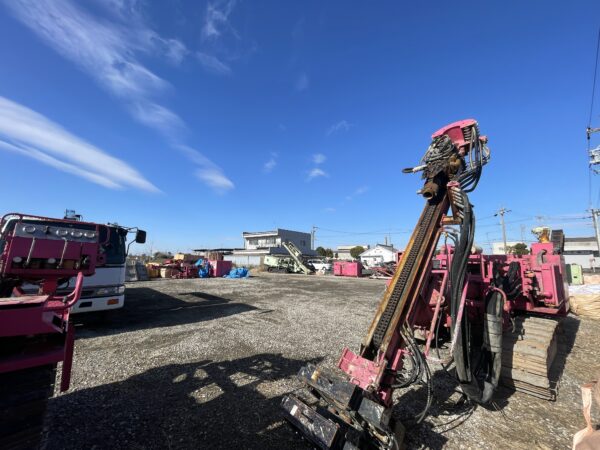
Unless something changes, I'll be making my rounds at the companies as usual.
But that's beside the point.
Everyone knows what screws (bolts and nuts) are, right?
Do you know how screws are made?
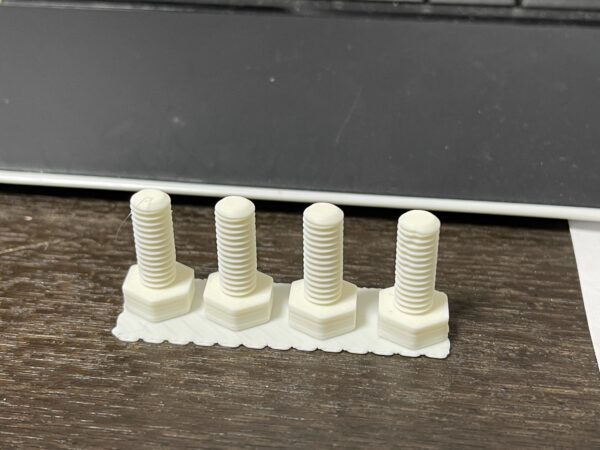
This is an M6 bolt made with a 3D printer.
The tool used to thread this into the nut is called a tap.
At metalworking shops and similar facilities,TappingThat's what they say.
If screw holes or similar features become damaged on-site, you can repair them to some extent if you have a tap.
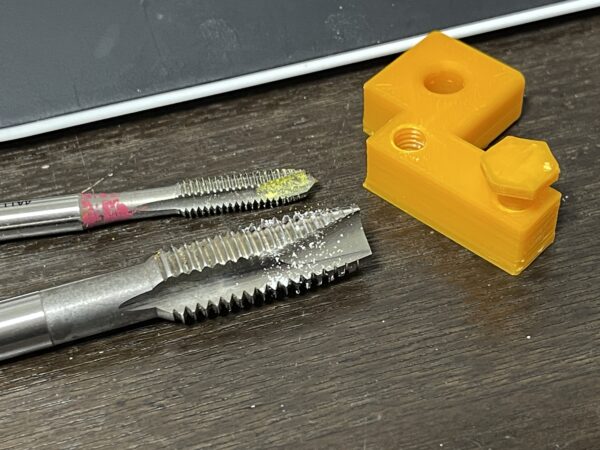
The metal tool on the left is called a tap.
If you insert this into the pilot hole and screw it in, the threads will form properly.
There are three types of taps used in the actual tapping process: the first is a fine-pitch tap, followed by a coarse-pitch tap, and finally a finishing tap, which are used to cut the threads.
Since the finish on screw threads produced by a 3D printer tends to be rough, people often use a tap instead.
It’s handy to know this, since you might use it on the job.
On the other hand, sometimes it’s the bolt that fails, right?
In cases like that, we use dice.
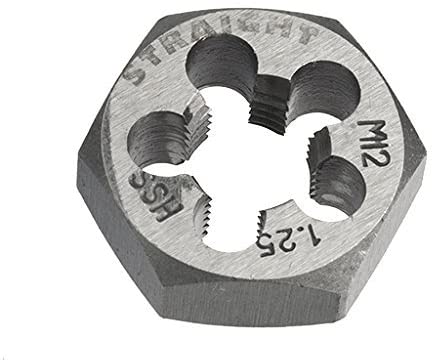
This is a die.
By screwing bolts into this, you can sharpen the bolt threads.
You can make a screw even from a plain rod with no threads. (There is a specified optimal diameter.)
It’s reassuring to have a die on hand in case a bolt’s threads are stripped, but since it’s cheaper to just buy a new bolt, you don’t need a die if you have a spare lol.
Both the tap and the die have their own handles, so please use those.
It's just a small tool, but it comes in handy to have one on hand.
It’s pretty common for bolts to fly off, go missing, or lose their threads on the job site, isn’t it?
If you're working with threaded holes, having dies and taps on hand comes in very handy.
Of course, you should always have spare bolts and nuts on hand, but when it comes to every single type...
On the other hand, there are fewer dies and taps than bolts, and since there are quite a few sets available, I recommend them.
There are plenty of inexpensive options out there, but I think as long as you use them in the right place and they’re suitable for the job, even the cheaper ones should be fine.
However, the downside is that the tap itself may break or, conversely, fail to cut properly (cheaper models often have issues with precision and strength).
Personally, even if they're a little pricey, I recommend getting high-precision tools like these.

It's a real pain when the machine breaks down, lol.
We use the dice set shown above, too.
It's just a temporary fix, though.
See you later.