Hello, everyone.
This is Enta.
I went to Mie the other day for my first day back at work, but there was snow...
It's not a big deal—just a little snow—but it gets gradually colder afterward.
It's usually relatively warm on snowy days, but it got a little chilly the other day.
Well, I was just there to deliver the equipment—once it was set up, I went home and made the rounds to say hello.
We really struggle with staff shortages this time of year, but when a certain point comes around, I find myself thinking, “Maybe it’s actually a good thing we’re short-staffed?” lol
I really wish they'd do more to even things out...
But that's beside the point.
How many layers of cement are stacked there?
Or rather, what is the maximum length in centimeters that is considered safe?
If you can answer that right away, you must be a veteran, lol.

A pile of stacked cargo, such as cement, cardboard boxes, and pallets, is called"Yes"It is called...
Assemble and stack them so they don't fall apart"Say 'Yes'"is what they say.
On the other hand, to unload the cargo safely without causing it to collapse,"Haikuzushi"is what they say.
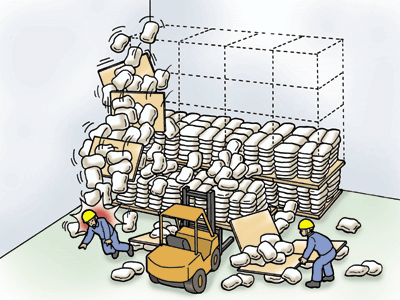
Our slope maintenance team doesn't often see a "yes" like that, but,
You assemble the base material for the vegetation substrate and set it aside, right?
That's what's called "hai-tsuke."
So, you actually need a license to assemble this “Hai.”
The required height is2.0 meters or moreThat's it.
When loading more than 2.0 metersは"Yes, foreman."the installation of, and
Safety and Health Training for Workers"Yes, Occupational Safety and Health Training for Workers"is required.
I didn't know this until I looked it up myself, but there are all kinds of certifications, huh? lol
Safety is a deep and complex subject—there’s so much I don’t know about it.
Conversely, this means that as long as the height is 2.0 meters or less, it doesn't matter who loads it.
Please keep the height of the cement and base material at 2.0 meters or less.
See you later.