Hello, everyone.
This is Enta.
Construction sites in the summer—especially on slopes—are pure hell, aren't they?
I wondered if there was a difference in temperature between flat ground and slopes, so I looked into it.
Then all kinds of data started popping up, lol
Today, I’m going to write about “Why are slopes hotter than flat ground?” from the perspective of sunlight and reflected heat lol
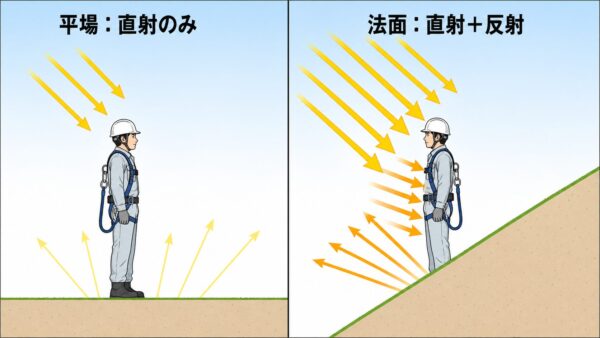
Difference from Flat Terrain (1): Angle of Incidence of Sunlight
Apparently, the "energy per unit area" from sunlight varies depending on the angle at which it hits a surface!
The surface is strongest when struck vertically from directly above, and becomes weaker when laid on its side.
On the other hand, if you set it up facing the sun, the light may be stronger than on flat ground.
This is the phenomenon that occurs on slopes, particularly on south-facing slopes in the summer.
Check out this solar power setup lol
That's totally facing the sun, and it's at an angle, right? lol
A classical formula has been established for calculating the direct solar radiation incident on a slope; it is calculated using the ratio of the cosine of the angle of incidence to the cosine of the zenith angle (apparently, this is an approach used in the field of solar radiation estimation).
To put it simply, around noon in the summer, a south-facing slope comes to an angle that is nearly "directly facing" the sun, so the solar radiation energy per unit area may be greater than that of a flat surface.
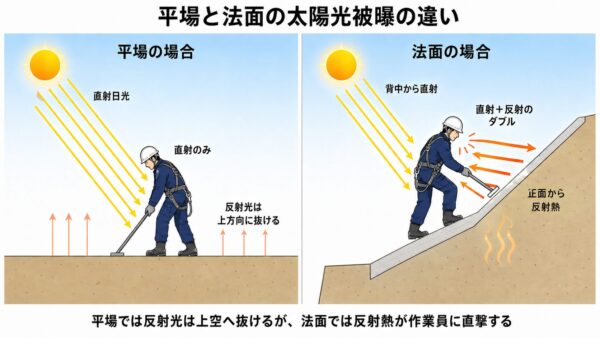
Difference from a Flat Surface (2): The Direction from Which Reflected Light Returns
I think this is the explanation that best matches what we experience on the ground.
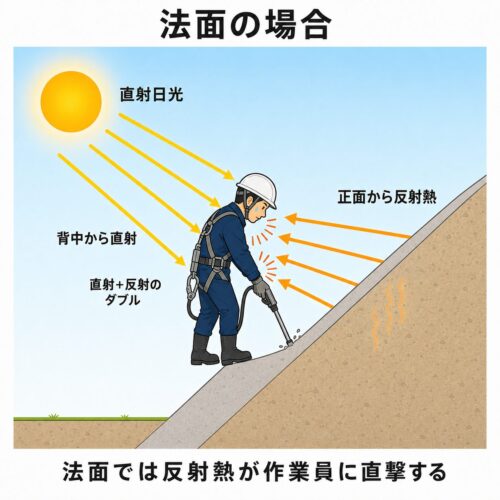
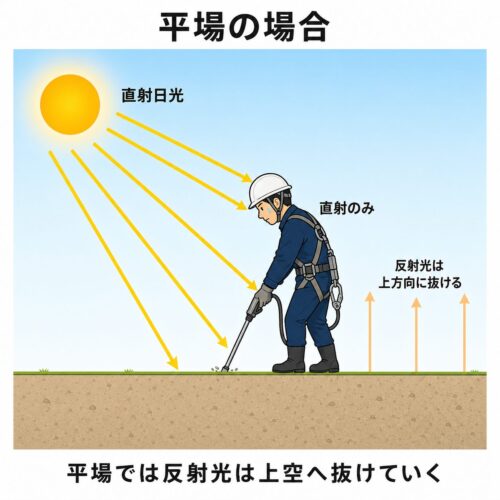
When working while standing on level ground, light reflected from the ground generally escapes “upward.”
It hardly ever comes back to our faces or torsos.
However, on a slope, light reflected from the slope’s surface bounces directly toward the worker’s chest and face.
Direct sunlight from behind, reflected light from the front.
Double WhammyYou're getting drenched, aren't you?
That's why we slope workers are sweltering!!
And the slope worker's face is crazy dark lol
When you examine the spatial relationship between the slope and the flat area during construction, it’s physically self-evident, but,
To be honest, as far as I could tell, I couldn’t find any publicly available data showing direct measurements comparing “slopes vs. flat ground” using the WBGT.
So you're just lumping everything together as if all the on-site conditions were the same, huh? lol
Difference from Flat Terrain (3): High albedo on the slope surface
"Albedo" is a word I learned for the first time while doing some research lol
Apparently, "albedo" refers to "solar reflectance," and it seems to be a common term in that field, lol (albedo)
Newly applied sprayed mortar is pure white, isn't it? It looks that way, especially in the summer.
Hmm, apparently it has a high reflectivity, just as it looks.
Based on the figures published in the paving industry, here’s a rough idea of what it looks like.
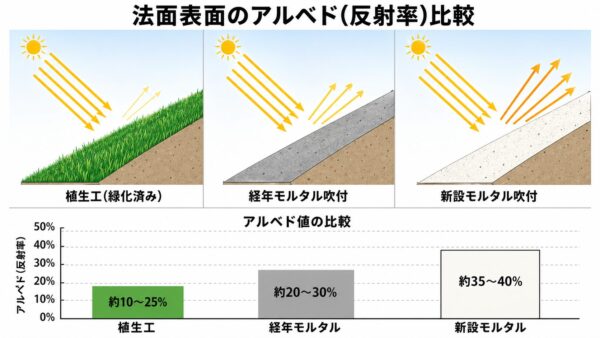
- Vegetation Engineering (Landscaped): 0.10–0.25
- Aged sprayed mortar (the blackened kind): 0.20–0.30
- Newly applied sprayed mortar (the whitish one): approximately 0.35–0.40
*Since publicly available measurement data in Japan specifically regarding mortar spraying on slopes is limited, this includes estimates based on data from the pavement sector (such as published values from the American Concrete Pavement Association (ACPA) and others).
In other words, when applying sprayed mortar to a new structure or installing retaining walls, there’s a higher likelihood of being exposed to reflected light than on sites where vegetation engineering is being performed.
This means you need to be careful about heatstroke.
Heat Stress That Hits You with a Double Whammy
If you add the three items listed so far, you get this.
- Depending on the angle of incidence, there are times of day when solar radiation is greater than on a flat surface.
- Reflected light bounces back toward the worker's face
- The higher the surface albedo, the stronger the reflected light.
Direct sunlight on my back, reflected light from the front, and radiant heat from the mortar at my feet.
According to the Ministry of Land, Infrastructure, Transport and Tourism’s “Guidelines for Heat Island Countermeasures,” the surface temperature of mortar surfaces can reach 50–60°C, similar to that of paved surfaces.
(Please note that the range is between 40 and 60°C, depending on the conditions.)
I’ve finally realized that “It’s so hot on the slope!” isn’t just “all in my head”—it’s actually a physically harsh environment lol.
Measures That Can Be Taken on Site
So, the question is, “What should we do?” Here’s what we can think of at this point.
① Measuring WBGT on a Slope
This just goes to show that a WBGT forecast for flat ground alone isn't enough. Measure it right next to the slope—ideally, near where you'll be working.
② Break up your breaks into smaller intervals
Not once an hour, but once every 30 minutes. Even if it's just a little, make sure to hydrate in the shade.
③ Be careful of equipment being installed
At summer job sites, we’re stepping up protection for the entire face—including the neck—with sunglasses and helmet covers.
④ Prioritize breathable clothing
In addition to air-conditioned clothing, of course, choose items that are designed to allow air to circulate through both the top and bottom.
An era when you can't protect workers without investing in equipment.
Don't Let Them Collapse During the Summer Services
Heat-related deaths in the construction industry are clearly on the rise.
To a slope worker, summer construction sites just seem like nothing but a grueling physical ordeal.
This isn't the kind of heat you can just power through with determination and grit.
Since we're working in an environment that's physically more demanding than a standard workplace, it's unrealistic to expect us to perform using the same equipment and following the same break schedule as in a standard workplace.
In particular, to all site supervisors and construction managers.
Please take a closer look at the craftsman's work.
Complexion, how quickly the sweat subsides, and the sharpness of their replies.
If something feels off, take a break right away.
If someone were to collapse on the slope, the rescue operation itself would be a life-or-death situation.
Stop it before it happens. That's really all there is to it.
See you later.