Heatstroke Prevention Measures in the Japan Maritime Self-Defense Force
Once the rainy season ends, the sun’s rays suddenly become much stronger, creating an environment where heatstroke is even more likely to occur.
In recent years, preventive measures and public awareness campaigns regarding heatstroke have been actively promoted, and the Japan Maritime Self-Defense Force, where I used to work, is no exception. This is because heatstroke cases result in a loss of combat capability for the Self-Defense Forces, which can make it impossible to carry out operations depending on the situation.
In this session, I’d like to discuss a case of heatstroke that occurred at a construction site within the Japan Maritime Self-Defense Force.
Using Flag Colors to Communicate the Heat Index
The Japan Maritime Self-Defense Force disseminates information on the heat index (WBGT) based on forecasts from meteorologists assigned to its units and weather observations conducted by meteorological personnel. To ensure that unit members are aware of the conditions, the Force displays colored flags corresponding to different levels on flagpoles and other structures at its facilities.
The flag colors follow the standards used by the U.S. military; black indicates that outdoor activities are generally prohibited. Next is red, which means physical activity should generally be suspended; orange indicates a high alert; and yellow indicates a warning, with activity restrictions determined based on the heat index.。
Naturally, the Japan Maritime Self-Defense Force also takes measures to prevent heatstroke—such as adjusting training content and the frequency of breaks—based on the heat index.
As part of a simple paving project that also served as construction training…
This happened when I was stationed at a unit on a certain southern island. The rainy season had ended, and we were carrying out construction work to improve the parking lot—a project that also served as training, as scheduled in our annual plan.
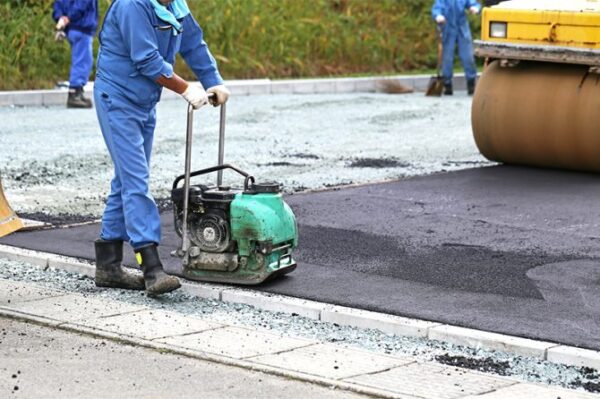
Due to budget constraints, we planned to use gravel instead of asphalt. This was a training exercise in basic site preparation and compaction using equipment. The area to be prepared was approximately 500 square meters, and we set aside a longer timeframe—four days plus one reserve day—taking into account the island’s weather conditions and each participant’s work schedule.
As I’ve mentioned before, there are few personnel in the facilities specialty within the Japan Maritime Self-Defense Force. At the time, the facilities management department of the unit stationed on a southern island consisted of only two officers, two petty officers (enlisted personnel) in the facilities management section of the unit stationed on a southern island where I was serving at the time. In addition to these, there were three petty officers specializing in boilers and electrical systems within the shipboard trades—making a total of seven Self-Defense Force personnel, plus an electrical engineer, for a total of just eight people.
The actual work was primarily carried out by petty officers, and the training team consisted of me—who was in charge of on-site operations—and five petty officers. However, since only two members from the facilities division hold the necessary certifications to operate heavy machinery and other equipment, the three members from the shipboard operations division will be working as general laborers.
The temperature is 34°C. Should we stop working?
This was on the third day of work. On the second day, frequent downpours—typical of southern islands—began in the morning, making it impossible to work, so we had to suspend operations; therefore, in terms of the construction project, this was the second day.
Since the workers had gotten the hang of the work procedures to some extent on the first day, the morning went smoothly, and it looked like they would be able to finish the job that same day if they kept up that pace. However, unlike the previous day, the weather was clear and sunny. The thermometer set up at the site was already reading 33–34°C before noon.
Since we had some leeway in the schedule, I felt there was no need to push the crew too hard, given their physical condition, so I consulted with the Senior Petty Officer and suggested, “For this afternoon’s work, why don’t we suspend operations for one hour—from 2:00 p.m. to 3:00 p.m., when it’s likely to be the hottest—and resume work after 4:00 p.m.?”
The senior petty officer said he wanted to consult with the crew, then returned. Everyone agreed that they should take frequent breaks while continuing to work, with the goal of finishing the job by the end of the day.
"As long as we stay hydrated and take frequent breaks, we'll be fine," I agreed with everyone else, and we resumed work in the afternoon as planned.
Incidence of Heat Stroke Cases
In the end, the high for the day was 36°C, making it a relatively hot day even for a southern island. When the work was finished and I returned to the office in the evening, a crew member in his mid-40s from the shipboard operations division complained of “feeling sluggish and dizzy,” so I instructed him to lie down on the sofa and bought him a sports drink from the store to help him rehydrate. Just to be safe, I also notified the infirmary, and a medical assistant came to the office to examine him and help cool him down with ice packs and other measures.
The public health officer advised, “I believe the symptoms are definitely those of heatstroke. Since the team member in question lives alone, I think it would be best for someone to pick them up and drop them off on their way home and tomorrow morning, just to check on their well-being.” It was a blessing in disguise that, in the end, nothing serious happened.
I do regret making them perform work they weren’t used to, especially in such extreme heat. Even though I assumed the facility staff would be fine, it was my fault for failing to realize that, for someone with no construction experience, the work would be a real struggle.
Surprised by a Private Construction Company's Heatstroke Prevention Measures
I don’t know how things are now, but when we were training in the Self-Defense Forces, we basically had to either bring our own heatstroke-prevention items and drinks or pool our money to buy them. I think this was a very inadequate approach for an organization. It was also common for the officers in charge on the ground to provide these items out of their own pockets.
After switching to the private sector and talking to various people, I was surprised to learn that many companies provide drinks, salt candies, and other items when employees go out to work sites.
As you all know, heatstroke can be fatal if not handled properly. I expect working conditions on-site will become even more grueling as the season progresses, but life is nothing without health. If you feel even the slightest change in how you’re feeling, please have the courage to let those around you know as soon as possible.