
Bears in Residential Areas and Property Rights; Scaffolding on Neighboring Properties and Property Rights
I often see scary news reports about bears appearing in residential areas. If you were about to be attacked by a bear and, while fleeing, ended up damaging the fence of someone else’s house, you would be exempt from punishment under Article 37 of the Penal Code if it were recognized that you had no choice but to do so to avoid a threat to your life, “Emergency Evacuation"may apply. Emergency avoidance refers to,An act of infringing on the rights of others out of necessity to protect oneself from an immediate dangerThis refers to a legal system under which certain acts that infringe on property rights are not punishable.
Another measure aimed at reconciling this with ownership rights is “Right to Use Adjacent Land"Emergency Evacuation" is intended to avert a threat to life or physical safety, whereas "the right to use adjacent land" is established to promote the effective use of land. Using adjacent land without permission constitutes an infringement of a neighbor's property rights.
However, if it were absolutely prohibited to use adjacent land without the neighbor’s consent, there would be cases where construction projects would have to be abandoned, hindering the effective use of land—which could be considered a social loss. Therefore, the law recognizes the right to use adjacent land as a balance to property rights.
Reiwa 5: Amendments to the Right to Use Adjacent Land
Effective April 1, Reiwa 5, the provisions of the Civil Code regarding the right to use adjacent land have been amended.
Article 209 of the Civil Code (Request for Use of Adjacent Land)
A landowner may use adjacent land to the extent necessary for the purposes listed below. However, with regard to dwellings, the landowner may not enter them without the consent of the residents.
I. Construction, Removal, or Repair of Barriers, Buildings, or Other Structures on or Near a Boundary
(2) Survey of boundary markers or surveying related to boundaries
III. (Omitted)
② (omitted)
(3) Any person who uses an adjacent lot pursuant to the provisions of paragraph (1) must notify the owner and any other user of the adjacent lot in advance of the purpose, date, time, location, and method of such use. (The remainder is omitted.)
Compared to the pre-amendment provision, which stated that “one may request the use of an adjacent lot owned by another person,” the amended provision stipulates that “one may use an adjacent lot,” thereby clarifying the right.
Furthermore, Paragraph 3 of the same article states, “The owner and user of the adjacent land must be notified of the purpose, date, time, location, and method.” While this could be interpreted to mean that entering the adjacent land is permitted as long as written notice is provided, that is not the case. Consent is still required, and without it, the matter must be brought before a court.
While you may be “allowed to use” the adjacent property for construction work, even if you have the right to use it under the Civil Code, using it without the owner’s consent is not permitted as a form of self-help.
Self-help
Self-help refers to a situation where a rights holder enforces their rights by force without going through legal procedures. For example, even if you find a stolen bicycle in another apartment building’s bike parking area, you are prohibited from retrieving it on your own. Remedies for rights infringements should be sought through public institutions such as the courts, and self-help is, in principle, prohibited. If your request for the right to use an adjacent property is denied, entering that property without permission and beginning construction constitutes self-help. If the owner of the adjacent property does not consent, you will still need to go to court. However, in ordinary court proceedings, it can take years for a judgment to become final. In cases where damage would occur unless construction begins immediately, you can file a petition for a preliminary injunction. As the term “provisional” suggests, this is a system designed to issue temporary orders within a short period—ranging from a few days to a few weeks—in cases of urgent necessity. After a provisional injunction is issued, the case proceeds through the regular court proceedings.
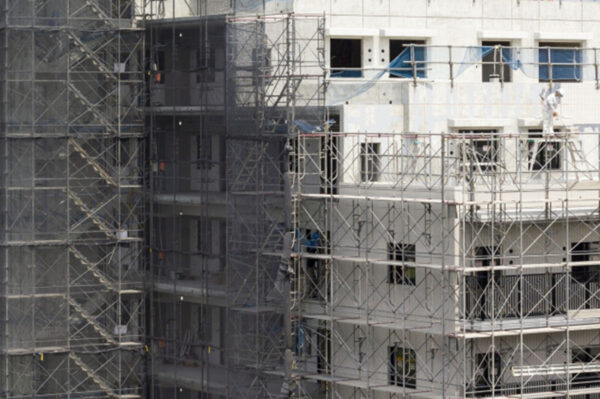
The Existence of a Proviso Regarding “Residences”
Article 209, Paragraph 1 of the Civil Code states in its proviso: “However, one may not enter a neighbor’s dwelling without the neighbor’s consent.” There is a case in which this proviso was used to deny a claim for the right to use adjacent land. The details of the case are as follows.
- The building owned by X had been standing for 30 years and had become dilapidated, with the exterior walls beginning to crumble, among other issues, making repair work necessary.
- Due to construction work, we needed access to the rooftop and emergency staircase of the neighboring building owned by Y—which stands about 30 centimeters away from the building owned by X—and requested their cooperation.
- Y refused X's request for cooperation. Furthermore, Y set up a temporary barrier made of steel plates on the roof and attached plywood to the handrails of the emergency staircase to prevent construction work from taking place.
- X filed a lawsuit with the Tokyo District Court seeking “consent to use the land and enter the building, among other matters.”
- Y argued that the building he owned was a “residence.” He contended that, because it was a residence, the court’s judgment could not be substituted for his consent.
- On the roof of the Y Building, there was nothing but electrical substation equipment and air conditioning outdoor units.
Judgment on the Issue of “Residence”
Since the rooftop of Y's building contained only substation equipment and air conditioning outdoor units, the court rejected Y's claim and granted X's request.
Judgment
“According to the proviso to Article 209, Paragraph 1 of the Civil Code, entry into a ‘dwelling’ requires the neighbor’s consent; however, since the basis for this provision is understood to be the protection of the neighbor’s peace of mind (privacy), the rooftop and emergency staircase of Y’s building should be deemed not to constitute a ‘dwelling’ given their manner of use. Y is hereby ordered to grant permission for entry. Furthermore, since the temporary fencing is obstructing the construction work, Y is ordered to remove it.” (January 28, Heisei 11, Tokyo District Court)
Incidentally, there was a reason for Y’s refusal. Previously, when X constructed an annex to its building, the vibrations from the construction caused distortion in the walls of Y’s building, resulting in the collapse of a portion of the exterior wall. When Y requested that X repair the damage, X refused. While the court acknowledged that “there were aspects of Y’s refusal that were not entirely without merit,” it ultimately ordered the removal of the obstruction. This was done solely to ensure the effective use of the land.
Incidentally, regarding emergency evacuation procedures in the event that a bear appears in a residential area, the National Police Agency has issued a directive to the heads of each prefectural police department.
"Given that there are situations where hunters may arrive at the scene before police officers, the hunter in question is not prohibited from using a hunting rifle to cull bears or other animals as a measure of emergency self-defense (Article 37, Paragraph 1 of the Penal Code) based on his or her own judgment."
It seems that both civil and criminal law are applied flexibly to accommodate people’s daily lives.