Hello, everyone.
This is Enta.
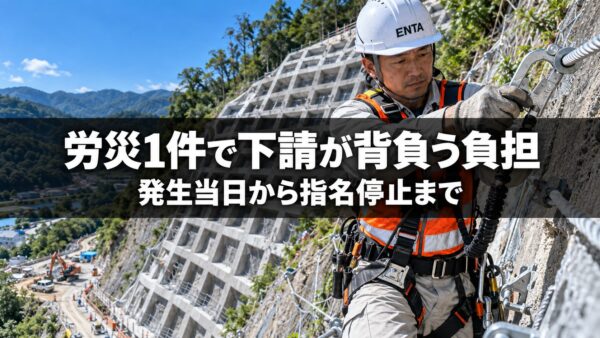
In this post, I’ll outline, in chronological order, what happens to a subcontractor when a work-related injury occurs on a job site.
"Accidents are no good"—everyone says that.
However, surprisingly few foremen know exactly who has to run around for how many days after an accident, which documents need to be submitted, and which expenses the company is responsible for paying.
If you know the proper procedure, you won’t panic if you’re involved in an accident. More importantly, I hope that realizing, “If I cause an accident, I’ll have to deal with all of this,” will help strengthen your sense of responsibility and raise your awareness of the consequences of accidents.
What to Do on the Day of a Work-Related Injury and the Following Day
For example, suppose a worker slips while moving a spray hose on a small step of a slope and falls about 2 meters down to the next step, fracturing his wrist.
The first thing to do is provide first aid and call 119.
It’s dangerous to think, “I can just take them to the hospital in my own car.”
You can't tell right away whether someone has hit their head.
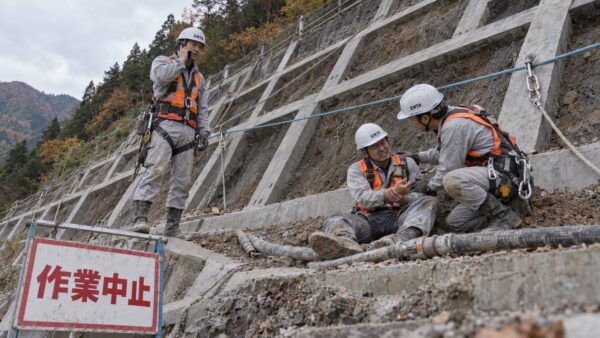
Next, we will halt work to prevent secondary accidents.
Turn off the spray machine and compressor, and guide the workers on the same landing to a safe location.
After that, I immediately called the general contractor’s site representative.
The initial report to the general contractor need only include the following details: “When, where, who, what they were doing, what happened, and which hospital they are currently at.”
I'll put speculating about the cause aside for now and just share the facts we know.
We will leave the site as undisturbed as possible.
The Labor Standards Inspection Office and the general contractor will later verify the position of the safety rope, where the safety harness was attached, and the condition of the ground beneath the worker’s feet.
In some cases, even the police.
If you clean it up, you won't be able to explain what happened.
It is standard practice for the general contractor’s safety officer to request an accident report sometime between the evening of the incident and the following day.
It will make things easier later on if you take statements from the victim, any workers who witnessed the incident, and the foreman, and keep a chronological record of the events.
I'll write it down in as much detail as possible—things like "What time and minute did the fall occur?", "What time and minute did the ambulance arrive?", and "Was the safety harness on at the time? From what position?"
People's memories change surprisingly quickly—in just two or three days, lol.
We’ll also decide by the end of the day who from the company will be responsible for contacting the families of the victims.
Workers' Injury, Illness, and Fatality Reports and Compensation for the First Three Days of Absence
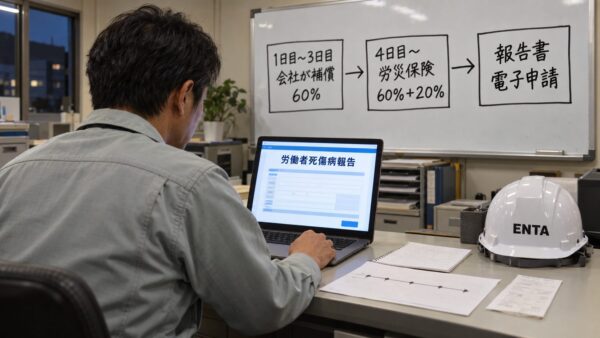
If an injured worker is required to take time off, the company is obligated to submit a “Worker Injury, Illness, or Death Report” to the Labor Standards Inspection Office.
The Occupational Safety and Health Regulations stipulate that reports for absences of four or more days must be submitted without delay, while reports for absences of fewer than four days must be submitted in a single batch each quarter.
The Ministry of Health, Labor and Welfare has revised the reporting requirements, and electronic filing will become mandatory starting January 1, Reiwa 7. (I’ve written about this several times on this blog.)
To those in charge who think, "I'll just print it out on paper," that's no longer the case.
Please also let the disaster victims know not to present their health insurance cards at the hospital reception desk.
Injuries sustained while on the job are covered by workers' compensation insurance; health insurance cannot be used.
The process of switching later is quite a hassle for both the employee and the company.
Please say right from the start that you were injured on the job.
Under the Labor Insurance Collection Act, the general rule is that the general contractor is responsible for enrolling all workers at a construction site in workers' compensation insurance as a single entity.
Therefore, even if a subcontractor’s worker is injured, it is the general contractor’s workers’ compensation insurance that covers the claim.
However, business owners themselves and sole proprietors are excluded from coverage and will not receive compensation unless they have enrolled in the special enrollment program.
These days, it’s almost unheard of for a sole proprietor to be involved in public works projects, but if the company president gets injured, that’s where things come to a standstill lol.
That's why it's better for the president to stay off the front lines.
Alternatively, you must have special supplementary insurance (all of our employees are covered as well—so we can provide solid protection no matter what happens!).
And there is money to be paid by the subcontractor that caused the accident.
According to documents from the Labor Bureau of the Ministry of Health, Labor, and Welfare, workers' compensation benefits for lost wages are paid starting on the fourth day of absence from work.
The first through third days constitute a waiting period, during which the employer is required to pay 60 percent of the employee’s average daily wage for each day, in accordance with the Labor Standards Act.
Starting on the fourth day, workers' compensation insurance will provide a disability compensation benefit equal to 60 percent of the basic daily benefit amount, along with a special disability allowance equal to 20 percent.
Failing to file a report, submitting false information, or engaging in what is commonly referred to as “concealing workplace accidents” constitutes a violation of the Occupational Safety and Health Act and is punishable by a fine of up to 500,000 yen.
Keeping quiet because you don't want to cause trouble for the general contractor ends up costing you the most.
And if it's discovered, the general contractor will also be penalized.
Burdens Remaining Until Construction Resumes and After Resumption
From the day of the accident onward, the extent to which work at the site is suspended will depend on the severity of the accident and the general contractor's decision.
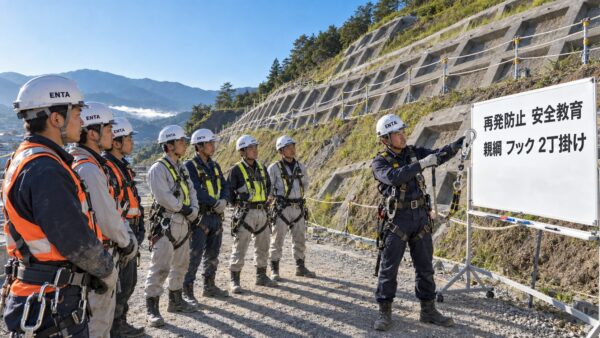
Even in the case of a simple fracture, work cannot resume until the investigation into the cause is complete, measures to prevent recurrence have been established, work procedures have been reviewed, and all workers have undergone retraining.
If the fall occurred from the lower platform at the start, measures to prevent a recurrence would likely include re-securing the main rope, reviewing the route for moving between platforms, and strictly enforcing the use of safety harnesses when moving along the hose.
Once this is put in writing and approved by the general contractor (or prepared by the general contractor’s safety department), and explained to everyone at the morning meeting, we can finally discuss resuming work.
Based on my experience, I think operations will be halted for at least two days in the case of a work-related injury requiring immediate medical attention, and for at least one week in the case of a work-related injury resulting in a temporary work stoppage—at the very earliest, operations will be halted for at least two days to several weeks.
In the meantime, we’re still incurring daily costs for the leased spray equipment and generators, and we also have to plan the next steps for the workers.
So far, this is the money you can see.
What's scary is what comes after the construction is finished.
According to the Ministry of Land, Infrastructure, Transport and Tourism’s “Guidelines on Measures Such as Suspension of Eligibility for Bidding in Construction Contracts,” if inadequate safety management results in injuries or fatalities among construction personnel, the suspension period is set at a minimum of 2 weeks and a maximum of 4 months for projects under the Ministry’s direct jurisdiction, and at a minimum of 2 weeks and a maximum of 2 months for general construction projects if the accident is deemed serious.
Furthermore, if a subcontractor is also at fault for the accident and that subcontractor holds bidding eligibility with the same client, the system is designed so that the subcontractor is also suspended from bidding for a period corresponding to the prime contractor’s suspension period.
Even if a company usually works as a subcontractor, if it submits its own bids and wins prime contractor projects, this will affect its own bidding process.
In fact, there are plenty of contractors who have been barred from receiving contracts.
A fine of 200,000 yen may seem like a minor penalty at first glance, but when you factor in the referral to prosecutors, the trial, the suspension of contracts, and the subsequent impact on the company’s reputation with the general contractor, the company stands to lose many times that amount.
The greatest loss—one that can’t be quantified—is the injury sustained by the worker and the stigma from the general contractor asking, “Is that area really safe?”
Once it gets on something, it's really hard to get off...
We’ve also been involved in an accident recently and have caused some trouble, so we’re truly sorry.
It's an accident that happened on a day off, but it's proof that the whole company has let its guard down.
We will continue to raise awareness thoroughly.
If you follow the sequence of events like this, I think you’ll see that it’s not just the victims who are affected by a single accident.
Supervisors and foremen must submit reports; the company must file an electronic application and provide compensation for the first three days; the general contractor must explain the situation to the Labor Standards Inspection Office and the client; and the entire company faces the risk of being barred from bidding.
If it means the process will be delayed by two or three days, I'll err on the side of caution.
You can make up for delays in the production process, but it takes years to clean up the mess left by an accident.
If someone says, “I’m in a hurry, so I don’t need to wear a safety harness,” please firmly remind them of the rules and provide safety training again.
And never cause an accident! And don't cover it up! This is important.
However, it cannot be denied that there is a tendency to hide accidents because penalties are imposed when they occur.
See you later.