



Here’s a story about a rebar insertion job we did in Kagawa Prefecture the other day.
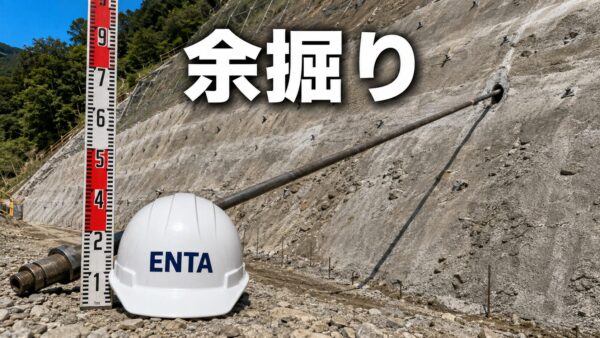
I assumed that several components (such as spacers and injection pipes) would be attached to the reinforcement to form a single reinforcement member, but at this job site, it included an “end cap”—something I myself haven’t used very often.
⬆ “Tip Cap”
I, too, found myself wondering, “What’s the point of this? What does it mean?”
Well, since the materials were approved and we checked them, the installation is now complete.
So, the work is now complete...
So, a few days later, the person in charge at the government office contacted the general contractor and apparently asked, “By the way, are end caps really necessary?” I searched through the literature to see if end caps were required, but couldn’t find any mention of them anywhere (they’re only shown in the illustrations in the “Design and Construction Manual for Ground Reinforcement Earthworks”).
If there are any references regarding tip caps, I’d appreciate it if you could let me know. 🙇🏻♀️
Since the start of this year, government offices in Kagawa Prefecture have been asking about the necessity of “Bell Caps,” and I get the feeling that people are starting to wonder, “Aren’t they actually unnecessary? (from an economic standpoint).”
I get the impression that NEXCO tends not to use “Bell Caps” very often (based on my experience).
Well, while tip caps are relatively inexpensive, I felt that even for such small components, we need to thoroughly evaluate their necessity and propose ways to improve cost-effectiveness—even if only slightly.
P.S. Do you use “tip caps” in other prefectures?

In Oita, it's clearly shown on the blueprints.
Thank you
Let's try to cross them off one by one, lol.