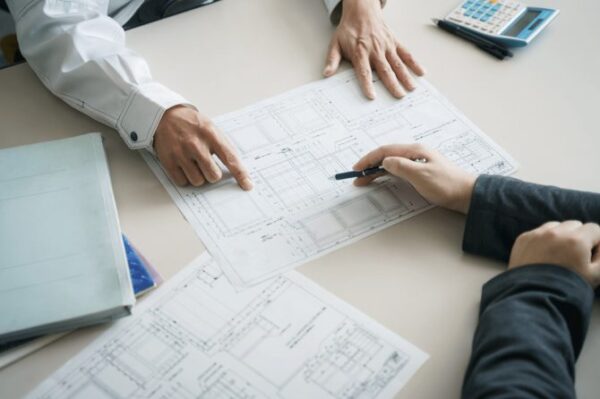
As a civil engineering construction manager working in the civil engineering industry, all of my projects are public works. As a result, I’m one of the many victims caught up in the endless cycle of drawing revisions that’s unique to public works projects.
When I was young, my senior colleagues told me over and over again, “Revising drawings is our job, so get into the habit of redrawing them yourself.” Thanks to all the drawings I revised back then, I can now make corrections to drawings much faster.
But now, I find myself wondering every day: Is revising drawings really part of our job as construction managers...?
It's not my job to correct drawings.
The job of a construction manager is to see a project through to completion. Normally, you’d think that revising drawings is the job of a CAD operator or someone similar.
When I take on a construction project, the first thing that strikes me is that the blueprints are far too rough. And isn’t the real problem that this is considered the norm?
As anyone working in civil engineering knows, the drawings you’re given at the very beginning are practically useless. The floor plans don’t match the cross-sections—they’re all drawings that are impossible to construct in reality.
Construction management begins with redrawing those drawings into a usable format.
Even if there are purchase drawings, they might as well not exist.
It is certainly our job to include coordinates in the drawings and to address any issues that arise as construction progresses.
But no matter how much I think about it, it’s ridiculous to have to redraw almost all of the blueprints I received at the beginning. The order drawings might as well not exist.
It goes without saying that receiving consistent ordering drawings would greatly improve the efficiency of construction management tasks. It is no exaggeration to say that the fact such tedious work is considered the norm is what contributes to the construction industry’s reputation for being exploitative.
Public Works Projects Riddled with Contradictions
Here’s another point I’d like you to consider. Isn’t it reasonable to argue that if a contractor carries out construction based on the drawings provided by the client and makes a mistake, the contractor bears full responsibility?
It’s become commonplace for this utterly contradictory situation to occur: you’re told to write “a,” you write “a,” but it’s wrong, and you end up getting scolded.
Even though the drawings provided by the client are completely inaccurate, if a mistake is made as a result, the contractor is the one who faces penalties. When you think about it calmly, this is a strange trend.
All you need to do is send us “proper drawings.”
As I’ve said many times, the job of a construction manager is not to make changes to the drawings. It is to ensure that the project is completed according to the client’s specifications. That said, I understand that the construction manager must make any necessary adjustments.
However, please try to put yourself in our shoes—we’re the ones who are forced to deal with these utterly nonsensical drawings and spend days correcting them while juggling our day-to-day work on-site.
Many consultants use excuses like, “I can’t draw proper blueprints” or “I didn’t expect to find something like that on-site,” simply because they aren’t out in the field—but these aren’t just minor mistakes. These are issues that require spending days poring over cross-sections and floor plans to correct from scratch.
It makes me want to ask, “If we in construction management are the ones rewriting the drawings and doing the design, what exactly is the consultant’s job?” If the consultant would just provide more realistic, sensible drawings, it would greatly reduce the burden on construction management.
From the perspective of someone who routinely makes revisions to drawings as a construction manager, my comments might come across as “whining.” However, unless we address these kinds of pointless tasks, the workload and working conditions in construction management will never improve.
When ordering drawings, I hope you’ll double-check to make sure they’re consistent and “proper” before submitting them to the construction management team.